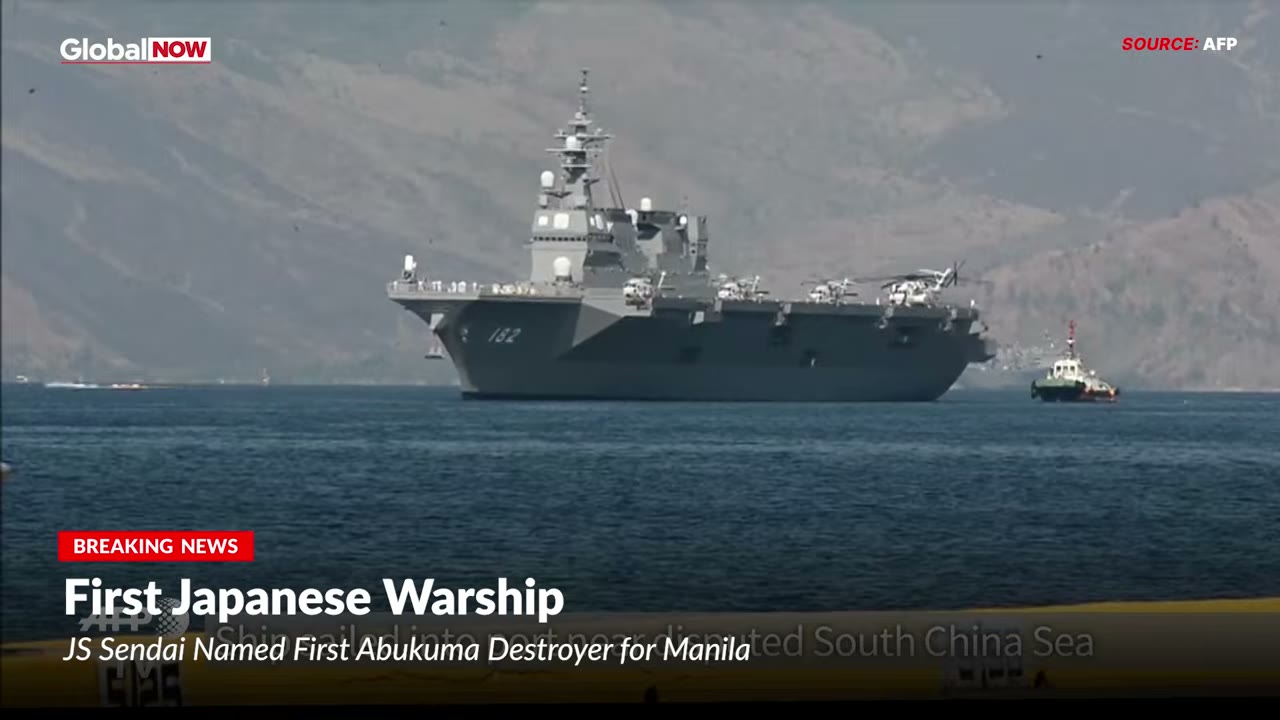
Japan plans to transfer the destroyer JS Sendai to the Philippine Navy, its first export of fully armed warships under revised defense rules. The deal signals deepening Japan-Philippines security ties, but training, logistics and decommissioning mean the ships will not arrive soon.
1Japan to Transfer Armed Destroyer JS Sendai to the Philippines
Japan will hand the Philippines a fully armed destroyer — its first-ever export of lethal military equipment. The ship is the escort destroyer JS Sendai, which Japan plans to transfer to the Philippine Navy after withdrawing it from the Japan Maritime Self-Defense Force. Kyoto News, as reported by the Manila Times, said the move marks Japan's first export of lethal military equipment under updated regulations. These are not empty shells; reports describe them as fully armed destroyers. Sendai is one of six Abukuma-class escort destroyers built for the Japan Maritime Self-Defense Force and commissioned between 1989 and 1993. The roughly 2,000-ton ships were designed for coastal defense and escort, built at the end of the Cold War when Soviet submarines were the main threat. They carry a 76 mm gun, Harpoon anti-ship missiles, anti-submarine missiles and torpedoes, and the Phalanx close-in combat system. They are not the newest ships in the Japanese fleet.
2Japan Loosens Postwar Arms Export Rules for Lethal Weapons
Japan is decommissioning the destroyers it sends Manila because it is building a new generation of frigates to replace them. For the Philippine Navy, they will add real capabilities. But the bigger story is what the transfer means for Japan. After World War II, Japan adopted a pacifist constitution and kept strict restrictions on arms exports for decades. In 2014, it replaced a near-total arms ban with the "three principles for the transfer of defense equipment and technology." Those rules allowed some exports, but mostly non-lethal equipment such as radar and patrol boats. In April of this year, Tokyo reviewed the principles again. The change allows Japan to transfer military equipment to countries that have agreements with Tokyo to protect classified information. The Philippines is one such country. When Sendai eventually sails under the Philippine flag, it will be a turning point in Japan's post-war defense policy. Japan is not only doing this with the Philippines: Australia previously selected an upgraded version of Japan's new Mogami-class frigate for its navy, in what would be Japan's largest defense export deal.
3Timeline of Japan-Philippines Destroyer Transfer Talks
The idea of transferring Abukuma-class ships to the Philippines was first discussed in 2025. In May 2026, during a visit to the Philippines by Japanese Defense Minister Shinjiro Koizumi, the parties formed a working group to expedite the process. Japan has publicly called for the rapid transfer of the destroyers. On July 7, 2026, Philippine Defense Secretary Gilberto Teodoro confirmed that the Philippine Navy would receive five Abukuma-class ships as part of Japan's official security assistance. At a meeting in late October, Koizumi and Teodoro agreed to hand over the first ship as soon as possible after it was decommissioned. Their joint statement said the ministers "reaffirmed their intention to deepen comprehensive cooperation covering vessel operations, logistical support, human resource development and information exchange." They noted this would take defense cooperation, especially in maritime security, to a new level. It is not just a transfer of ships: it includes training Philippine crews, maintaining combat readiness and exchanging information at sea.
4Transfer Faces Years of Delays, Crew Training and Logistics
The transfer can only take place after Sendai leaves service in Japan, and reports indicate it is expected in a few years, not weeks. Filipino sailors will need training on an unusual class of ships with Japanese systems and instructions. Spare parts, maintenance and logistics must be set up, because a warship without spare parts quickly turns into a ship lying in port. That is why the joint statement focused so heavily on logistics and human resource development. Each Abukuma-class ship requires a crew of around 120 sailors. Five ships mean several hundred trained officers and sailors, plus engineers and technicians who will maintain them ashore. The crews are to learn Japanese engines, radars, weapons systems and procedures. Some training will likely take place in Japan aboard the ships before their transfer under the guidance of Japanese instructors. The ships may also need retrofitting to adapt communications systems and other equipment to Philippine Navy standards. There is also the question of where the ships will be based and whether Philippine bases have berths, dry docks and support facilities to service them. The Philippine Navy has already hosted foreign ships from the US and South Korea, but this requires time, money and careful planning.
5Headlines Claiming Japanese Warships Already Patrol Are False
Headlines suggesting Japanese warships are already patrolling the Philippines are not true. The deal is real, and the name of the first ship has already been determined, but the timeline is measured in years. Both governments are focusing on the support package, not just the ships themselves.
6Japan's Earlier Military Transfers to the Philippines
This would not be the first time Japan has transferred military equipment to the Philippines. In 2017 and 2018, Japan transferred five TC-90 trainer aircraft to the Philippine Navy, to be used for maritime patrol and surveillance over the West Philippine Sea. Japan also provided spare parts to help maintain the Philippine Air Force's helicopter flights. The largest patrol ships of the Philippine Coast Guard, including the 97-meter BRP Teresa Magbanua, were built in Japan with Japanese loans. These ships have become the public face of the dispute in the West Philippine Sea. When Chinese Coast Guard ships use water cannons or block Philippine vessels, it is the Japanese ships of the Philippine Navy that are under attack and are the ones who hold the defense. There is already a long history of Filipino crews learning to operate Japanese equipment. The difference now is that the Abukuma-class ships are armed warships, and they will belong to the Philippine Navy, not the Coast Guard.
7Philippine Navy Modernization From WWII-Era Ships to Frigates
For decades, the Philippine Navy has relied on old ships, many of which were built during or shortly after World War II. Some of them have served for over 70 years. For much of this time, the country's armed forces were focused on fighting insurgents within the country, rather than protecting its waters. This began to change in the 2010s. The Philippines acquired three decommissioned U.S. Coast Guard cutters and converted them into its first modern patrol frigates, starting with the BRP Gregorio del Pilar in 2011. Then it ordered new frigates and corvettes from South Korea. As part of the modernization program, it is also purchasing new patrol aircraft, fighter jets and missile systems. The transfer of the Abukuma ships is part of this effort.
8Five Destroyers Expand Philippines' Patrol Reach and Capability
The five destroyers will not make the Philippine Navy equal in strength to the Chinese navy, the world's largest in terms of number of ships, but they will give the Philippines more units on the water and more capabilities to monitor, patrol and respond. The Philippine Navy is responsible for one of the largest archipelagos in the world, with over 7,000 islands and a vast exclusive economic zone. Its fleet of modern frigates and corvettes is still small. In recent years it has been replenished with the frigates BRP Jose Rizal and BRP Antonio Luna, as well as newer ships such as BRP Miguel Malvar and BRP Diego Silang. The five additional destroyers will significantly expand patrol capabilities in the West Philippine Sea and Luzon Strait. Anti-submarine defense is an area where the Philippine Navy has very limited capabilities. China, on the other hand, has a large and growing submarine fleet. The Abukuma class was created specifically for the tasks the Philippines lacks: submarine detection and tracking. Japan is now ready to send lethal weapons to a partner under pressure from China.
9Japan's Broader Security Package for the Philippines
Since the 2010s, Japan has funded 17 coast guard boats for the Philippines, which are now on the front lines, such as near Scarborough Shoal. In February of this year, Japan handed over five coastal radar systems. On November 9, a deal worth 4.3 billion yen, about $27 million, was signed to supply a coastal radar system for the Navy and reconnaissance drones for the Philippine Air Force. Japan has also expressed a desire to sell air defense, maritime surveillance and anti-drone systems to the Philippines. The two countries have signed a mutual access agreement that allows their forces to train on each other's territory. They also signed an agreement allowing the forces to provide each other with fuel, food and other support during joint exercises. Japanese warships visited Manila and conducted training exercises with the Philippine Navy in the South China Sea.
10China Unhappy With Japan's Growing South China Sea Role
Overall, Japan has become the Philippines' second most important security partner after the United States. China is unhappy with Japan's growing role in the South China Sea. Beijing views every move by Tokyo as interference in disputes that, in China's opinion, do not concern Japan. He also called negotiations between Japan and the Philippines over maritime boundaries illegal. Relations between Beijing and Tokyo are already at a low point a year after Japanese Prime Minister Shinzo Abe said a Chinese attack on Taiwan could pose an existential threat to Japan.
11Chinese Ships and Bomber Near Philippines After ASEAN Summit
A week after the ASEAN summit, the Philippine military counted 48 Chinese coast guard and navy ships near four sites in the West Philippine Sea, up from 19 a week earlier. A Chinese H-6 strategic bomber also flew within about 45 nautical miles of the Philippine coast. Against this backdrop, five Japanese destroyers cannot arrive soon enough. For the Philippines, Japan is a partner that helps protect its own waters in times of growing Chinese pressure. Manila sees things very differently from Beijing.
12What to Watch Next in the Sendai Transfer
Japan has not yet set the date it will decommission the Sendai — and that date starts the clock on its journey to Manila. Once Japan identifies it, the countdown to the ship's presence in the Philippines begins.
Next comes a program to train Filipino crews, which will show how quickly the Philippine Navy can operate these ships.
Then watch for the names and transfer dates of the other four ships.
And finally, China's reaction, both in words and at sea.
13Conclusion: Historic Sendai Transfer Will Take Time
The first Japanese warship headed for the Philippines now has a name: Sendai. It will be a historic event, adding much-needed capability to the Philippine Navy — but it will take time.
The wait runs from decommissioning to the day the Philippine flag is raised on the ship. Every step in between is still ahead.
China's reaction, in words and at sea, remains one of the things to watch as the transfer moves forward.