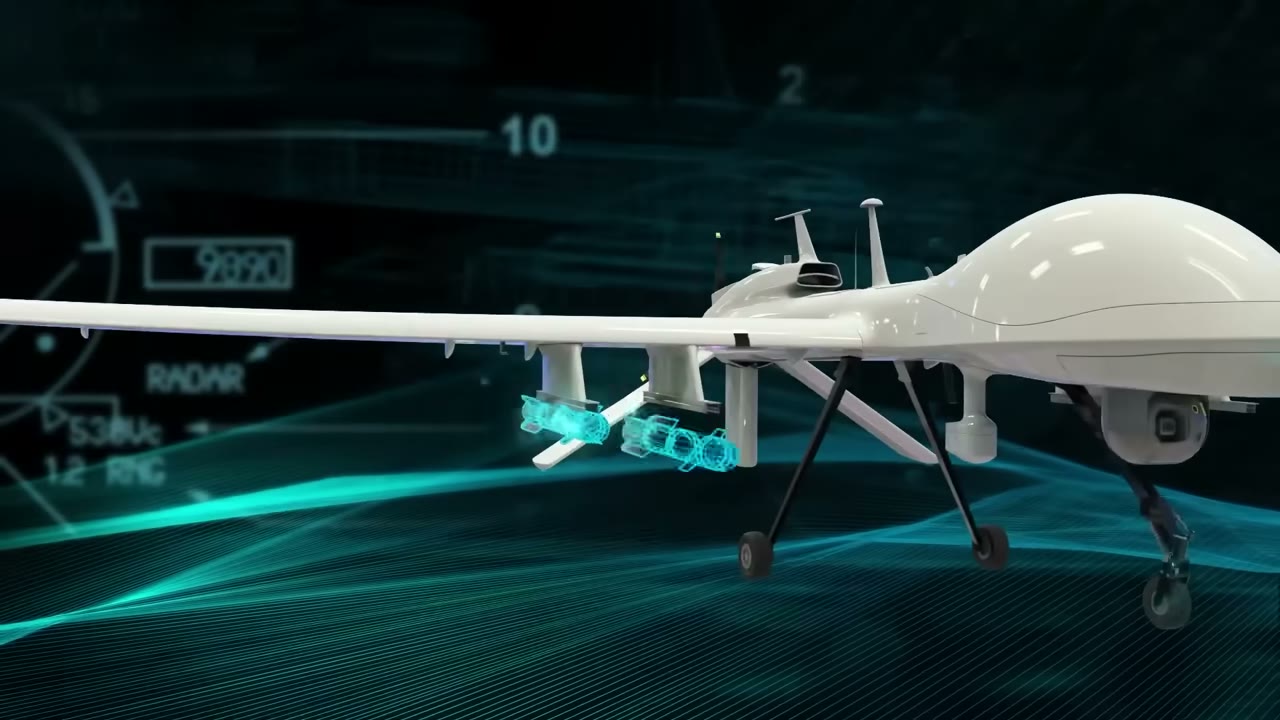
The MQ-1C Gray Eagle is the US Army's primary armed drone, used for reconnaissance and strike missions. This video explains how it teams with Apache helicopters, its organization, and its limitations against advanced air defenses.
1MQ-1C Gray Eagle: Army's Armed Reconnaissance Drone
The U.S. Army's most substantial drone can carry up to four Hellfire missiles. The MQ-1C Gray Eagle is an Army-specific variant of the Air Force's retired Predator drone, built for both reconnaissance and strike missions.
That sets it apart from the smaller, unarmed RQ-7 Shadow used in brigade combat teams and Apache cavalry units. In its attack configuration the Gray Eagle carries four AGM-114 Hellfires; in an attack/recon configuration it carries two; with none aboard, it can prioritize time in the air or other payloads.
2Gray Eagle and Apache Use Laser Designators for Hellfire Strikes
A drone doesn't need to carry weapons to destroy a target. Both the Gray Eagle and all Shadow V3s — two per Shadow V2 platoon — can use laser designators to guide in Hellfires fired from other aircraft.
That lets the unmanned Gray Eagle do the risky work of spotting and maintaining contact with the enemy, while another Apache fires the missile.
3Gray Eagles Enable Apache Strikes in Dense Urban Terrain
Gray Eagles let Apache crews stay hidden while still landing Hellfire strikes. The setup takes advantage of the missile's maximum range to, hopefully, outrange enemy short-range air defenses.
During counter-insurgency operations, it was noted how Gray Eagles could allow partnered Apaches to engage targets in dense urban terrain. Buildings and winding streets meant the Apaches couldn't necessarily see targets, so Gray Eagles could hold a vantage point directly over an area.
4Gray Eagle Helps Identify Targets and Shares Live Video with Apaches
An Apache can detect something and recognize it as a vehicle — but a UAV may be better positioned to tell an enemy tank from a civilian semi-truck or a friendly APC. That identification work goes beyond simply acquiring a target.
The Apache also has the added benefit of receiving a live video feed directly from partnered UAVs, improving the crew's situational awareness.
5Gray Eagle Can Engage from High Altitude via Apache Relay
When an Apache unit gets a call for fire from a ground unit, it can relay it to a Gray Eagle. The UAV can then covertly engage from high altitude, letting the Apaches stay concealed.
Because Gray Eagles normally fly at those higher altitudes, the airspace has to be deconflicted to avoid friendly fire by setting up a restricted operations zone, or ROZ. The ROZ limits who can enter the airspace to those who need to be there — the same kind of zone you'd see below an AC-130 firing its weapons.
6UAVs Provide Aerial Security for Helicopter Flights
Cavalry or reconnaissance units give ground forces early warning of enemy activity. UAVs work the same way for helicopters.
They can be deployed forward, on the flanks, or to the rear of a flight of helicopters to provide aerial security. That increases the situational awareness and survivability of the manned helicopters.
7Attack Battalions Lack Organic UAVs, Rely on Attached Gray Eagles
Apache-equipped Attack Battalions have no UAVs of their own — unlike an Attack/Reconnaissance Squadron, which has four Shadow UAVs in each Apache troop. That leaves the battalions with inferior recon capability unless Gray Eagles are attached or assigned in support from division.
One notional Attack Battalion task force could include a battalion headquarters company leading two Attack Companies of eight Apaches each, an assault helicopter company with 10 Blackhawks, a 3-ship MEDEVAC platoon, a 4-ship Gray Eagle Platoon, a forward support company and an aviation maintenance company.
8Gray Eagles Support Helicopter Assaults and MEDEVACs
Gray Eagles can support helicopter assaults or MEDEVACs, providing security for the manned helicopters by identifying targets, terrain and signs of life.
They can launch hours ahead of a main force to gather information about the target area and the route.
9Gray Eagle's 22-Hour Endurance Extends Aviation Reach
A standard Gray Eagle can stay in the air for up to 22 hours. An Apache's average fuel endurance is about 2 hours.
Extended Range upgrades push endurance to up to 40 hours — a 1,000-kilometer round trip to the target area and 14 hours of loiter time, though that is reduced when carrying two Hellfires. Superior endurance lets Gray Eagles extend how far aviation can push out in front of a ground unit, increase time in contact with the enemy, and let commanders preserve and mass manned aviation at a decisive point.
10UAVs and Manned Aircraft Have Complementary Recon Roles
Unmanned aircraft suit stealthy, slow and deliberate reconnaissance — tasks that minimize surprise contact with the enemy and require long loiter times.
Manned aircraft lend themselves more to rapid reconnaissance focused on a few key tasks, and to forceful recon where aircraft are ready to engage the enemy.
11Manned-Unmanned Teaming (MUM-T) Levels of Interoperability
Close cooperation between UAVs and manned helicopters has a doctrinal name: manned-unmanned teaming, or MUM-T. How close that cooperation gets depends on the level of interoperability.
At Level 1, imagery and data go from the Gray Eagle to the ground controllers flying it, who then pass it to ground units. At Level 2, the supported unit — an Apache or troops in contact — gets imagery directly from the UAV, but the ground station retains control. Level 3 lets an Apache crew directly control the UAV's weapons payload and sensors. Level 4 lets an Apache control the UAV in its entirety with ground supervision, except takeoff and landing. Level 5 includes takeoff and landing but isn't currently done.
12Apache Crews Face Task Overload Controlling Drones Directly
The closest levels of interoperability get the most attention online, and a loyal wingman fully controlled by a manned aircraft has appeal. But after talking to a soldier in an Air Cav unit, it seems more like a neat trick than a practical capability in most cases.
An Apache crew already has a lot going on operating their own aircraft, and directly controlling a second aircraft can easily lead to task overload. It's reportedly more efficient for an Apache crew to direct a ground controller instead, which is sufficient most of the time. Level 2 or 3 is the norm for MUM-T integration.
13Gray Eagle Conducts Reconnaissance and Surveillance for Division
Gray Eagle units can maneuver independently to satisfy the division commander's reconnaissance and surveillance requirements — and fly for the division most of the time.
The difference comes down to active versus passive. Reconnaissance is active, focused on obtaining information on the enemy, terrain or weather in a specific zone, area or route; surveillance is the passive observation of a given area. Sending a UAV forward to check whether a road has obstacles, signs of enemy troops or unforeseen damage is reconnaissance.
14Gray Eagle Secondary Missions and Limitations
Gray Eagle drones can hunt for enemy attacks, but they pack limited firepower. The aircraft's primary job is surveillance, watching an avenue of enemy attack so no one slips through. As secondary missions, they can strike targets, relay communications for ground forces, or pass air data to other aircraft. They can loiter continuously over an area of operations, a plus for relay work. Yet their firepower is limited, and so is the field of view of their sensors.
15Multiple UAVs Mitigate Gray Eagle Limitations
Teaming several Gray Eagles together can offset the drone's weak points. Multiple aircraft provide more sensors and more weapons on target, while still freeing up manned aircraft for other work. Another option pairs an unarmed, more expendable Shadow UAV as the hunter with a killer Gray Eagle. The approach addresses limits on firepower and sensor coverage without putting crews at risk.
16Gray Eagle Vulnerable to Medium and High-Altitude Air Defenses
The Gray Eagle was introduced in the middle of a counter-insurgency and has flown mainly in uncontested airspace. It generally operates at higher altitudes, which makes it especially susceptible to medium- and high-altitude air defense. Man-portable systems, or MANPADS, are less of a threat at a service ceiling of 25,000 feet. But more capable air defenses exist precisely to deny those higher altitudes.
17Upgrades: Synthetic Aperture Radar and Stand-Off Munitions
A synthetic aperture radar could spot military targets from 75 kilometers away, instead of relying on video cameras. On the strike side, the Gray Eagle Extended Range upgrade has been tested with GBU-69 Small Glide Munitions, extending strike range from 8 to 32 kilometers. Small air-launched drones called Air Launched Effects may also be added to the Extended Range version, pushing its vision further into hostile airspace.
18Upgrades Could Keep Gray Eagle Out of Range of Russian Air Defenses
New features could let the Gray Eagle stay out of range of most Russian maneuver-unit air defenses, including MANPADS, Strela-10 and Tor-M2. The aircraft could also act as jammers, decoys, or weapons themselves. It would still be vulnerable to fighter aircraft and strategic systems like the S-400, which protect key infrastructure rather than maneuver units. Whether a Russia-type opponent, suppressed by the US Air Force and saturated with higher-value aircraft, could spare its best SAMs for Gray Eagles is an open question.
19Ground Control Stations Vulnerable to Artillery, Satellite Control Upgrades
Ground control stations can be targeted and destroyed by artillery, the current conflict has shown. To counter that threat, part of the Gray Eagle upgrades will include the ability to control the aircraft via multiple satellite constellations. The aim is uninterrupted flight, with ground operators well beyond line of sight. The change addresses the survivability of the ground station and datalink, not just the aircraft.
20Gray Eagle Requires 4,500-Foot Runway, Complicates Logistics
The Gray Eagle needs a 4,500 by 100 foot improved runway, about 1.4 kilometers long. Older Shadow versions could launch from a catapult and land on a 710 foot, or 216 meter, unimproved runway. A Gray Eagle company might therefore have to be geographically separate from the rest of its aviation brigade, which is mostly helicopters that don't need runways. That separation demands more robust logistics and communications to integrate the drones into operations.
21Gray Eagle Units: 15 Companies Across the Army
The Army holds its Gray Eagles in 15 unmanned aerial system companies. Eleven belong to combat aviation brigades in each active duty division except the new 11th Airborne. The 25th Infantry Division's Gray Eagle company is stationed at Fort Wainwright in Alaska and attached to the 11th. Two companies are part of the 160th Special Operations Aviation Regiment, and two belong to the 116th Military Intelligence Brigade, known as the aerial exploitation brigade. As of 2019 the fleet totaled 204 aircraft, including 11 training and 13 float aircraft.
22Gray Eagle Company Organization: 12 Aircraft, 6 Ground Stations
Each deployed company operates one Gray Eagle system: 12 MQ-1C aircraft, 6 ground control stations, and other gear for passing data and auto-landing the aircraft. The systems are split among 3 Flight Platoons able to operate independently from different airstrips. Companies in Special Operations Command and Intelligence and Security Command add a 4th platoon of people but no UAVs, allowing more launch sites. Divisional companies can support up to 2 separate launch sites; companies above division level can support 3. Each platoon has an HQ, a Ground Control Section, and a Launcher/Recovery Section.
23Gray Eagle Platoon Leadership and Ground Control Section
A Chief Warrant Officer 3, a subject matter expert in unmanned aircraft systems, leads each platoon, assisted by a Sergeant First Class as Platoon Sergeant. The Ground Control Section has a UAS Operations Technician ranked Chief Warrant Officer 2 and 8 enlisted Gray Eagle operators. Unlike a helicopter unit, where pilots are warrant or commissioned officers, Army UAV operators are enlisted soldiers. Even a Specialist can hold command authority when piloting a UAV.
24Operator Roles, Shifts, and Instructor Designations
At least one operator, a Sergeant on paper, is specifically qualified and designated as an instructor/operator who trains and evaluates the other crew members. Another, nominally a Staff Sergeant, is designated as the MQ-1 Sergeant. Operators take shifts to ensure they get enough rest between missions, and take more rest if the unit conducts surge operations.
25Gray Eagle Company Sortie Generation Rates
In normal operations, divisional companies can keep three aircraft in the air continuously from two launch and recovery sites, or four when consolidated at a single site. During surge operations, a company can generate up to 5 missions a day with split basing, or 6 if consolidated. That pace is less sustainable over time, and operators need a day's rest after surging. At least two operators are required for most missions, except when the UAV serves as a data relay for other aircraft.
26Launch and Recovery Section and Maintenance Platoon
The Launch and Recovery Section has an instructor/operator, nominally a Staff Sergeant, and 5 other MQ-1 Operators. Both sections use a truck-mounted ground control station, and the launch and recovery section has automatic takeoff and landing systems that let Gray Eagles launch and recover without operator interaction. The drones are held in the UAS Maintenance Platoon, which has an HQ and three Maintenance Sections. An Aviation Maintenance Technician leads the platoon, and each 8-man section is led by a Staff Sergeant. Each section has 2 larger semi-trailer flat beds for transporting 4 UAVs, which can be disassembled into compact crates. The platoon also in theory has an aviation maintenance augmentation team with Gray Eagle Repairers and two Aircraft Structural Repairers.
27Maintenance Roles and Reliance on General Atomics Field Reps
The Army's Grey Eagle drone airframes are repaired by General Atomics contractor field service representatives, not by the Army's own structural repair specialists. MQ-1 Repairers handle the aircraft's systems and related hardware, including the ground control stations, while Aircraft Structural Repairers fabricate new parts when the airframe itself is damaged. But the Grey Eagle relies on General Atomics field service representatives, known as FSRs, to work on the airframe, according to what the unit was told. The 15Gs listed in the MTOE, the unit's authorized staffing document, do not actually work on Grey Eagle airframes. That leaves a key repair job in contractor hands.
28Company-Level Support Sections: Automotive, Fuel, and HQ
A Grey Eagle company carries its own fuel and ammunition section, stocked with 2 HEMTT fuel tankers, 2 ATLAS all-terrain forklifts, 2 semi-trailers and 2 HEMTT trucks with trailers. The Class 3 and 5 Section supplies the company with fuel and ammunition. An Automotive Maintenance Section keeps the unit's ground vehicles running, mostly staffed by Wheeled Vehicle and Engine Mechanics. The Company Headquarters is only somewhat different from any other company HQ. Its Commander ranks Major instead of the typical Captain, and its Executive Officer ranks Captain instead of a Lieutenant. It also includes a First Sergeant, Supply Sergeant, Signal NCO, CBRN NCO, Medic and Supply Specialist.
29Flight Operations Section Handles Battalion-Level Tasks
A Grey Eagle company has a Flight Operations Section that does some of the jobs of a battalion headquarters. The section handles day-to-day flight activities: coordinating airspace, maintaining air crew records, mission planning and managing flight schedules. Other aviation companies don't typically have this element in their MTOE, because Grey Eagle companies are organizationally independent of any battalion. A flight operations officer briefs the commander on the unit's flying capabilities, aircraft availability and the status of crews.
30Key Points: Gray Eagle's Role, Limitations, and MUM-T
The Gray Eagle's main job is reconnaissance, surveillance and target acquisition, but carrying Hellfire missiles cuts its time in the air significantly. It can also fly armed reconnaissance and run its own strike missions. It is less well-armed and less survivable than an Apache attack helicopter. UAVs and helicopters can still employ MUM-T to make forces more survivable and flexible overall. Other non-combat roles include acting as a communications relay for ground forces or an air data relay for other aircraft. Gray Eagles are known to be vulnerable in high-intensity conflicts, and the intended solution is increasing the aircraft's stand-off range to limit its susceptibility to air defenses.