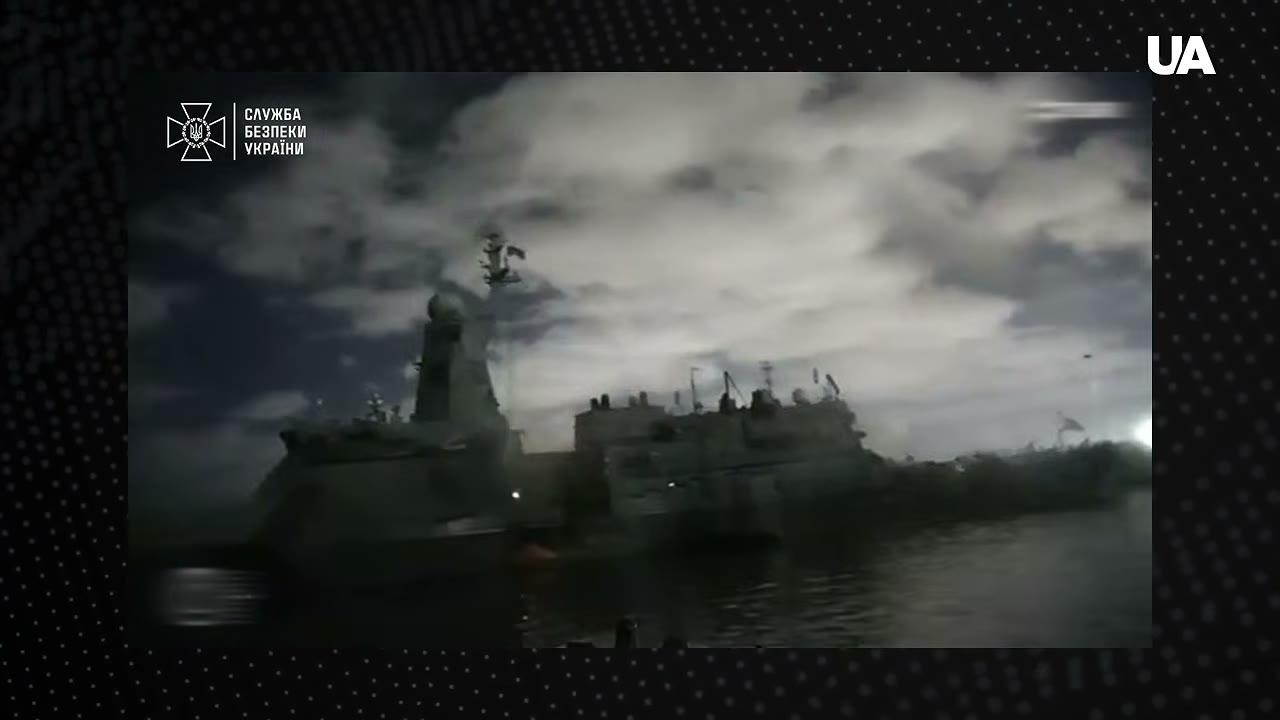
Ukrainian naval drones sank the Russian corvette Mercury in Benghazi and hit three cargo ships supplying Russian forces. Ukraine also cut Russian oil refining to a 20-year low and liberated 14 settlements in Kharkiv region.
1Ukrainian drones sink Russian corvette Mercury in Libyan port of Benghazi
Seven Ukrainian naval drones sank a modern Russian warship moored at a pier in the Libyan port of Benghazi on November 22. The corvette Mercury capsized and went down near the pier, leaving only its bow above water — and the combat helicopter on its deck went to the bottom with it.
President Zelensky confirmed the operation, released video of the attack, and said the ship was sunk despite Russian attempts to repel it.
The Mercury was one of the newest ships in the Russian Navy, commissioned in 2023 and showcased at a naval parade with Putin present. Officially part of the Black Sea Fleet, it never entered the Black Sea because Turkey has kept the straits closed to Russian warships since the full-scale war began. Instead it escorted convoys carrying Russian weapons, first to Syria and then to Libya, and reportedly loaded weapons, ammunition and drones at its last port call.
The ship's commander is the first crew member known to have died. The total number of dead and injured was not made public.
2Drones strike sanctioned Russian cargo ship Angara in Benghazi
Drones struck the Russian cargo ship Angara in Benghazi the same night as the corvette Mercury was sunk — a vessel under US, EU and UK sanctions that Ukrainian intelligence said was carrying North Korean weapons and ammunition to Russia and supplying Russian troops in Africa.
Russia moved its military transports to eastern Libyan ports after the fall of the Assad regime in Syria in late 2024 left it unable to safely use naval bases there. Through Libya, it now supplies its troops in Mali, Chad, Burkina Faso and Sudan.
A UN arms embargo has been in place in Libya since 2011, but no European weapons have been able to stop the traffic, according to the report.
It marks the first time Ukraine has officially claimed responsibility for an attack on a Russian warship in the Mediterranean Sea.
3Ukraine strikes Russian cargo ship Sparta II in Gulf of Finland
Two drones struck the Russian cargo ship Sparta II in international waters of the Gulf of Finland on November 21 as it headed to Kaliningrad with what Zelensky said was a cargo of weapons. A fire broke out on board.
The vessel is owned by a company affiliated with the Russian Ministry of Defense. In 2022 it returned Russian air defense systems from Syria, and after the fall of the Assad regime it transported Russian military equipment from Syria to Libya.
After the attack the ship lost propulsion and control and drifted until it entered Finnish waters. Finnish and Estonian rescuers evacuated 16 crew members and fought the fire for almost two days.
4Drones hit Russian rail ferry Ambal near Leningrad Region port
A series of drones struck the Russian rail ferry Ambal just as it approached port facilities in the Leningrad Region that same morning.
The ferry carries trains, trucks and military cargo to Kaliningrad by sea so the cargo does not have to cross the territory of European Union countries.
According to Ukrainian intelligence, it also transported troops and supplied occupied Crimea.
5Four attacked ships disrupt Russian logistics to Kaliningrad and Africa
Four ships in service with the Russian Defense Ministry have now been attacked — and if they are lost or stuck under repair for months, Russia will struggle to move heavy equipment to Kaliningrad and supply its units in Africa.
The vessels were transporting cargo to Kaliningrad, supplying Russian troops in Africa and delivering weapons from North Korea.
The corvette that accompanied these convoys now lies at the bottom of the port of Benghazi.
6Libya, Italy, France and EU react to Ukrainian strikes on Russian ships
France's foreign minister called the attacks on Russian ships Ukraine's absolute right to self-defense, while Libyan authorities accused Ukraine of violating its sovereignty.
Italian Foreign Minister Antonio Tajani said Rome was unaware of the operation, though he added that Italy would continue to support Ukraine. A European Union representative stated that the Russian ships are legitimate military targets.
All targets attacked this week were Russian — warships and cargo ships under Western sanctions transporting weapons — and Ukraine did not affect any port or any European ship, according to the report.
Zelensky ordered improved communication with partners so the strikes do not come as a surprise to them.
7Ukraine vows to continue attacks on Russian fleet across five seas
Kyiv made clear that attacks on the Russian fleet will continue — and its drones have already reached Russian ships in five seas.
Ukraine does not have a fleet of large warships. From the Black and Azov Seas, where over 300 vessels of Russia's "shadow fleet" have reportedly been attacked this year alone, its reach now extends to the Caspian, Baltic and Mediterranean Seas.
These ships were transporting weapons for the Russian army. But the fuel for their trucks, tanks and generators comes from refineries located deep in Russia — and those plants just had their worst month in over 20 years.
8Russian oil refining falls to lowest level in over 20 years
Russian refineries were processing 2.6 to 2.7 million barrels of crude oil per day as of November 20 — almost half the volume at the end of October and the lowest level in more than 20 years, according to estimates from energy consulting firm Rystad Energy.
Rystad compiles the estimates from supply chain data, oil tanker movements, satellite imagery and industry sources. The figure is lower than the lows recorded after previous waves of Ukrainian attacks this year.
Since late October, Ukraine has attacked at least 18 Russian oil refineries, and industry sources indicate refining volumes fell by 45% in just the first three weeks of November. Some plants run at reduced capacity after earlier drone attacks; others resumed quickly after repairs, but the overall figure kept falling as new attacks came one after another.
9Russian fuel shortage grows as Moscow exports more crude oil
Russian drivers have faced a constant fuel shortage since the summer, and the army's diesel supply is tightening as refineries shut down.
With many plants out of service, Moscow is forced to send more crude oil abroad — selling raw materials instead of finished fuel.
The Russian army runs on diesel, so every plant out of service means less fuel for trucks and armored vehicles at the front, and fewer petroleum products Moscow can sell abroad to finance the war.
Rystad's data does not include the November 25 attacks on two major refineries in the Samara region.
10Ukraine strikes Rosneft refineries in Samara region
Two major Rosneft refineries in the Samara region caught fire after a nighttime drone attack on November 25 — strikes not yet included in Rystad's estimates.
The Syzran refinery can process about 8.9 million tons of crude oil per year, and the Kuibyshev refinery in the city of Samara about 7 million tons.
Ukraine's General Staff reported that the attack on the Kuibyshev plant damaged two primary oil refining units, a reforming unit for high-octane gasoline components and two storage tanks. Satellite images released the next day showed damaged installations and tanks still burning.
Both plants had already been attacked in September.
11Ukrainian drones hit Transneft oil pumping station in Bashkortostan
Ukrainian attacks reached the Shakhtinsk-Kulovo oil pumping station in Bashkortostan on the night of November 26 — more than 1,000 km from the Ukrainian border.
The station is owned by Transneft, the state company that operates Russian oil pipelines. Ukraine's General Staff describes it as a hub through which oil from Western Siberia and Bashkortostan circulates through a pipeline system.
By the end of the day, at least four storage tanks had been damaged, including two large tanks of 10,000 cubic meters each.
12Neptune missiles strike Marynivka airfield in Volgograd region
Ukrainian Neptune missiles struck the Marynivka military airfield in the Volgograd region on the same night as the Bashkortostan pumping station hit — meaning Ukraine attacked an airbase and an oil hub separated by over 1,000 km in a single night.
At the pumping station, at least four storage tanks had been damaged, two of them still burning.
13Ukraine's Bear Trap operation thwarts Russian encirclement in Kharkiv
Russia's plan to encircle a large Ukrainian grouping in northern Kharkiv and seize nearly 500 square kilometers collapsed this fall — and Ukraine's counter-operation closed a ring around Russian positions by October 10.
In late June, Russian troops crossed the border in the north of Kharkiv Oblast and formed a salient inside Ukrainian defense lines. Moscow dubbed its plan "Bear Corner": two strike groups facing each other from east and west to trap the Ukrainians.
In early September, commander Mykhailo Drapaty ordered reinforcements. The operation, called "Bear Trap," was led by the 475th Separate Assault Regiment with the 120th Separate Reconnaissance Regiment. Units got orders on September 10, entered the area the next day, and the assault began on September 20.
During the assault, two Ukrainian tanks advanced along the central road to one village and fired on fortified positions, killing nine Russian soldiers in one house, while 18 Far Point long-range drones attacked Russian reserves moving up as reinforcements.
14Ukrainian units use drones, repeaters and evacuation drone in Kharkiv assault
Ukrainian drones mined Russian supply routes up to 30 km inside Russia, according to the units involved. Because Starlink does not operate on Russian territory, the engineers built their own network of radio repeaters to keep communications running.
Interceptor drones shielded Ukrainian armored vehicles from Russian strike UAVs. An evacuation drone named Starch carried out seven medical evacuations of wounded fighters over several weeks.
The regiment reported the liberation of 14 settlements and almost 200 square kilometers of territory. It put Russian losses at about 911 soldiers killed or wounded and almost 400 pieces of equipment — Ukrainian data not confirmed by independent sources.
Ukrainian troops continue to clear towns near the border.
15Ukraine reports liberation of 14 settlements in Kharkiv operation
The operation is not yet complete, but the situation has already completely stabilized, the regiment's commander said. Lieutenant Colonel Oleksandr Mastenko gave that assessment as Ukrainian troops continue to clear towns near the border.
The regiment has reported the liberation of 14 settlements in the Kharkiv operation. Russian losses were put at about 911 soldiers killed or wounded and almost 400 pieces of equipment — Ukrainian figures not confirmed by independent sources.
Elsewhere, in the Donetsk region, Russian forces are pressing their attacks.
16Russia intensifies tank assaults toward Druzhkivka and Kostyantynivka
Russian assault columns wrapped in heavy anti-drone nets tried to slip through thick fog near Druzhba in mid-November. Most were destroyed or disabled before they arrived.
Moscow's forces had intensified tank assaults toward Druzhkivka and Kostyantynivka that month, trying to prepare the ground for an offensive against the belt of fortified towns Ukraine controls in the Donetsk region.
On November 25 the Russians tried again, on the southern outskirts of Solidovo, choosing a day of strong winds. A BMP-1 and a BTR-82 carrying 11 attack aircraft advanced, but an FPV drone patrol from the 25th Airborne Brigade spotted the column first and struck. The armored personnel carrier was then blown up by a mine.
The soldiers switched vehicles and pushed on until they too were destroyed; surviving infantry scattered toward the forest belt. "The enemy was convinced that no drone would be able to stay in the air in such a wind," the paratroopers said. "But the enemy was wrong."
17Lars unit hits 22 Russian equipment units deep in Zaporizhia rear
Analysts from the Lars group, a special unit of Ukraine's National Guard, hit 22 units of Russian military equipment massed deep in the rear of the Zaporizhia region, far from the front line.
Reconnaissance drones relayed precise coordinates to strike UAV crews. The follow-up attacks destroyed two tanks and a truck and damaged 12 more tanks, two command and staff vehicles, two engineering vehicles and three trucks — tens of millions of dollars in damage, according to the unit.
The unit claims to have destroyed over 2,400 Russian tanks in nearly five years of war, with its main task since 2022 being to destroy armored vehicles that threaten Ukrainian infantry. Days earlier, the same crews found a Pantsir-S1 air defense system hidden in the rear near occupied Donetsk.
18Heavy drone destroys $15 million Pantsir-S1 near occupied Donetsk
A single heavy drone bomber destroyed a Russian Pantsir-S1 air defense system worth about $15 million near occupied Donetsk, and drone footage shows it burning.
The complex had been well hidden in the rear, according to the Lars group, a special unit of Ukraine's National Guard. Its crews discovered the system days after hitting 22 units of Russian equipment deep in the Zaporizhia region.
The unit noted that Russian propaganda presents the Pantsir as a weapon capable of shooting down almost any target. This one was destroyed by a single heavy drone.
19Ukrainian marines launch Vampire drones from Barracuda boats on Dnipro
Ukrainian marines loaded heavy Vampire bomber drones onto homemade Barracuda boats and sent them down the Dnipro River to launch points closer to the front.
The 40th Separate Marine Brigade worked with the International Legion of the Ukrainian Defense Ministry and the "12 Friends of Ocean" unit. From the water, they launched strikes on Russian hideouts and critical supply points deep in the rear, while other boats delivered smaller, more maneuverable FPV drones to separate positions for a coordinated, multi-pronged attack.
"Vampire" is a Ukrainian bomber built with six powerful rotors. Carrying it by boat lets operators launch much closer to the front line, hitting targets otherwise out of range.
The brigade did not say exactly when or where the operation took place. Barracuda boats had already launched FPV drones in August at Russian boats transporting troops in occupied Kherson region.