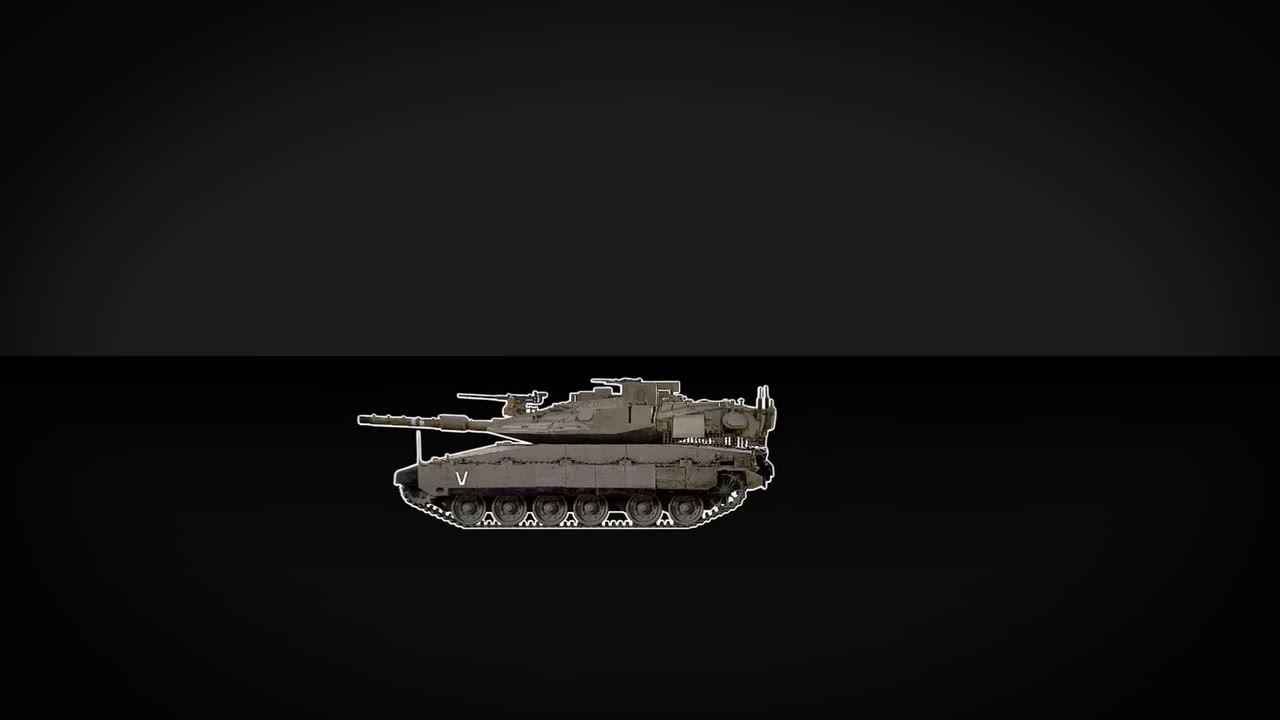
Battle Order breaks down how Israeli armor units are organized, from two-tank platoons to brigades, and how conscript crews and reserve companies fit in. It also explains the tactical markings that reveal a Merkava's platoon, company, battalion and brigade.
1Israeli tank company built around four-man Merkava Mk 4M
Israel's front-line tank company rests on a four-man crew. At its base sits the Merkava Mk 4M, whose 120mm cannon is loaded by hand — which keeps a fourth soldier, the loader, inside the tank alongside the commander, gunner and driver. That manual loading is what defines the crew layout of the Israeli company described here.
2Two-tank platoons pair young lieutenants with experienced conscript NCOs
An Israeli tank platoon is just two tanks, and one of them is often run by a young lieutenant. The platoon leader, a Lieutenant or Second Lieutenant depending on time in service, commands the first; the second, the "B" tank, goes to a Staff Sergeant or Sergeant — field NCOs, not professionals. The enlisted tankers are conscripts, with tank commanders near the end of their obligation. Veterans said the least experienced platoon leaders are generally paired with the most experienced field NCOs, and vice versa. There are no professional NCOs with more than 32 months in service.
3Israeli tank companies moved from three-tank to two-tank platoons
Israeli tank platoons didn't always hold two tanks. Originally the IDF fielded three platoons of three tanks plus two headquarters tanks. Active companies now run four platoons of two tanks each, numbered 1 to 4, with a commander's tank and a "B" tank in each. The reserve brigades still keep three tanks per platoon, adding a third "A" tank for the newest commander.
4Three-tank platoons traced to post-1956 Suez experiments
The three-tank platoon is most often tied to the Russians, but the shift from five tanks to three has been claimed as a result of experimentation after the 1956 Suez Crisis. Other nations used the smaller platoon to tighten command and control during fast maneuvers, or to fit more platoons into a company, more companies into a battalion, or more battalions overall — a tradeoff that can pay off in large-scale conflict. The British and Germans did it historically, the Swedes still do, and the US at least tested it.
52006 plan weighed shrinking tank companies from 11 to 7 tanks
Israel once weighed cutting its tank company from 11 tanks to 7. A 2006 article from Defense Update reported the idea: sections of two tanks operating autonomously, enabled by the technology and capability of the new Merkava Mk 4M. The current setup looks like an evolution of that thinking — but with four platoons instead of three, and two headquarters tanks instead of one.
6Veterans say small platoons stretch scarce, costly Merkava 4Ms
Israel's small military and the disproportionate expense of its Merkava 4Ms help explain its unusual platoon sizes, veterans said — smaller platoons stretch scarce, costly tanks. One veteran said that when a company attacks as a whole, it can maneuver together or split into two groups of platoons, one under the commanding officer and one under the executive officer. That's similar to the five-tank platoon more in vogue during the Cold War and World War II.
7Company HQ tanks crewed two different ways, veterans say
The company headquarters runs two tanks, one for the commander and one for the executive officer — and veterans describe two different ways of manning them. One said the company training NCO, equivalent to a US Army Master Gunner, rides in the CO's tank in the loader's hatch and is the assigned tank commander, giving that Merkava five crew in combat. Another said both HQ tanks have a dedicated tank commander in the commander's position, while the CO and XO lead from the loader's hatch. In that setup, if they button up, the CO or XO can crawl into the rear compartment — for a limited time without removing the ammo pods.
8Company fields M113 repair APC, Jeep Wrangler and Isuzu D-Max
An Israeli tank company's support vehicles include an M113 armored personnel carrier carrying about six repair technicians, each specialized in a different part of the tank — mechanical, electrical, radio. The company medic can ride there in wartime, though this may vary by unit. For light transport the company has a Jeep Wrangler, driven by the CO's driver, and an Isuzu D-Max for the Company Sergeant, a logistics NCO. In wartime they'd join the battalion trains to coordinate forward sustainment. The newest Wranglers and D-Maxes in IDF service are basically dealership vehicles in black and white; the drab-painted Storm jeep and D-Max variants exist, but painting them is considered a waste for vehicles not meant for combat.
9Armor battalion mixes two active tank companies with reserve and support units
An Israeli armor battalion mixes two active tank companies with one maneuver support company and one reserve tank company, alongside a headquarters and service company. One veteran said those reserve tank companies may be centralized at brigade level and only handed out to battalions during wartime. Another said he hadn't seen the reserves training on their own tanks, but on tanks loaned from the active companies. The maneuver support company is described as closer to the British concept of maneuver support.
10Maneuver support company shifting toward Namer APCs and drones
The maneuver support company began as a Humvee recon and mechanized mortar formation. It is now intended to become a sort of "smart" infantry unit, with Namer APCs, drones and a fire support NCO. Details on that plan are described as shaky.
11Armored brigade adds engineer battalion and signal company
An Israeli armored brigade generally holds three armor battalions, one armored engineer battalion and a signal company. It used to have a dedicated reconnaissance company too, but those were integrated into the armor battalions' maneuver support companies. Dedicated infantry sit within infantry brigades at division level.
12Active armor brigades listed under 36th and 162nd divisions
Israel's active armored brigades include the 7th and 188th under the 36th Division, which also has the 1st Golani Infantry Brigade and the 282nd Artillery Regiment. The 401st Armor Brigade falls under the 162nd Division, alongside the 84th and 933rd Infantry Brigades and the 215th Artillery Regiment.
13460th brigade trains armor commanders; seven reserve brigades hold Mk 3s
The 460th brigade is the training unit hosting Israel's armor school, and its wartime role may reach across the force. A veteran said its cadre could be used in wartime to provide tank and APC commanders across the force. Beyond the active units, there are seven reserve armor brigades, mostly equipped with Merkava Mk 3s.
14Turret and mudflap numbers identify platoon and individual tanks
A single letter painted on a tank can mark its crew as a platoon commander's wingman. Israel's Merkava tanks carry a number and letter on the side of the turret and on the front right and rear left mud flaps, identifying platoons and individual tanks.
Platoons are numbered 1, 2, 3 and 4. A commander's tank carries its platoon number, while a wingman's carries the platoon number plus the letter B.
The company commander's tank is marked with a Gimel, equivalent to Charlie, and the XO's tank with a D. The APC is marked with a 9, the Battalion Commander's tank with 10C and the battalion XO's with 11C.
15Arrow direction and lines reveal a tank's company
The direction an arrow points on a tank's side tells you which company it belongs to. Down means 1st Company, forward means 2nd, up means 3rd and rearward means 4th, according to markings on the side paneling.
The same code repeats on the mudguards beside the platoon and tank designations, as a series of horizontal lines.
Brigades number their companies differently. In the 7th brigade, the tank companies are the 1st and 3rd, while 2nd is the maneuver support company and 4th is the headquarters and service company.
16Cannon barrel rings and mudguard symbols identify battalion and brigade
Count the rings on a cannon barrel and you have the tank's battalion. One, two or three rings mark it, and the same numeral repeats on the opposite mudguard.
The brigade is shown by the symbol surrounding the battalion number on the mudguards. A square represents the 401st brigade, a shield the 7th and a star the 188th.
Together with the turret and mud flap markings, the rings and symbols let an observer read a Merkava's unit from the outside.
17Worked examples decode three Merkavas down to brigade level
One Merkava can be read as the B tank of 1st Platoon, 3rd Company, 2nd Battalion, 401st Armor Brigade, just from its markings.
Another is also a B tank, but of 2nd Platoon, 3rd Company, 3rd Battalion, 188th Brigade. The head of a column appears to be the commander of 1st Platoon, 1st Company, 3rd Battalion, 7th Armor Brigade.
The examples show how the turret, barrel and mudguard markings combine to identify a tank down to brigade level.