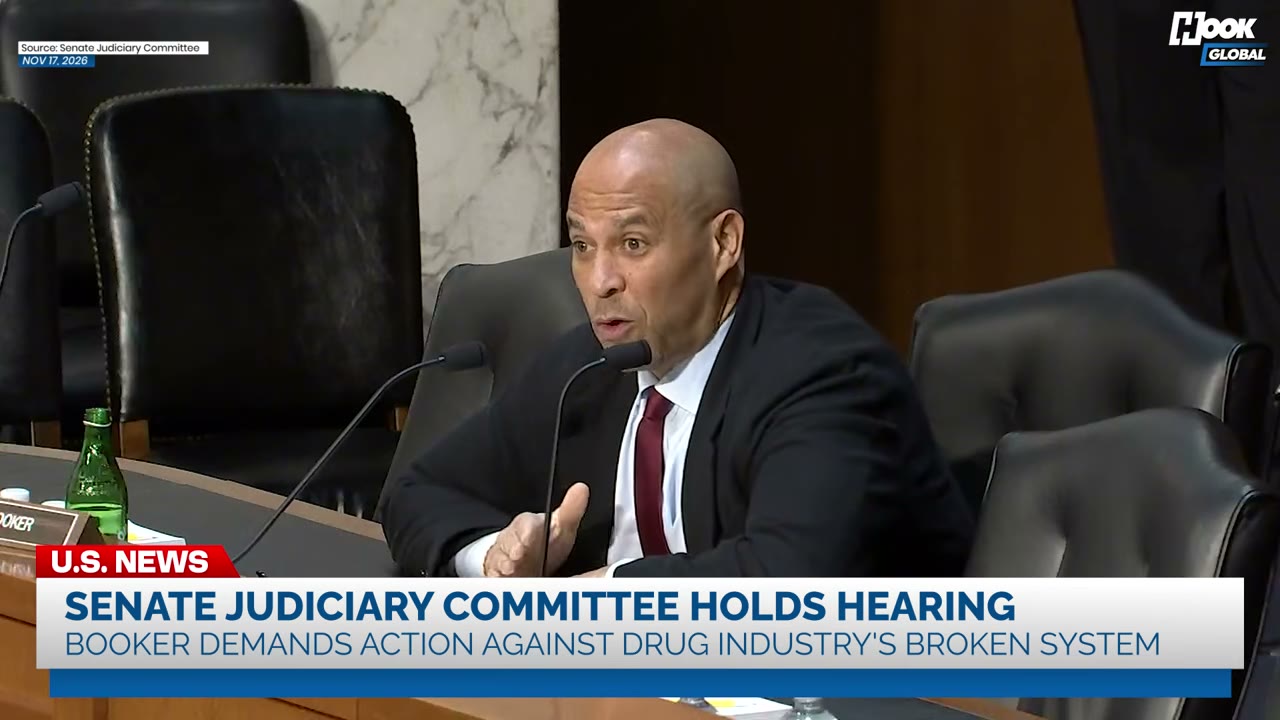
Sen. Cory Booker questioned a health economist about pharmacy benefit managers taking about 41 cents of every prescription dollar. The hearing examined conflicts of interest, vertical integration and FTC deals with PBMs as patients face rising drug costs.
1Booker Warns Americans Face Financial Ruin Over Drug Costs
One in four Americans either skips medication they cannot afford or cuts pills in half, Senator Cory Booker said at a hearing on prescription drug costs. He called the situation a national crisis, saying a prescription has become "a path to financial ruin" rather than a path to recovery.
Booker said he has traveled across the country and his state and spoken with elderly people who split their pills and with people who struggle with mental disorders, suffer attacks and relapses, lose their jobs and slide into financial ruin.
He described the hearing as one of the most important taking place right now and said he wanted to delve into the aspects behind the crisis.
2Booker Jokes About USC Football Before Drug Pricing Question
Senator Cory Booker opened his questioning of Dr. Sood by mocking the University of Southern California's football team. "They have a terrible football team," Booker said, adding that he somehow scored a touchdown for them.
Booker asked that the touchdown be put on the record. He called the university great but said its football team seems to have emerged from some dark place.
He then turned back to the hearing, saying the matter at hand was extraordinary to him.
3Study Finds Middlemen Take 41 Cents of Every Drug Dollar
Middlemen take about 41 cents out of every dollar spent on prescription drugs, according to research cited by Senator Cory Booker. He said that is almost half the money, taken by intermediaries rather than doctors or drug manufacturers, and it comes out of the patient's pocket.
"This is outrageous," Booker said. He said he wants to know who is getting rich off Americans' diseases and how much of a life-saving medication's price goes to companies that did not invent or manufacture the drug and provide nothing to the patient.
Booker said there is evidence this is a wealth drain that other countries are not doing. He asked the witness to briefly describe it.
4Economist Confirms Middlemen Share Rose With Insulin
A health economist told Senator Cory Booker that out of every $100 a patient or consumer pays, $40 or $41 went to middlemen and about $60 went to pharmaceutical companies. She said she repeated the research years later using insulin data.
She found intermediaries are earning more and more, and this does not lead to a decrease in overall costs. She said they are taking money from pharmaceutical companies and increasing their own profits without changing overall costs.
She testified that because the patient share of costs is based on list prices, as discounts increase, so do prices, so patients end up paying more.
5Booker Flags Conflicts of Interest in Vertically Integrated Firms
Senator Cory Booker said the most worrying part of the system is not just middlemen taking money from patients in critical condition, but extraordinary conflicts of interest. He said corporations can earn more by referring patients to their own facilities, even when cheaper alternatives exist.
"Adam Smith would have a heart attack if he saw this kind of market manipulation," Booker said. He called it simply outrageous.
He asked the witness to briefly explain, in his last seconds, why this works against the free market.
6Expert Says CVS-Aetna Merger Exploits Competition Rules
An expert told senators she was one of the few who opposed the CVS-Aetna merger over a decade ago, calling vertical integration an exploitation of everything known about competition. She said PBMs are supposed to negotiate with pharmacies, but if a PBM owns its own pharmacies, it creates a disadvantage for other pharmacies in the market.
She said the FTC is "playing theater" and does not supervise. She said it made three deals with two of the three dominant PBMs over similar insulin practices, but the deals do not break up the conglomerates or eliminate conflicts of interest, and their validity expires in 10 years.
She said the deals tell corporations to behave better while leaving intact the structures that incentivize exploitation of patients.
7Senators Split on Transparency Versus Breaking Up PBMs
Senators split on how to fix the drug middleman system, with one pointing to transparency gains from the CAA and Department of Labor regulations and another saying transparency cannot solve the problem. The first said he wants to see how transparency works, especially with added fiduciary responsibility, and that if PBMs continue to take advantage of consumers, there will be no choice but to dismantle vertical integration.
The other said that is not how these companies behave and that this is not a transparency issue. He said the structure that allows vertical integration must change and that nothing has been done to do so, calling the structure broken and saying vertically integrated companies need to be broken up.
The first senator said he is not a fan of vertical integration and opposed it over a decade ago, but is hesitant about requiring companies to sell all their pharmacies because he fears patients could be hurt if many pharmacies close and they have to travel longer distances.
8Booker Says Family Pharmacies Lost to Vertically Integrated Giants
Senator Cory Booker said he wants to give transparency and fiduciary responsibility a chance, meaning companies will be held accountable. With his time up, he said the reason pharmacies are closing is that they are taking unfair advantage.
He said family pharmacies are being lost to large vertically integrated companies. "The system is broken," Booker said.
He said everyone is ripping her off, causing her patients to suffer, and closed by calling the USC football team just awful.
9PBM Revenue Tripled Since Original 41-Cent Study
PBM revenues have roughly tripled since the study that found middlemen take 41 cents of every drug dollar, according to testimony at the hearing. A senator asked what portion of the 41 cents goes to the PBM, noting the study was conducted over 10 years ago.
The witness said that back then, about $6 of every $100 went to PBMs. She said she repeated the study recently using insulin data and found PBM revenues have tripled, or a little less than three times — two and a half times.
She said a published study in a leading medical journal shows that for every $100 spent on insulin, PBMs used to get $4 or $5 and now get almost $15.