A ranking of the world's ten most advanced military helicopters, from Russia's Mi-35M to the US AH-64E Apache Guardian. The video compares speed, range, armor, weapons and digital battlefield technology across Russian, American, European, Turkish, Chinese and South African machines.
1Russia's Mi-35M ranks 10th as armored transport-attack hybrid
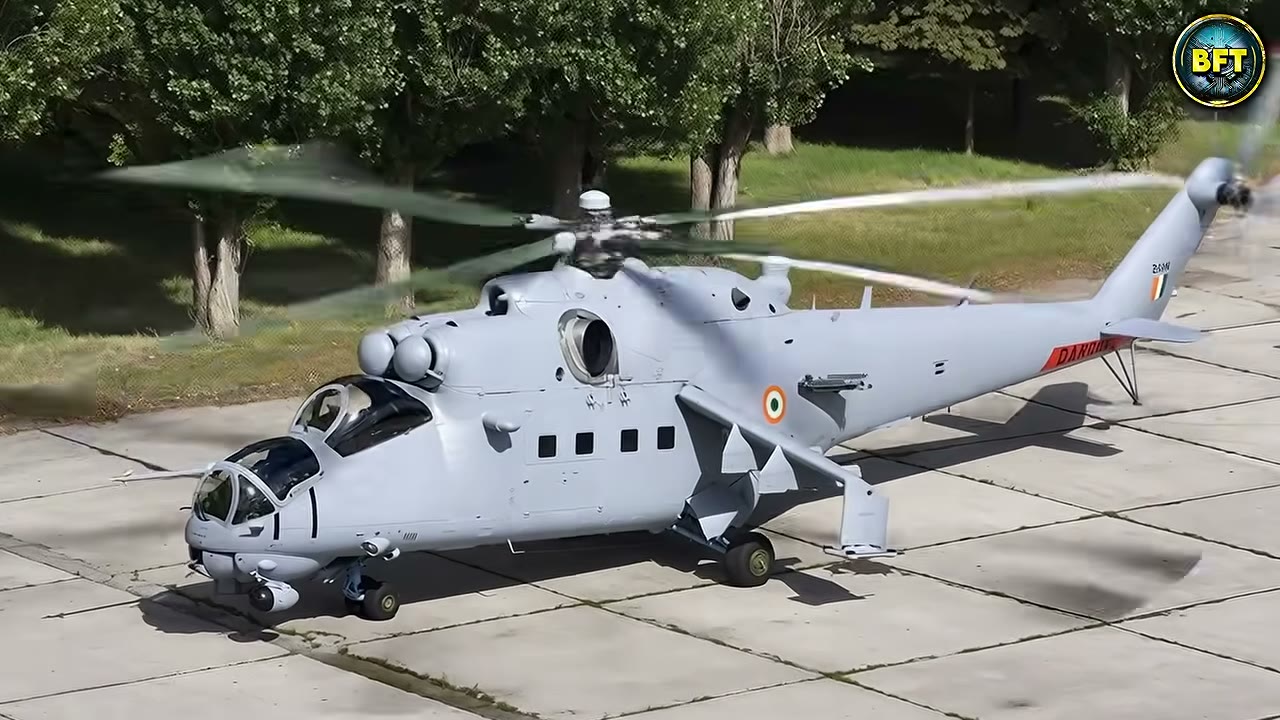
Russia's Mi-35M carries eight fully equipped soldiers while destroying tanks ahead of it. The armored transport-attack hybrid ranks 10th on the list of the world's most advanced military helicopters.
It is a modernized version of the classic "flying tank," adding modern intelligence to the original design. A non-retractable chassis saves weight and strengthens the structure, while two modern turboshaft engines push it to 310 km/h.
The 450 km flight range lets it strike deep behind enemy lines. Night vision and thermal imaging systems let the crew hunt in complete darkness.
Armament includes a twin-barreled 23mm automatic cannon under the nose, plus anti-tank guided missiles and unguided rockets on underwing pylons. Composite rotor blades make it quieter and more durable than older versions.
2Bell Boeing V-22 Osprey takes 9th place with tiltrotor design
The Bell Boeing V-22 Osprey hits a maximum speed of 509 km/h — roughly twice that of a regular helicopter. The tiltrotor ranks ninth on the list.
It takes off and lands vertically like a helicopter, then rotates its huge wing-mounted propeller engines 90 degrees forward to become a high-speed turboprop aircraft. That lets troops launch from a tiny ship deck in the middle of the ocean and fly at double a normal helicopter's speed.
It has a combat radius of 722 km without refueling and carries 24 fighters or over 9,000 kg of cargo. Each propeller spans more than 11 m.
Early flight tests were challenging, but years of engineering development made it a mainstay for special operations forces and the Marine Corps. It can fold its wings and propellers in just 90 seconds to fit on crowded aircraft carriers.
3South Africa's Denel AH-2 Rooivalk ranks 8th as desert predator
South Africa's Denel AH-2 Rooivalk has a 20mm cannon that aims wherever the pilot looks. The attack helicopter ranks eighth on the list.
Named "red falcon" in Afrikaans, it was built to operate in harsh African conditions — heat, dust and isolation — without constant maintenance. It was developed when South Africa needed its own tank destroyer.
The pilot sits behind the gunner in a sleek tandem cockpit for maximum visibility and safety. Two turboshaft engines give it a top speed of 309 km/h and a flight range of 1,130 km.
It carries up to 16 anti-tank guided missiles and several unguided rocket pods under its short wings. Its electronic warfare suite scans for enemy radar and laser threats and automatically fires heat traps and dipole reflectors to disorient missiles.
4Turkey's TAI/T129 ATAK 2 takes 7th place for high-altitude combat
Turkey's TAI/T129 ATAK 2 can operate at altitudes of over 6,000 m — where other helicopters can barely hover. It ranks seventh on the list.
Thin air on steep, icy mountains seriously reduces a heavy helicopter's efficiency. Twin turboshaft engines were built to solve that problem, letting the ATAK 2 hunt in tough mountain battles.
It has a top speed of 281 km/h and a maximum flight range of 537 km. Its lightweight composite airframe provides the maneuverability to perform rolls, dives and sharp turns that would break older helicopters in half.
Armament includes a 20mm triple-barreled Gatling gun under the nose, laser-guided missiles, long-range anti-tank missiles and air-to-air missiles for self-defense. Digital displays and a target detection system work in darkness, rain or thick smoke, and crew helmets project flight data directly in front of their eyes.
5China's Harbin Z-20 ranks 6th as multi-role mountain helicopter
China's Harbin Z-20 uses a five-bladed main rotor instead of the traditional four — an extra blade that provides significantly more lift in the thin air of the Tibetan Plateau. It ranks sixth on the list.
The medium-sized multi-role helicopter was designed to fill a gap in the Chinese military for extreme mountainous conditions. At first glance it bears a striking resemblance to the American Black Hawk, but its interior is completely modern.
Two turboshaft engines push it to speeds of up to 300 km/h, with a range of about 1,000 km. It carries up to 12 fully equipped soldiers or 4,000 kg of cargo on an external suspension.
Instead of old mechanical cables, computers send electronic signals directly to the flight control surfaces, making flight smoother, safer in bad weather and easier during risky landings. Newer naval variants have folding propeller blades and specialized radar for hunting enemy submarines.
6Franco-German Eurocopter Tiger enters top five with stealth design
Over 80% of the Eurocopter Tiger's fuselage is made of lightweight carbon fiber and Kevlar-based materials, reducing its radar visibility. The Franco-German attack helicopter ranks fifth on the list.
It was built on one philosophy: the main thing is not to get hit. Instead of heavy armor, it relies on stealth, maneuverability and radar evasion, making it extremely difficult for enemy air defense systems to target.
Two engines give it a top speed of 290 km/h and a maximum range of 800 km without extra fuel tanks. It is agile enough to perform full dead loops and barrel rolls in combat.
Depending on the version, a 30mm automatic cannon firing high-explosive shells sits in the bow, alongside anti-tank missiles, unguided projectiles and Stinger air-to-air missiles. Its mast sight above the main rotor lets the crew hide behind a hill, raise only the sensor above the treetops, identify targets and fire without exposing the helicopter.
7Bell AH-1Z Viper ranks 4th as modernized Zulu Cobra
The Bell AH-1Z Viper's lineage dates back to the Vietnam War, but the US Marine Corps redesigned it from the ground up for modern naval and land battles. It ranks fourth on the list.
Known as the "Zulu Cobra," it shares 84% of its parts with the UH-1Y Venom multi-role helicopter, making maintenance on Navy ships incredibly easy.
A four-blade composite main rotor reduces vibration while increasing speed and maneuverability. Two engines give it a top speed of up to 300 km/h and a maximum combat radius of 648 km.
Under the nose sits a 20mm triple-barreled Gatling gun capable of instantly piercing light armor. Underwing pylons carry up to 16 Hellfire anti-tank missiles, laser-guided missiles and Sidewinder air-to-air missiles. Large digital screens and a helmet-mounted aiming system project flight data directly onto the pilot's visor.
8Russia's Mi-28 Night Hunter takes 3rd with heavy armor
The Russian Mi-28 "Night Hunter" cabin can withstand direct hits from 12mm armor-piercing bullets, and its main rotor blades keep spinning after being hit by 30mm high-explosive shells. It ranks third on the list.
Known as the Havoc, it was built for one purpose: to seek out and destroy enemy tanks in all weather, day or night. Heavy energy-absorbing armor and bulletproof glass protect the entire cabin.
Two high-performance turboshaft engines accelerate it to a top speed of 320 km/h, with a range of 435 km to strike quickly and retreat just as fast.
A 30mm automatic cannon under the nose uses the same ammunition as Russian infantry fighting vehicles. It also carries up to 16 laser-guided anti-tank missiles and heavy unguided rocket pods. Radar mounted above the main rotor lets the crew scan the battlefield while hidden behind terrain, and an emergency escape system shoots the side doors open with inflatable bags cushioning the crew's jump.
9Kamov Ka-52 Alligator ranks 2nd with coaxial rotor design
The Kamov Ka-52 "Alligator" has no tail rotor at all. Instead, two main rotors are mounted one above the other, rotating in opposite directions — a coaxial rotor system. It ranks second on the list.
With no traditional tail rotor, all engine power goes directly to lift and flight speed. That gives it maneuverability to perform sideslips, sharp turns and hover in strong crosswinds that would force other helicopters to land.
It has a top speed of 300 km/h and a flight range of 460 km. The crew sits side by side, unlike most attack helicopters where the pilot sits behind the gunner, allowing instant communication without depending on intercoms.
Armament includes a 30mm side cannon, heavy anti-tank missiles and unguided rockets. It is also the world's only combat attack helicopter with a true ejection system: explosive charges shoot off the main rotor blades before the crew ejects.
10Boeing AH-64E Apache Guardian named most advanced helicopter
The Boeing AH-64E Apache Guardian's crew can directly control combat drones, sending them forward to scout targets and attack without risk to the helicopter itself. It takes first place as the most modern military helicopter in the world today.
The newest Model E transforms the classic combat helicopter into a digital command center in the sky. It shares real-time radar data with ground troops, fighters and ships.
Two turboshaft engines give it a top speed of 300 km/h and a range of 476 km. A 30mm chain cannon tracks the pilot's helmet and fires 625 explosive rounds per minute. It carries up to 16 Hellfire missiles or joint air-to-surface missiles capable of destroying heavy armor from kilometers away in complete darkness.
Its Longbow fire control radar scans 360 degrees, tracks dozens of targets at once and classifies them as tanks, trucks or aircraft in a split second. The system automatically prioritizes the most dangerous threats to the pilot.