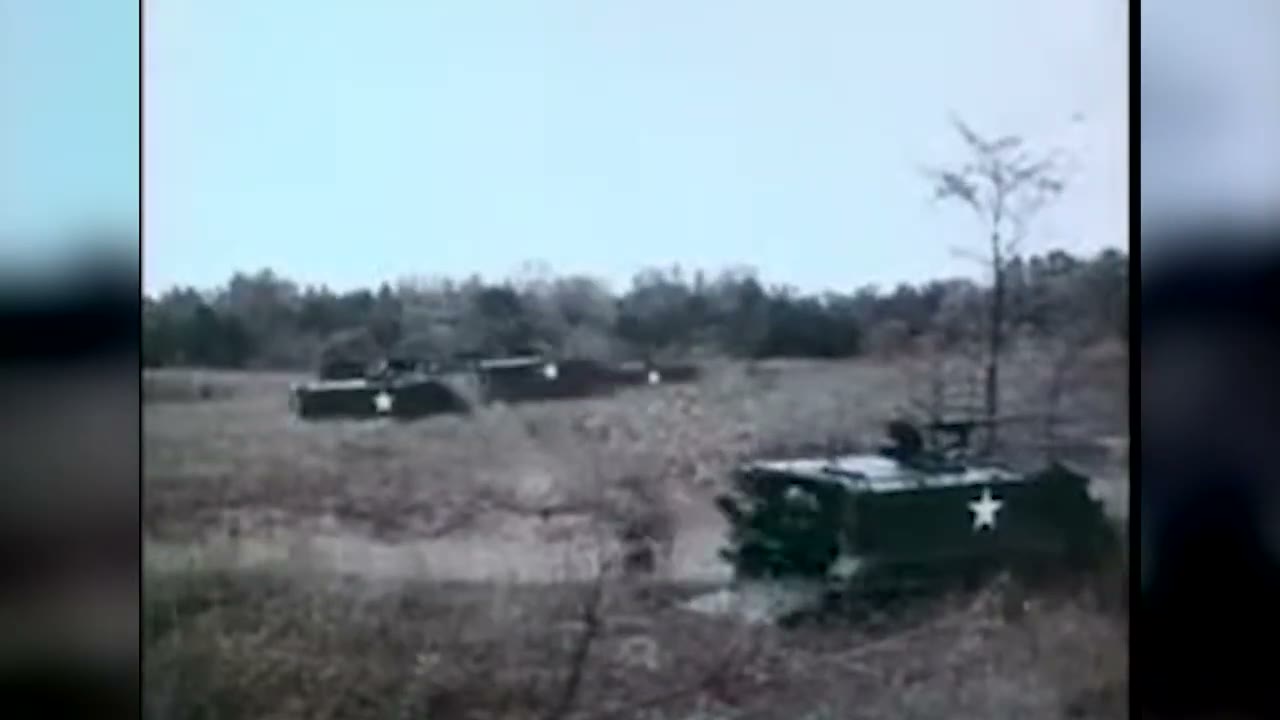
This video examines how South Vietnamese forces turned the M113 armored personnel carrier into a tank-like fighting vehicle during the Vietnam War. It traces the ACAV's development, its mounted combat tactics, and the unit reorganizations that made the APC the backbone of ARVN cavalry.
1The M113 APC and the gap between specifications and combat roles
Some US units in Vietnam fought the M113 armored personnel carrier as if it were a tank—with tank platoon structures, no dismounts, and tank-like missions. The M113 was designed as a battle taxi: it drops infantry near the fight, then hides or takes up hull-down positions to cover the attack. Adopted by the US in the early 1960s, it served as the primary transport for mechanized infantry until the Bradley replaced it. The Conventional Armed Forces in Europe Treaty defines a battle tank as a self-propelled armored vehicle weighing at least 16.5 metric tonnes, with a direct-fire high-velocity cannon of at least 75mm that can traverse 360 degrees, high cross-country mobility and protection, and not primarily designed to carry infantry. The M113 meets none of that. But beyond definitions, there is the concept of a tank-like role.
2Capability is relative to the enemy, not absolute specifications
A Stuart light tank that would be relegated to reconnaissance in Europe could credibly fill a main tank role in the Pacific—because Japan had lesser armor and anti-armor capabilities. Capability is framed in reference to the enemy, not absolute specifications. If the enemy has no anti-tank weapons, Abrams-level protection probably isn't required to bring about similar effects. If the enemy is footmobile, any amount of motorized mobility could be advantageous. And if the enemy's tanks aren't well-protected by modern standards or they have no tanks at all, firepower can be reduced in favor of higher ammo capacity, lower weight or higher rate of fire. For similar reasons, the French can deploy AMX-10RCs or ERC-90s to Africa and have them fill a tank-like role while retaining the advantages wheels and lighter weight provide. But while peacekeeping in Lebanon, where the deterred party has main battle tanks, they deploy Leclerc MBTs. It's relational to the enemy.
3South Vietnam develops the Armored Cavalry Assault Vehicle concept
South Vietnamese troops charged straight up through flooded terrain mounted, scattering guerrillas with shock effect and gaining fire superiority with their .50 cals. The predecessor to the Armored Cavalry Assault Vehicle was developed by the South Vietnamese in the early 1960s, before the US started major ground combat operations. In April 1962, the US provided two M113 companies assigned to their 7th and 21st Infantry Divisions. These companies were initially based on US Mechanized Infantry Companies, with an HQ, 3 rifle platoons, and a support platoon with 60mm mortars and bazookas. U.S. advisers initially wanted the Vietnamese to use the M113 like the Americans: maneuver around the enemy's flank and dismount infantry for the actual attack. But when troops did dismount at the request of American advisers, the inexperienced infantry would get bogged down in marshy terrain, and the Vietcong's small arms became effective. It quickly became SOP for M113 troops to fight mounted, and American advisers passed this knowledge onto the US Armored Cavalry Regiments.
4M113 mobility advantages and jungle-busting role in Vietnam
The M113 was amphibious, giving it a huge mobility advantage over both the Vietcong and tanks in the inundated terrain of the country's far south. Mounted troops generally suffered fewer casualties than the dismounted. Although protection and armament was inferior to a main battle tank, the M113 kept that edge in water. The French learned the same lesson during the First Indochina War in the 1950s and implemented amphibious cavalry squadrons manned mainly by Vietnamese troops. Even in jungle warfare, M113s played a decent jungle-busting role, driving ahead of the infantry to detonate anti-personnel mines, break through the bush, and break up enemy ambushes. However, the M41 Walker Bulldog was better at this, and the M48 Patton even more so.
5ACAV modifications: gunshields, side machine guns and hatch armor
After losing 14 track commanders manning unprotected machine guns, ARVN's 2nd Armored Cavalry and 80th Ordnance Depot began fabricating gunshields for their .50 cals from 1963. When the US 11th Armored Cavalry Regiment standardized the ACAV in 1966, they added two sidemounts for medium machine guns. The US and South Koreans used M60s. But ARVN had M1919A4s chambered in .30-06 in their organization tables. ACAVs also had hatch armor and an improved turret shield to provide 360-degree protection for the .50 gunner. Notably, US versions of the M113 used diesel engines, while Vietnamese versions ran on gasoline, which increased the ARVN version's susceptibility to serious casualties during mine strikes.
6Enemy anti-armor adaptation and ARVN's shift to Pattons
For a brief time, the Vietcong had no answer to South Vietnamese APCs. Then they received anti-armor weapons: recoilless rifles, mines, armor-piercing machine gun ammo, and RPG-2s. ARVN replaced their old French Chaffees with newer Walker Bulldogs in 1964. With North Vietnam bringing T-54s and PT-76s to the fight by the early 70s, ARVN received M48 Pattons as well. But M113s made up the bulk of ARVN cavalry to the end.
7Mechanized rifle squadrons become Armored Cavalry Assault Troops
Around 1967, ARVN's Mechanized Rifle Squadrons were redesignated as Armor Cavalry Assault Troops—and their platoons were reorganized like tank platoons. Instead of 3 APCs and 3 rifle squads, they had 5 ACAVs with only enough men to man the track and all its weaponry. The changes followed earlier reorganization: mechanized rifle companies were redesignated as mechanized rifle squadrons in 1962, becoming the 4th and 5th squadrons of the 2nd Armored Cavalry Regiment. Those squadrons received only minor org changes, with 60mm mortars and bazookas replaced by dismounted M1 81mm mortars and M18 57mm recoilless rifles. The 1967 shift was bigger: platoons mirrored tank platoons, with five ACAVs and crews sized to the vehicles rather than to rifle squads.
8Inside an ACAV troop: crew roles, tank-style mission and organization
Each ACAV track had a 7-man crew: a track commander, a driver, a .50 cal gunner, two .30 cal gunners, an M79 grenadier, and an ammunition bearer. Their mission was to "close with and destroy enemy forces, using fire, maneuver and shock action in coordination with other combat units, particularly on terrain improper for tanks." That is basically word-for-word the same mission as US Tank Companies of the time. Two tracks made up an assault section, under either an E8 Section Leader or Assistant Platoon Leader who was a junior officer. Two assault sections made up the bulk of the platoon, while the HQ had the Lieutenant Platoon Leader, his ACAV, and an identical crew. Assault Troops had 3 of these platoons, plus a support platoon and HQ platoon. The support platoon had an HQ, a mortar section with 3 M125 81mm mortar carriers, and a recoilless rifle and assault bridging section with 2 recoilless rifles and 1 lightweight assault bridge that could be mounted on an ACAV. In the 1968 TO&E the recoilless rifles are listed as the same 57mm, but by 1970 at least they were using M40 106mms. This gave the troop decent direct-fire capabilities beyond their .50 cals.
9Troop command and American adviser teams in ARVN cavalry
A typical Armored Cavalry Assault Troop was templated for a Major but usually commanded by a 1st Lieutenant. Each troop had 19 M113s, with an HQ Section, Maintenance Section, and Admin and Supply Section. By a 1970 report, one of the HQ ACAVs was replaced by an M577 command vehicle. The 1st Lieutenant was assisted by an American adviser team consisting of a Captain and a Senior NCO, normally a Sergeant First Class.
10Armored Cavalry Squadron evolves from regiments to battalions
By 1970, ARVN's Armored Cavalry Squadrons were battalion-sized and came in two variants: one with 3 Armored Cavalry Assault Troops, and one with two ACATs and a tank troop of 17 M41 Walker Bulldog light tanks. Back in 1963, they were regiments, with one company-sized squadron each of M24 Chaffee light tanks, M8 armored cars, and M114 recon vehicles, plus two mechanized rifle squadrons on M113s. The M41 had been phased out of US cavalry organizations in favor of the M48 Patton in the late 1950s, but it was a satisfactory replacement for the busted M24s the French left ARVN. Both variants had a Headquarters and Service Company, templated for a Colonel commanding but more often with a Lieutenant Colonel or Major at the helm, plus an American Major leading an advising team. If the squadron had a tank troop, it also had 2 M41s in the HQ.
11Flamethrowers, V-100 Commando cars and other squadron armor
The squadron's other armor included a flamethrower section with 2 M132 armored flamethrowers and a recon platoon with 6 V-100 Commando armored cars. The Commandos were mainly used for convoy security and typically didn't work directly for the squadron.
121968 expansion groups squadrons into four armored cavalry brigades
South Vietnam's armor was reorganized into four armored cavalry brigades, one for each Corps Tactical Zone, under the 1968 Vietnamese Armed Forces Expansion Program. The old model gave each of the 10 infantry divisions its own armored cavalry squadron; the new one grouped squadrons at corps level, though about half kept their ties to individual divisions.
The aim was to give each corps an armored rapid reaction unit led by armor commanders.
By the end of the conflict, 1st and 2nd Brigades each had four combined M113/M41 squadrons, while 3rd Brigade had five. The 4th Brigade, supporting the corps over the Mekong Delta's swamps and flooded rice paddies, had five M113-only squadrons because the vehicle performed better in that terrain.
13US supplies M48A3 Pattons to ARVN from 1971
Starting in 1971, the US began supplying ARVN with M48A3 Pattons, and the first unit to get them was the 20th Squadron under the 1st Brigade, stationed directly on the border with North Vietnam. The 22nd Squadron under the 3rd Brigade, near Saigon, followed, then the 21st under the 2nd Brigade at Pleiku.
After the fall of the south, much of this equipment transferred.