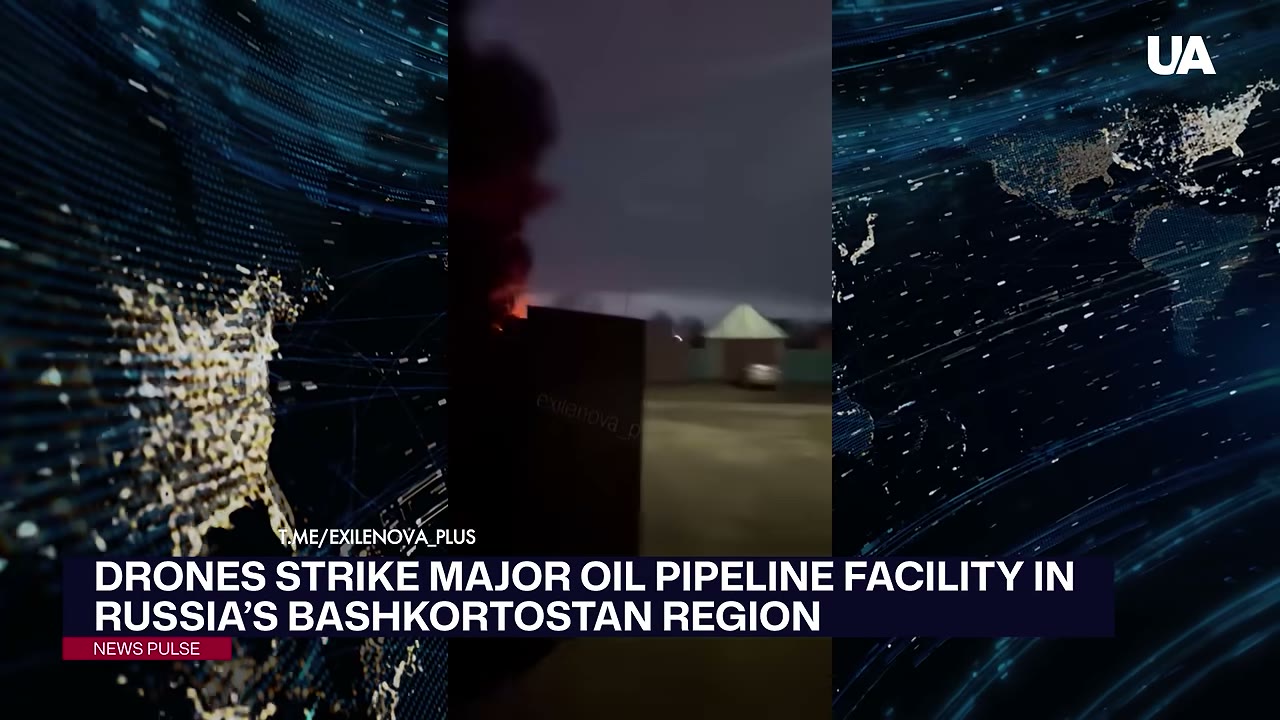
Ukrainian drones hit oil facilities in Bashkortostan and Samara, prompting Putin to urge new refineries in Russia's Far East. Poland asks NATO to consider downing Russian missiles, while Zelensky rejects territorial concessions and presses Washington for Patriot missiles.
1Ukrainian drones hit Transneft oil hub in Bashkortostan
Ukrainian drones struck a major Russian oil pipeline hub overnight, sparking a fire at a Transneft pumping station near Tuymazy in Bashkortostan. The facility is a key transit point in the Urals, moving crude from Western Siberia and Bashkortostan to refineries and export pipelines.
The same site was reportedly hit by drones in July, when a storage tank caught fire. Local media reported the latest attack caused a fire; the extent of damage was not immediately clear.
The strike came on the night of November 26, according to the report.
2Fire reported at Novokuybyshevsk refinery in Samara region
A fire has broken out at the Novokuybyshevsk oil refinery in Russia's Samara region, a day after the plant was reportedly attacked by a Ukrainian drone. The refinery processes about 7 million tons of oil a year and produces more than 20 types of petroleum products, including gasoline and diesel.
The reported blaze follows the strike on the Transneft pipeline hub in Bashkortostan, marking a second oil facility fire in a single day.
Details of the damage at Novokuybyshevsk were not immediately available.
3Putin threatens response as Ukraine defends refinery strikes
Vladimir Putin has threatened what he called an "inevitable response" to Ukrainian attacks on Russian refineries. The Russian leader's warning came as Moscow continued strikes on Ukrainian cities and civilian infrastructure.
Ukraine says its strikes on Russian oil facilities aim to undermine Moscow's military and economic potential. Kyiv describes them as a legitimate act of self-defense under Article 51 of the UN Charter, meant to weaken Russia's ability to wage war and force the Kremlin to end its aggression.
There was no immediate detail on what form Putin's response might take.
4Putin urges new Far East refineries as 110+ strikes hit
Ukrainian drones have attacked Russian oil refineries more than 110 times since the start of the year, pushing the campaign into increasingly remote areas far beyond the front lines. Against that backdrop, Putin called for building new refineries in the Far East.
Putin acknowledged the country's oil market is in a difficult situation, with the prospect of collapse even after repeated Ukrainian attacks. Only a few sites, mostly in Eastern Siberia and the Far East, remain intact for now.
The strikes are putting pressure on refineries deep inside Russia.
5US diesel prices fall despite strikes on Russian refineries
US diesel prices keep falling after the November 3 election, despite Ukraine's continued attacks on Russian refineries and oil depots. The trend raises questions about past statements by President Donald Trump, who blamed those strikes for rising US fuel prices.
Since then, Trump has repeatedly cited falling fuel prices as an achievement of his administration. Ukraine keeps targeting Russian oil facilities to cut fuel supplies supporting Moscow's military effort.
The contrast has prompted US media and lawmakers to seek explanations from the administration.
6Boris Johnson says NATO membership could have prevented war
A full-scale Russian invasion of Ukraine might never have happened if Kyiv had joined NATO before 2014, former British Prime Minister Boris Johnson says. In an interview with Sky News, Johnson recalled 2008, when US President George W. Bush backed Ukraine's membership bid but European countries blocked it.
Johnson called on Western allies to send more military aid to Kyiv, including more air defense missiles and access to frozen Russian assets.
His remarks come as Ukraine presses partners for stronger military support.
7Zelensky says 48 Patriot missiles await Hegseth's signature
Ukraine is waiting for the US to transfer 48 Patriot air defense missiles, and the process could end with a single signature — that of Defense Secretary Pete Hegseth, President Volodymyr Zelensky says. Speaking at a joint press conference with Hungarian Prime Minister Viktor Orban, Zelensky said Ukraine has not yet received a license to produce the missiles.
He said the process needs to speed up so Germany can start its own production.
The transfer remains a key unresolved issue in relations with Washington.
8Zelensky details Patriot missile requests in press remarks
Ukraine wants 60 Patriot missiles but is still waiting for Hegseth to sign off on a separate contract for 48, Zelensky said. "Unfortunately, Pete Hegset hasn't signed it yet," he said, adding: "So everything depends solely on him."
Zelensky said the request for 60 missiles is currently in the United States. Ukraine is counting on receiving 50 missiles, he said, and would welcome 60 if offered.
The remarks detail Kyiv's push for more air defense interceptor missiles.
9EU tightens export restrictions on 15 Russian companies
The European Union has tightened restrictions on Russia's military-industrial sector, limiting access to advanced technologies for 15 more Russian companies. The Council of the EU said the decision, adopted on November 25, expands export restrictions on dual-use goods and advanced technologies tied to Russia's defense industry or military capabilities.
One organization was removed from the list after it stopped the activities that led to its inclusion and assured it would no longer trade dual-use goods with Russia.
The EU is also seeking to limit Russia's international presence.
10Seven EU states seek visa bans for Russian athletes
Leaders of seven EU member states have called for visa restrictions on Russian and Belarusian athletes, arguing their participation in international events should not be normalized while Russia's war in Ukraine continues. The call came in a joint letter to European Council President António Costa and European Commission President Ursula von der Leyen.
The leaders of Denmark, Estonia, Finland, Latvia, Lithuania, Poland and Sweden signed it.
They cited the European Council's position that there should be no normalization until a just and lasting peace is achieved.
11Poland asks NATO to consider downing Russian missiles
Poland has asked NATO allies to consider shooting down Russian missiles over Ukraine if they head toward Alliance territory, Bloomberg reports. The proposal came at a meeting of NATO ambassadors in Brussels on Monday, after three Russian shells fell on Polish territory last week.
Some allies voiced support, but no final decision was made. Such a move would expand NATO's defensive operations in Ukrainian airspace and increase the risk of a direct clash with Russia, and would require unanimous approval and coordination with NATO's Supreme Military Commander.
Warsaw also plans a no-fly zone along its eastern border.
12Poland weighs expelling Russian ambassador over airspace breach
Poland is considering expelling Russia's ambassador after Russian missiles violated its airspace, Foreign Minister Radosław Sikorski confirms. Warsaw hopes Moscow will stop escalating but is prepared for Russia to respond by expelling a Polish diplomat, he said.
The Russian embassy in Warsaw rejected the accusations, calling claims of Russian involvement baseless and accusing Polish officials of fomenting what it called Russophobia.
On November 20, during a large-scale Russian attack on Ukraine, three Russian missiles violated Polish airspace before falling on Polish soil.
13Zelensky rejects territorial concessions on Donbas
Ukraine will not consider territorial concessions to Russia at the expense of Donbas, because such a step could mean losing the war, President Volodymyr Zelensky says. Speaking at the Congress of Local and Regional Authorities, he said the issue is far more than giving up a few hectares of land.
"I believe that withdrawing from Donbas would mean losing this war," he said, stressing he meant a voluntary decision to leave, not a withdrawal forced by fighting.
Zelensky warned that no security guarantees could prevent Russia from demanding more later.
14Ukraine strikes two Samara refineries and Savasleika airfield
Ukraine hit two Rosneft oil refineries in Russia's Samara region overnight and disabled five warplanes at Savasleika airfield, Kyiv's General Staff confirmed.
The refineries — Kuibyshev and Syzran — together process more than 15 million tons of crude a year and regularly supplied fuel to the Russian military, according to the General Staff. The operation on the night of November 25 was carried out with the support of the Black Spark partisan movement.
At Savasleika, the aircraft hit included three MiG-31 fighters, which Russia uses to carry Kinzhal missiles in attacks on Ukrainian cities.
15Details of damage at Kuibyshev and Syzran refineries
A direct hit and fire were recorded at the Kuibyshev Oil Refinery, one of the largest plants in Rosneft's Samara group, with capacity of about 7 million tons of crude a year.
Ukraine's Armed Forces said the AVT-4 and AVT-5 primary processing units, a reforming unit and two storage tanks were affected. Thick smoke rose over the Syzran refinery, where a large-scale fire broke out.
According to preliminary information cited by the Armed Forces of Ukraine, Syzran's AVT-6 unit, sulfur purification, catalytic reforming, hydrotreating and isomerization units, plus two storage tanks, were hit.
16Russian refining capacity losses mount across regions
Russia's Ryazan oil refinery, which supplies fuel to Moscow and its region, has lost 90% of its capacity, Ukraine's General Staff said, as strikes keep hitting plants across European Russia and Siberia.
The Novoshakhtynskyi refinery in the Rostov region has stopped operations after a November 23 attack, and two oil depots in Azov lost capacity after a November 16 strike.
Putin effectively acknowledged Russian air defense could not protect the country's European regions and urged oil companies to move refining east, to Siberia and the Far East. Refining volumes fell 45% in the first three weeks of November, according to industry sources cited by Reuters and The Moscow Times.
17Ukraine says strikes disabled over 55% of Russian refining
Ukrainian long-range strikes had disabled more than 55% of Russia's oil refining capacity by mid-November, according to Ukrainian estimates.
President Volodymyr Zelenskyy said the strikes are carried out virtually every day. They are a direct response to Russia's attacks on Ukraine's energy infrastructure, he said, and mean Russia "cannot feel safe even at sea."
The figures come as Kyiv presses a campaign against Russian refineries and depots. On November 22, the Security Service of Ukraine mounted a further operation.
18Ukrainian naval drones sink Russian corvette off Libya
Ukrainian naval drones sank the Russian Black Sea Fleet corvette Merkury off the coast of Libya, near Benghazi, in an operation by the Security Service of Ukraine and the defense forces on November 22.
The drones also hit a Ka-27 helicopter and struck the cargo ship MV Angara, which was transporting weapons, according to the account.
Russian forces face a worse position in the Black Sea, with their fleet effectively trapped, the report said: the Turkish and Kerch straits are closed and ships can no longer be moved from the Caspian Sea via the Volga.
19Ukraine strikes Savasleika airfield, disabling five aircraft
Ukraine's Defense Forces struck Savasleyka airfield in Russia's Nizhny Novgorod region on November 24 and the night of November 25, disabling three MiG-31 fighters and two Su-34 fighter-bombers, according to preliminary information.
The aircraft will not be able to take to the skies and strike Ukrainian cities and villages in the near future, the report said.
The strike hit one of Russia's key military airfields, extending Ukraine's campaign against bases used to launch attacks on its territory.
20Ukraine destroys Russian aerospace intelligence complex in Smolensk
Long-range drone operators from Ukraine's Main Intelligence Directorate destroyed a unique aerospace intelligence complex in Russia's Smolensk region, blinding the country's air and missile defense network.
The facility was a key intelligence center that monitored airspace and provided targeting to Russian air defense and missile defense systems, according to the report.
Ukraine's military intelligence described the strike as another high-precision operation against a site central to how Russia tracks and targets threats in the air.