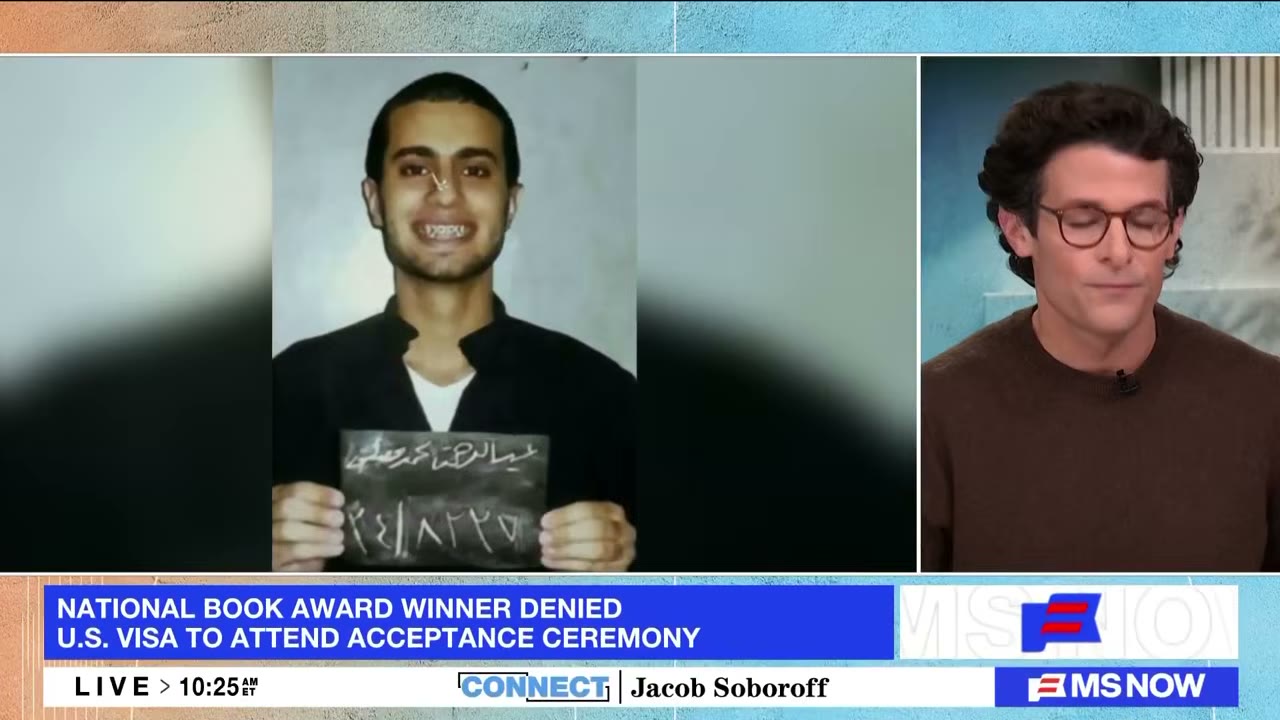
Abdel Rahman El Gendy wrote a memoir about six years in Egyptian prisons, then fled the U.S. fearing ICE detention under the Trump deportation crackdown. His book Huna won the National Book Award, but his visitor visa was denied and he could not attend.
1Egyptian author Abdel Rahman El Gendy's memoir Huna wins National Book Award
Abdel Rahman El Gendy imagined winning a book award from inside an Egyptian prison cell — and then he did. He wrote about torture, about being 17 when swept up in a police crackdown after Egypt's 2013 military coup, and about survival and resistance. Over more than six years in prison, scribbles became essays, and he began to imagine they might become a memoir.
In a recent essay for The New Yorker, he recalled spending hours under his mother's duvet delivering fictional acceptance speeches, revising them "fleetingly unincarcerated." He wrote that the fantasy helped: "if something helps in prison, you keep doing it."
In 2020, an appeals process determined he was wrongfully tried as an adult, and he was released. Two years later he came to the United States to pursue a master's degree in nonfiction writing at the University of Pittsburgh, where the memoir took final shape as "Huna."
In 2025, while in the final stages of editing, he left the U.S. for Europe. He was afraid his status as an immigrant and a critic of Israel's war in Gaza put a target on his back, as the Trump administration's deportation crackdown against immigrants continued.
2El Gendy's U.S. visa denied days before National Book Award ceremony
Abdel Rahman El Gendy's visa was denied with no explanation — and then his book won the National Book Award without him in the room. "Huna" was named a finalist for the 77th annual National Book Award for nonfiction, and he hoped to return to New York City for the ceremony.
He prepared carefully for his visitor visa interview, putting together color-coded documents and leaning on the practice persona he had developed over years dealing with immigration officers. Despite all of that, the visa was denied. No explanation was given.
Then "Huna" won. The award he had imagined winning from his prison cell was his, but he could not be there to accept it. His editor took the stage on his behalf and read his words.
"If you're listening to this, then a years-long dream of mine has come true," the statement began. "And I'm not there to live it with you."
3El Gendy describes visa interview and the denial arriving overnight
A consular officer congratulated Abdel Rahman El Gendy — then something popped up on her screen. His name had been flagged.
He said he went into the visa interview expecting a more hostile reception. Instead, the officer began by congratulating him, then said she could not decide the application at the embassy and would have to consult Washington.
"Under 24 hours, like I was there by the end of the day, and then I woke up in the morning, the denial was in my inbox," he said. He called it heartbreaking but unsurprising.
What stung was the dangling: the interview made it sound like it might not be a done deal. He had started imagining reunions with the literary community he built around the book — and meeting his fellow National Book Award finalists.
4El Gendy explains how writing began as a way to regain control in prison
Abdel Rahman El Gendy started writing in prison to name the chaos — and turned beatings into book scenes. Arrested at 17 along with his father in Egypt, he said writing began as an attempt to regain a sense of control, not over circumstances but to give the chaos language.
He smuggled pieces written in contraband notebooks to his family during visitation. They published them on social media and smuggled back readers' responses.
"When I was being tortured or beaten by batons, I would think, oh, at least it's going to be a great scene in the memoir," he said. He described it as an unhealthy coping mechanism that made him dissociate from his body — but in prison, if it works, you keep doing it.
He had a 15-year sentence and no idea if he would see light again. "Huna is not a book about how I survived prison," he said. "Huna is how I survived prison."
5El Gendy recalls reading smuggled reader responses in his cell
The Facebook comments his family printed out were tattered by the 15th day — he had read them over and over in his cell. Abdel Rahman El Gendy's family published his smuggled essays on Facebook and printed back the comments, shares and messages of solidarity people wrote.
Visits came every 15 days. By then, the pages were worn from rereading.
He described the exchange as transcendent: prison is built to sever political prisoners from the outside world, cutting off the world's access to their language and theirs to the world's. The smuggled pages were an aperture through which language could move in and out.
He kept doing it at immense risk, he said, because he could not go back to not having that.
6El Gendy explains the title Huna and the protest song behind it
Sixty-eight detainees crammed into a tiny room in a desert camp started singing "we will remain here" — and Abdel Rahman El Gendy felt chills. He first heard the protest song, from which his book title "Huna" (Arabic for "here") comes, on his third night in detention at Salaam Camp.
The 68 had been arrested that day from a mass protest. Some were shot and wounded. Then guards opened the door and gave them homemade food from their families, who had been turned away at the gate every day.
"We will remain here until the pain subsides," the song goes. "We will remain here, the melody will sweeten."
He wondered why they sang it — none of them wanted to remain there. He calls his book a six-year pursuit of that "huna": what it means to inhabit a space designed to erase you and still find ways to be.
7El Gendy fled the U.S. fearing ICE arrest like Mahmoud Khalil
Abdel Rahman El Gendy reached for a sweatshirt, then switched to a hoodie — thinking about what to wear if ICE knocked. He was in the final stages of revising "Huna" when he decided to leave the United States in 2025, writing in The Nation: "I was a political prisoner for over six years in Egypt. Last week, I fled the U.S. to escape the same fate."
He said he had watched footage of ICE arresting Mahmoud Khalil, the pro-Palestinian activist, and saw it coming. He described reliving what he was writing: locking his apartment door, buying groceries under a fake email and picking them up past midnight, friends scanning the street for unmarked cars.
His apartment was dismantled into six suitcases by his desk as he worked. He called the decision an "exile within an exile."
"It's not really about the knock coming," he said. "It's this life under the constant anticipation of its arrival."