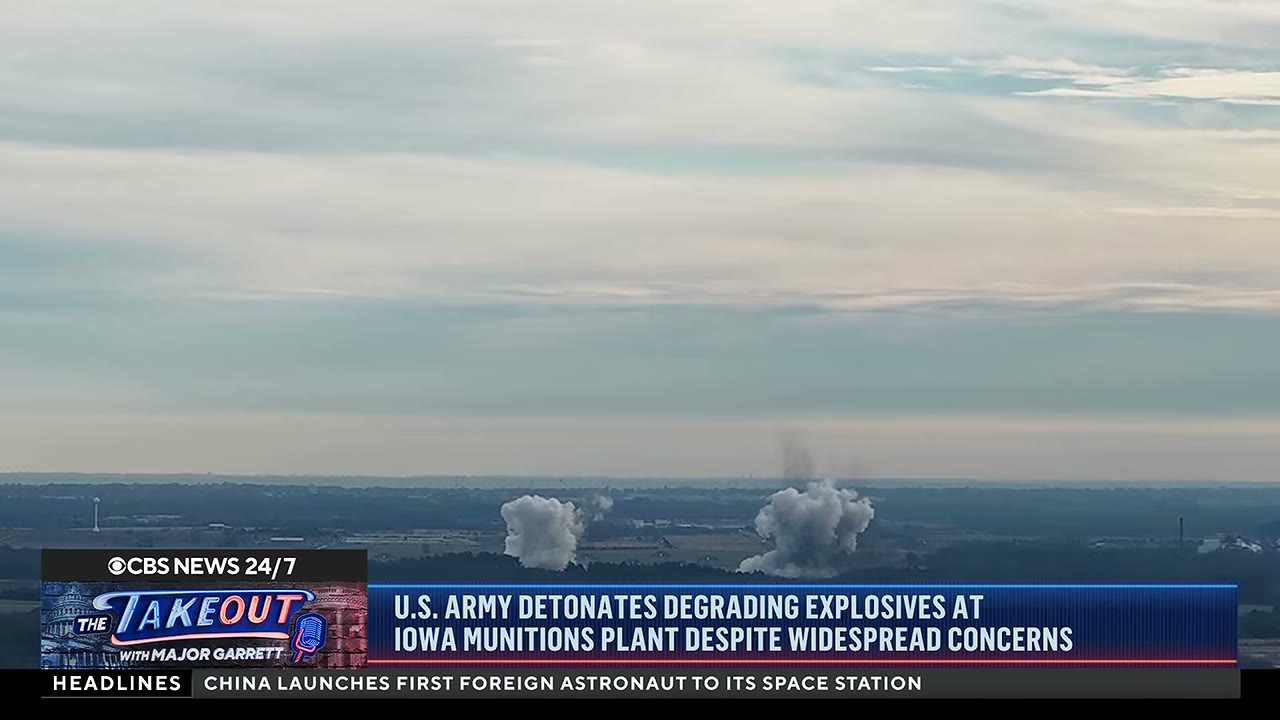
The US Army detonated five tons of degraded lead azide at a plant in Middletown, Iowa, and says monitoring found no lead in the air. The EPA and FEMA are still testing, and officials urge residents to clean surfaces and avoid yards and playgrounds as cleanup looms.
1Army Detonates Five Tons of Lead Azide at Iowa Plant
Five tons of lead azide — a degraded, bomb-making chemical — went up in a controlled blast at a plant in Middletown, Iowa, and the US Army is calling the detonation a success.
The explosion was deliberately set to destroy the stockpile. The EPA said no lead was in the air around the plant, and officials said no toxic dust appeared to spread to nearby homes and farms.
More testing is expected in the coming days.
2Army Used Barriers, Foam and Tarps to Contain the Blast
Officials threw "everything but the kitchen sink" at the Middletown blast, CBS News correspondent Ian Lee said, and that meant barriers, water tanks, a special foam and tarps.
The gear was meant to contain the explosion and stop lead dust from spreading toward nearby homes and farms.
Two plumes rose from the detonation, leaving the question of whether the measures worked. More testing is expected in the coming days.
3Army and EPA Monitors Detect No Lead After Detonation
None of the Army's or the EPA's monitoring stations detected any lead shortly after the Middletown blast — and four hours later, still nothing.
"It does look like they were successful with directing that blast downwards," Ian Lee said. He spoke with the ATF director, who said the goal was to push the lead directly into the ground so it wouldn't spread.
A lot of lead remains in the environment, and the main concern now is cleaning up the area so it doesn't leach into the soil and groundwater. Testing continues to make sure lead didn't spread farther.
4ATF Director Hesitant to Declare Residents Safe
Asked whether residents are in the clear, the ATF director was hesitant to say folks are safe as of now.
FEMA and the EPA are still looking into the situation. Even with 0.0 lead detected, the director urged caution for people going back home: wipe down surfaces, wash things, and be careful around yards and playgrounds for the time being.
Officials want a better sense of whether any lead actually spread before giving the all-clear.
5Army Faces Ticking Clock to Remove Lead From Soil
The Army says it will handle the cleanup, whether on the base or anywhere else — and it is working against a ticking clock.
The lead must be taken out of the soil before it leaches down into the ground. Wind and rain are among the weather conditions officials have to monitor.
What comes next is keeping tabs on soil, water and air.
6Thousands of Soil, Water and Air Samples Compared to Baseline
Thousands of samples taken across the area will be monitored against a baseline, Ian Lee said.
He spoke with a farmer who takes soil samples all the time for normal business; those will be tested against their baseline as well.
Lee also asked how officials would ensure something like this didn't happen again.
7Army to Inspect Other Explosives Nationwide After Blast
The Army will look for any more lead azide around the country and inspect all other explosives nationwide, Ian Lee was told, to make sure something like this doesn't happen in someone else's backyard.
Officials described the controlled explosion as the best of the worst options.
The review follows the destruction of five tons of lead azide at the Middletown, Iowa, plant.