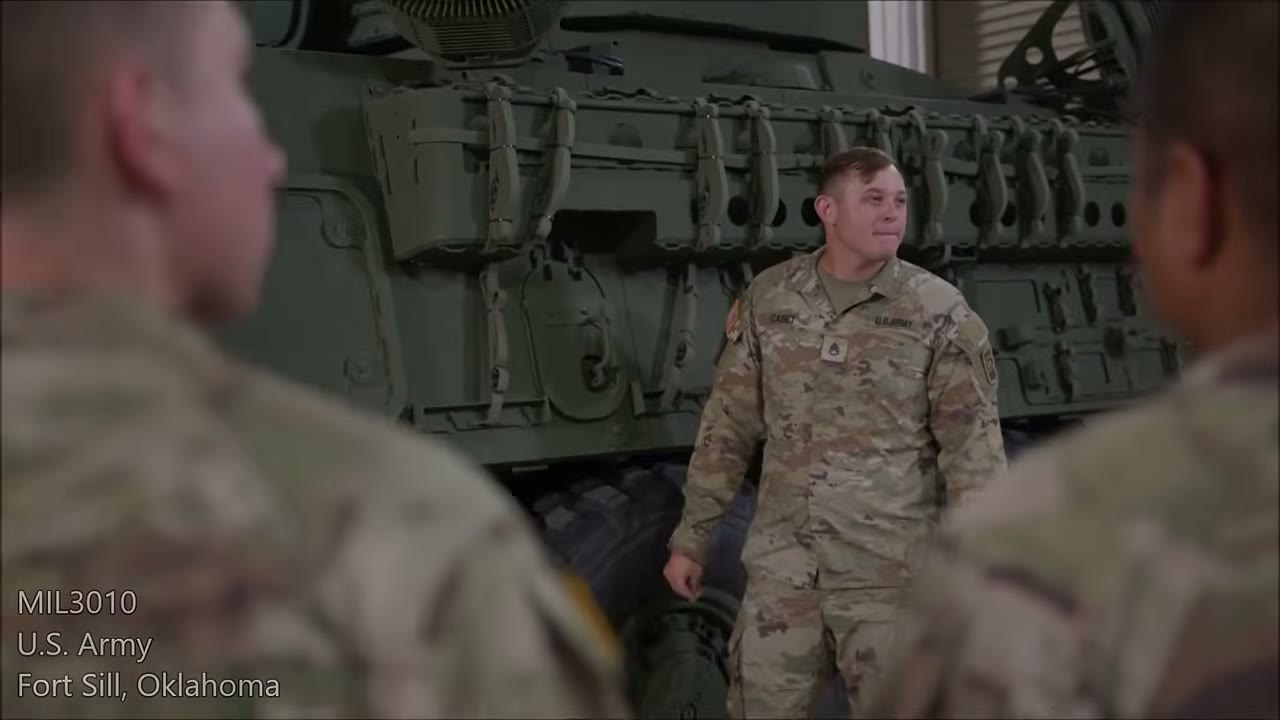
A MIL3010 report from Fort Sill, Oklahoma, shows soldiers training on the M2 Rattler vehicle, its radios and machine guns, and the Stinger missile system, including a live-fire exercise. Troops practice operator maintenance, radio procedures and turret operations.
1Soldiers learn M2 Rattler vehicle, its armor and coaxial machine gun
The M2 Rattler carries paint on its front that can warn soldiers about lethal chemical agents. That detail came up as troops learned the vehicle’s features, including a coaxial machine gun.
The interior also has a system called RIWP. The instructor said the M240 Charlie, or M240, is a coaxial machine gun chambered in 7.62 by 5.1.
Soldiers were asked why military vehicle paint feels different, then walked through what the front paint and interior system are for.
2Inside the M2 Rattler: cameras, laser rangefinder and commander displays
A vehicle commander in the M2 Rattler can see everything the gunner is looking at, including every input the gunner presses. The view comes through camera displays inside the vehicle.
“They’re actually pretty insane,” an instructor said of the cameras. The crew also has a laser rangefinder for tracking targets.
In a three-man crew, the gunner, vehicle commander and driver are all up holding the pause, according to the instructor. In a four-man setup, crew members can see each other on the display and do tactical planning through it.
The instructor compared the setup to a video game, with a controller used in the same way.
3Crew checks engine, cooling loop and height management system on Rattler
The M2 Rattler has what an instructor called probably the shortest dipstick you’ve ever seen in your life. It sits hidden down low on the vehicle.
Soldiers checked the engine area, including the cooling loop and a gauge. They also went over the height management system, which controls the vehicle’s height; it was in transport mode at the time.
The crew reviewed startup procedures, which are printed on a piece of paper, and the center display gauges, including fuel level. The instructor stressed using three points of contact when getting on and off.
4Soldiers train on radio retransmission, self-test and channel setup
A radio’s middle function lets 25-series troops set up a retransmission station that increases the range they can cover, an instructor said.
Soldiers also learned the function test, which runs a self-test and tells you if something is wrong and needs maintenance. The standby function is for when you plan to turn the radio off for just a little bit.
During the drill, troops held the frequency button, kept speaker boxes off to avoid noise, and set volume to one to prevent feedback. They practiced changing channels through the menu and making radio checks with an instructor station.
5Trainee runs radio function test and frequency entry drill
A soldier ran a radio function test and watched the screen tell whether it passed or did not pass. The drill then moved to frequency entry.
The instructor said the fourth spot in the frequency can be a four, a five, a two or a zero, and told the trainee to try pressing two five because the radio operates in 25 hertz.
The trainee picked up the handset, put it back, and worked through the function test and frequency menu steps as part of the standard.
6Operator maintenance on M3P machine gun with safety warnings
Removing the back plate on an M3P machine gun can cause injury or death if you stand behind the weapon, a safety warning states. The warning says to prevent personal injury, do not stand behind the machine gun when removing the back plate.
Soldiers performed operator maintenance on the M3P in sequence and without error. An instructor asked one soldier what phrase the crew says when clearing the back blast area.
The soldier was told he had two hours to get the task done. The drill also covered a smooth transition of ammo through the feed chute.
7Soldiers identify feed chute, infrared receiver and mating bolts
A flexible feed chute leads ammo into the weapon, and soldiers traced what comes next. They identified the forward looking infrared receiver, with an instructor prompting: “Think of baseball.”
The drill also covered mating bolts and a warning: if you attempt to start your PPU while any switches are not in their neutral position, the PPU will not start.
Soldiers were told to check argon bottles operating on the pressure and to let maintenance know if they see more than one issue. They also covered using an Allen tool to move something physically.
8Stinger missile training covers 28-foot length and seeker lock-on
A Stinger missile is 28 feet long, and an instructor showed what it would look like coming out of the pod at that distance. The missile spins as it flies.
Once it locks onto something, it stays locked. The seeker head and navigational tracker work together: the seeker looks up the target, calculates how long it will take to get there, and sends the calculation to the tracker. “So, we’re not a chaser,” the instructor said.
Soldiers also learned the un-cage button, which opens the divider so the seeker head can freely move, plus the cruise button and the IFF antenna and button.
9Live-fire exercise with missile launch and hit confirmation
A crew was cleared to fire and told they may shoot at will in the area where they started. The order came during a live-fire exercise.
After the launch, a call of “Good flash” was heard, followed by “Hit your dummy again.” A soldier was then asked why he activated his missile.
The exercise included confirmation of a hit on a dummy target.
10Soldiers briefed on missile pod safety and turret movement
Soldiers training on a missile turret are given one blunt warning: keep your fingers out of the missile pod. "Don't put your fingers inside the missile pod, all right? Have a bad day," an instructor tells the crew during a briefing at Fort Sill, Oklahoma.
The briefing walks through the firing sequence. Before pressing and holding the bottom button, the operator must know the turret will turn. The first step is to shout "All clear" — and the trainee does, twice.
The instructor then has the operator hold the button and look away while the turret moves all the way down. Crews also check elevation and watch coordinates change on screen.
Next comes the controls: a right trigger, a gun trigger and a phone grip used to move the turret.
11Turret operators practice missile button, intercom and camera controls
Trainees at Fort Sill, Oklahoma, get hands-on with a turret's missile button, intercom and cameras — and the first lesson is simple: press and hold the button and don't let go. An instructor walks an operator through the grip controls.
The turret is "still in a bit fast," so the trainee is told to unfreeze the bird with F9 and switch it to run before handing the camera back for the next person.
The middle switch is held down to enter commands. The intercom setting won't produce a tone because there are no headset speakers, the instructor says. The listen mode feeds into the brass and link collector, which isn't there yet but will be later.