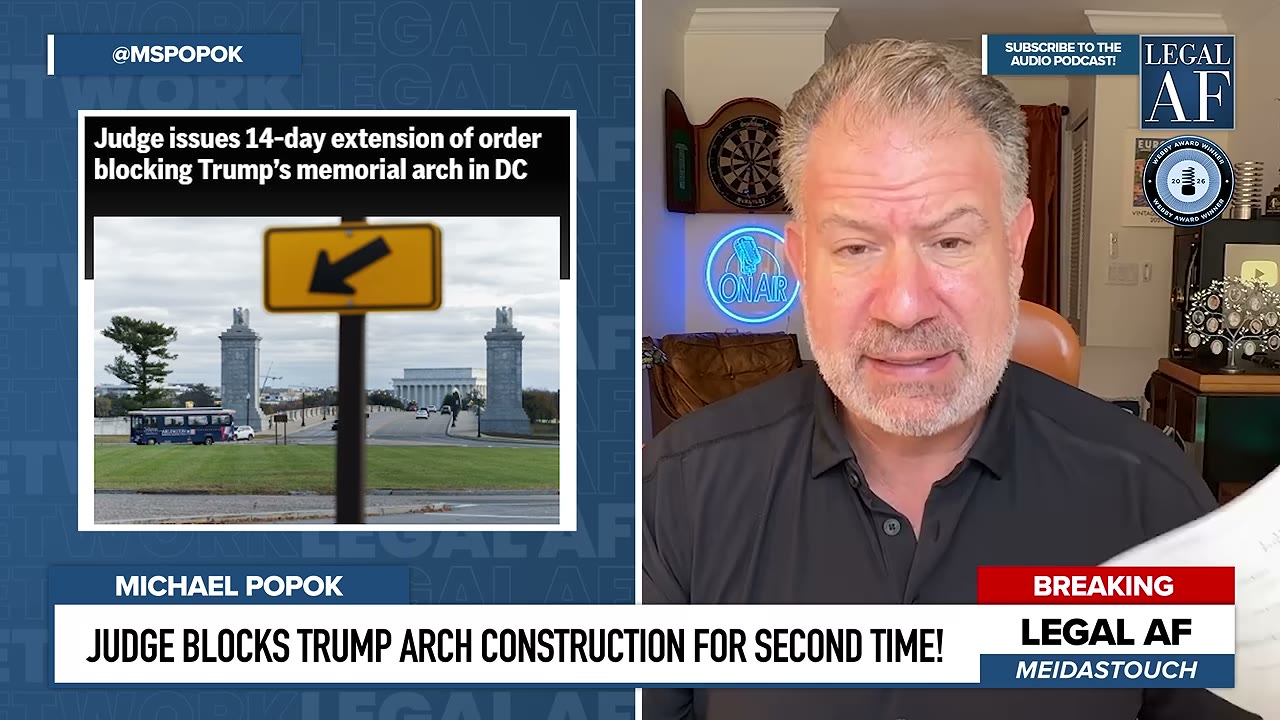
Judge Tanya Chutkan extended her temporary injunction for 14 days, blocking construction of Trump's proposed 250-foot arch at Memorial Circle. Virginia and Washington, D.C. joined veterans and a historian in suing, arguing Congress never approved the project. Trump's claim of 1925 approval was rejected.
1Judge Chutkan Extends Injunction Against Trump's 250-Foot Memorial Arch
A federal judge has extended her temporary injunction for another 14 days to keep a 250-foot arch from rising on Memorial Circle. Judge Tanya Chutkan issued the extension to buy time to review the paperwork for a preliminary injunction against construction, at least for the duration of the case.
The temporary order is meant to hold until a preliminary injunction can take its place, and Chutkan made clear she wants no gap between the two. She does not trust that the arch would stay unbuilt if her order lapsed, according to the account of her reasoning.
The veterans who filed the lawsuit, along with the District of Columbia and the Commonwealth of Virginia, want no loophole that would let construction start. A 250-foot arch takes time to build, but the plaintiffs are giving it no chance to begin.
2Trump Admits Midterm Loss Abroad as Court Cases Continue
Donald Trump admitted he lost the midterm elections to the Democrats, and he called the defeat devastating. The admission came while he was overseas, sent to China to meet with Putin and the Chinese president.
According to the account, the remark surfaced when Trump was tired and spoke plainly. "They won," he said in a clip played during the discussion. "Politics is a dirty game, and they won."
The admission is expected to carry into the courtroom. In this telling, every time Trump concedes he lost badly, it gives federal judges more confidence in cases against his administration, because it signals he is starting to give up.
3Judge Chutkan's Initial Injunction and the Arlington Shadow Argument
Judge Chutkan's first order against the 250-foot arch read as if she wrote it while standing at the Lincoln Memorial looking west, explaining why the arch could not cast a shadow over Arlington National Cemetery. That is how the ruling was described.
The initial temporary restraining order came about a week before the extension. Virginia Attorney General Jay Jones spoke about the case and updated the public on developments.
The Kennedy family also filed a lawsuit over the Eternal Flame at Arlington, which honors the late President John F. Kennedy, and the judge accepted it. With the District of Columbia and Virginia now joined as parties, she gave herself more time, hence the 14 days. The Trump administration has not appealed the temporary order to the federal appeals court in the District of Columbia.
4Trump's Defeat Admission Clip and Chutkan's Ruling Details
Three Vietnam War veterans and an architectural historian sued on February 19, 2026, to challenge a 250-foot triumphal arch on Memorial Circle. The District of Columbia and Virginia filed separate suits that were consolidated.
On November 5, 2026, the Interior Department made a final decision approving the arch. That same evening, the court granted Virginia's motion for a temporary restraining order, barring construction, excavation, demolition, road closures and other work on or near Memorial Circle for 14 days. Its expiration date is the 19th.
In a clip, Trump conceded: "They won. Politics is a dirty game, and they won." The parties proposed a schedule for arguing the next step, a preliminary injunction, through November 18.
5Judge Rejects Trump's 1925 Congressional Approval Claim
Trump's lawyers argued the arch was approved back in 1925. The judge's response, as described: excuse me, what?
What they produced was 1925 congressional approval for the Memorial Bridge and the creation of the park, plus a pair of 160-foot columns that were supposed to be built but never appeared. The columns spanned nothing and were not a massive arch, so she did not accept it as approval for this project.
Trump now calls the arch an ammunition depot the Department of Defense will use to defend Washington, including with drones. On page four, the judge found good cause for a short extension, noting you can't build something without congressional approval that blocks the view of the monuments and Arlington National Cemetery. She extended the order 14 days and will hold a hearing on the preliminary injunction.
6Appeal Prospects and New Congress Plan to Cut Arch Funding
By January 3, when the 120th Congress begins, the fight could shift from the courthouse to the purse. The new Congress is expected to cut off funding for the arch.
Oversight committees responsible for federal parks plan hearings, with everyone who took part in the executive branch decision-making summoned. Subpoenas, public hearings and funding cuts are all in the mix, according to the account.
If Trump loses the preliminary injunction, he would have to appeal to the U.S. Court of Appeals for the District of Columbia, where a three-judge panel would hear the case. The account expects the case to eventually reach the Supreme Court. New Congress members could also file friend-of-the-court briefs or their own lawsuits, arguing Congress never approved the arch.
7Virginia Attorney General Jay Jones on Arlington as Sacred Ground
Arlington National Cemetery sits in Virginia, and the state's attorney general calls it a sacred place. "This is the place where people who gave their lives for this country rest," Jay Jones said.
Jones described the view from the Lincoln Memorial's steps looking east, past the reflecting pool and the World War II Memorial to the Washington Monument and the Capitol. Facing west, the memorial looks across the Potomac to the Arlington Memorial Bridge and Memorial Circle, the roundabout where the bridge ends.
Construction of Memorial Circle began in 1940, and the land inside stayed an undeveloped green space, giving an unobstructed view of Arlington Cemetery for over 85 years. Last October, Trump announced plans to build a 250-foot arch there.