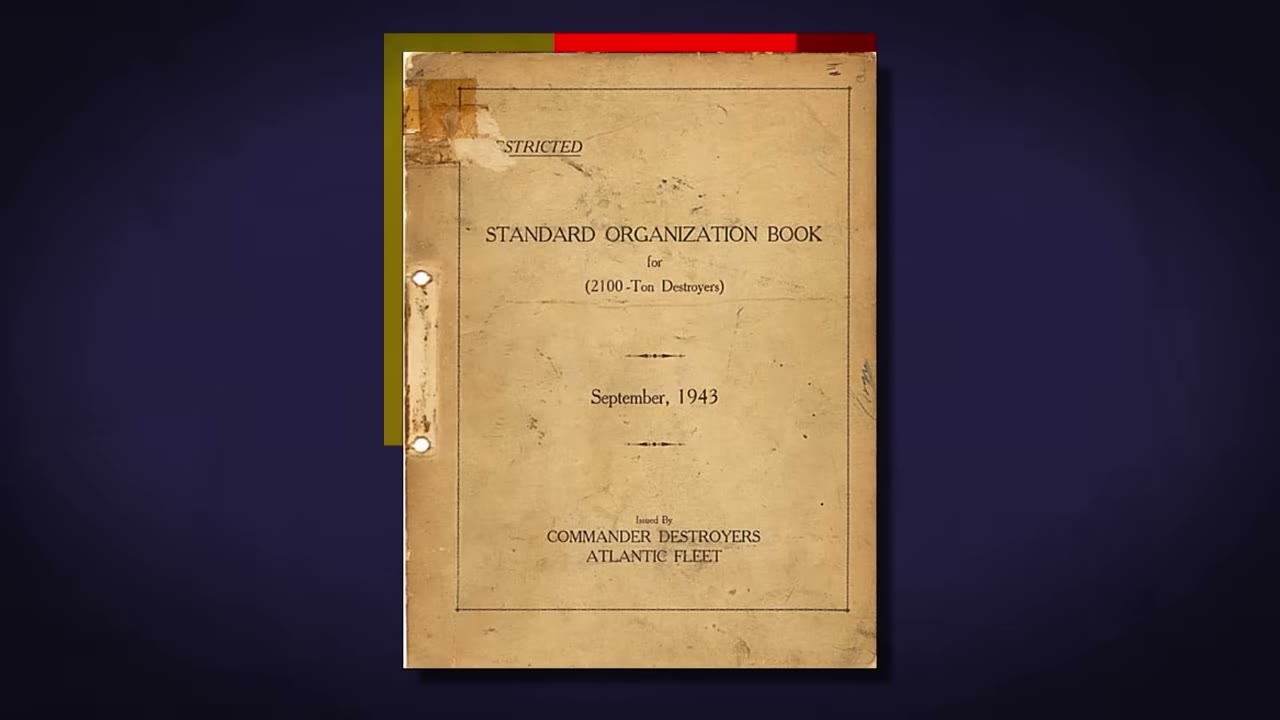
A 1943 Standard Organization Book shows that US Navy destroyers formed rifle squads from their crews. The video traces how Bluejacket landing parties evolved from small destroyer platoons into Marine-style squads armed with M1 Garands and BARs.
11943 Destroyer Manual Reveals Navy Rifle Squads
A 1943 Atlantic Fleet manual for 2,100-ton destroyers lists something you might not expect aboard a warship: Navy rifle squads. Sailors, not just Marines, were organized to fight as infantry.
Until the 1970s, using a ship's crew as infantrymen was a valued skill in the US Navy. Early in the 20th century, so-called Bluejackets carried out large-scale amphibious assaults at brigade strength, and landing party manuals from after World War II still provided for sailor battalions pulled from various ships in a formation.
By the end, those missions were generally limited, according to the account — due to a lack of organic firepower, poor sustainment and their ad hoc nature.
2Fletcher-Class Destroyer Landing Force Had Two Rifle Squads
A World War II Fletcher-class destroyer's entire Landing Force was essentially a very small platoon, led by the ship's First Lieutenant — who was also the Damage Control Officer and head of the 1st Division.
The force had two rifle squads. One was formed from men of the 1st and 2nd Divisions, the deck and hull divisions; the other came from the Engineering Division.
Number 1 Squad had a Squad Leader, a Second-in-Command, 3 Scouts, 2 Automatic Riflemen and 3 Riflemen. The Squad Leader was a Petty Officer — a Boatswain's Mate 2nd class — and his 2IC was a non-rated Seaman 1st Class, with the rest any grade of Seamen.
Most carried rifles, most likely M1903 Springfields, while the Automatic Riflemen had Thompson submachine guns. The 2nd Squad was identical but led by a Gunner's Mate 1st Class from the Ordnance Division, made up of Firemen from Engineering.
31950s Navy Landing Parties Adopted Marine-Style Squads
By 1950-1960, Navy Landing Parties looked much more like their Marine cousins: squads led by Carbine-armed Petty Officers Third Class, built from 3 fire teams of 4 men each.
Each team was led by a Seaman 1st Class, the highest of the non-rates, while the rest were Seamen 1st or 2nd class. Like a Marine squad, most were armed with M1 Garands, while an Automatic Rifleman manned an M1918A2 BAR.
Earlier, the Fletcher-class had two lifeboats that could be used for landing forces, each with an additional Chief Petty Officer or Petty Officer first class acting as Boat Officer.
At this time, destroyers, destroyer leaders and destroyer escorts were intended to provide up
4Ship Types Tasked to Provide Squads, Platoons and Companies
The ship-to-squad math was stark: destroyers were intended to provide one rifle squad, amphibious assault ships a rifle platoon, and battleships, carriers and cruisers a rifle company.
Division flagships were to add a battalion headquarters company to lead their division's companies. A battleship division generally had four battleships, which by itself could provide a full battalion. Destroyer squadrons would provide two platoon and one company headquarters — with eight ships in a squadron of the time, that force could notionally land a company.
Petty Officers Third Class led squads; lieutenants junior grade or ensigns led platoons; lieutenants commanded companies, with a Company Chief Petty Officer as First Sergeant. Battalions were led by commanders and regiments by captains — though the manuals state regiments were envisaged only for parade purposes.
5Battalion Firepower Limited to M1919 Machine Guns and Naval Gunfire
The heaviest weapon in a Navy landing battalion was the M1919A4 .30 caliber machine gun, housed in a company machine gun platoon.
Battalions had no artillery, no mortars and no tanks. Fire support was limited to naval gunfire support and aviation.
That shortfall lines up with the earlier account of why sailor landing forces were generally limited by the end: a lack of organic firepower, poor sustainment and their ad hoc nature.