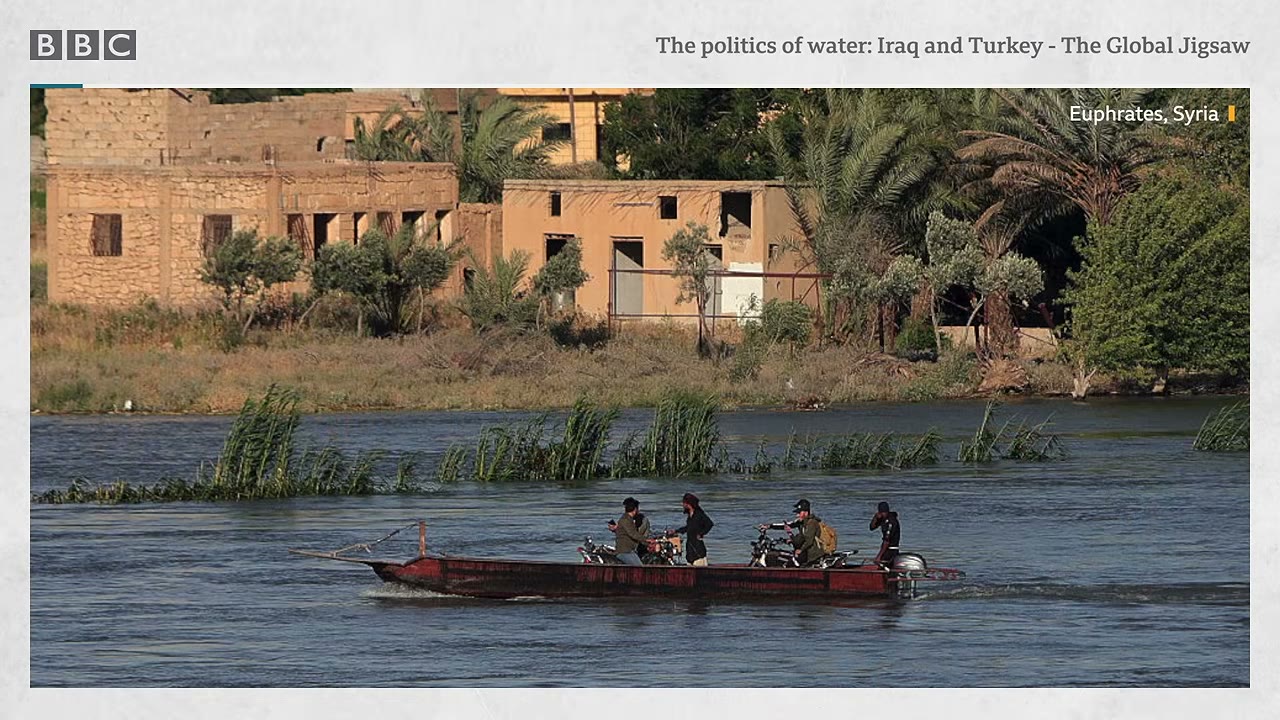
The Tigris and Euphrates are drying up, and Iraq blames upstream Turkey for taking its water. The BBC Global Jigsaw podcast examines drought, dams, displacement and the 2025 oil-for-water deal between Baghdad and Ankara.
1Tigris and Euphrates run dry as climate change and dams hit Iraq
Two rivers that fed some of history's great empires are running dry. The Tigris and Euphrates rise in Turkey's Taurus mountains and flow through Syria and Iraq, but a toxic mix of climate change, outdated irrigation and regional power dynamics is pushing them to the brink.
Iraq's core problem is geography: it sits downstream. "The upstream neighbours can turn the tap off," the transcript notes. Turkey is seen as the most significant actor on water flow into Iraq, and many Iraqis believe Turkey, Syria and Iran are essentially stealing Iraq's water.
Turkey keeps building dams and has rejected any legal framework imposing a fixed downstream quota. Iraq has pushed into negotiations with Turkey that stretch beyond rivers to security cooperation, trade routes and energy.
2Map traces the Tigris and Euphrates from Turkey to the Gulf
The Euphrates and Tigris both start in Turkey, but they take different routes to the same end. The Euphrates winds through Syria before entering Iraq; the Tigris comes directly from Turkey.
BBC Monitoring's Iraq expert Mohammed al-Jumaily traces them on the map. They flow together until closer to southern Iraq, where they join and form the Shatt al-Arab, which runs into the sea.
The rivers shaped Mesopotamia, the cradle of civilisation. "Mesopotamia means the land between the rivers," and these waters helped shape some of the earliest cities, irrigation systems, writing, agriculture and state structures in human history.
3Rivers central to Iraq's identity from Mesopotamia to Ashura
The two rivers are the backbone of Iraq's water system, supplying drinking water, irrigation, fisheries, livestock and some hydropower. They also carry deep religious weight.
Ashura, a significant day for Shia Muslims, marks the martyrdom of the Prophet's grandson. Part of that story centres on the Euphrates, called Al-Furat in Arabic. Imam Hussain and his companions were denied water from the river on that day and for the three days before, so that when they were massacred, they were massacred thirsty, denied water.
The rivers have witnessed some of the most crucial and heart-wrenching episodes in Iraqi history.
4Speicher massacre on the Tigris banks scars Iraq's memory
The Tigris carries not only ancient legends but recent scars. In 2014, around 1,700 Shia cadets were rounded up and massacred by IS, shot on the banks of the Tigris River.
The Speicher massacre is one of the darkest chapters tied to the waterway. While the rivers are central to Iraq's story, they are just as important for Turkey.
Dilay Yalcin, part of the Istanbul team, explains their significance there.
5Turkey's Euphrates, the Firat, is a source of life and literature
In Turkey, the Euphrates is called the Firat, and it is one of the most important water resources for all the ethnicities living in the area for thousands of years. It is so woven into life that many Turks carry its name.
"I think I have 20 friends named Firat after the river," Dilay Yalcin says.
The river appears constantly in literature, especially Kurdish literature, as a source of life. The rivers were the source of civilisation.
6Iraq's Mesopotamian marshes, a UNESCO site, face existential threat
The Mesopotamian marshes formed by the Tigris and Euphrates have been described as the historic location of the biblical Garden of Eden. They are a UNESCO World Heritage site and one of the world's largest inland delta systems, with the Hawizeh Marshes the biggest part.
Under Saddam, large parts were drained in the 80s and 90s to punish and control the Marsh Arabs, alongside brutal repression. After Saddam, the marshes became habitable again and many Marsh Arabs returned.
Today they face an existential threat. By the end of 2025, Iraq's water reserves had fallen to roughly 4 billion cubic metres.
7Iraq's water reserves fall to under five percent of capacity
Iraq's water reserves had fallen to roughly 4 billion cubic metres by the end of 2025. Its full capacity is about 100 billion cubic metres, so that is not even five percent.
Agriculture is the biggest user of Iraq's water, and it has been badly affected. Iraq introduced restrictions on water-intensive crops and even banned some types of wheat because of how much water it uses.
The result has been a massive economic impact, with Iraq relying heavily on imports.
8Nearly 200,000 displaced as herders and fishermen lose livelihoods
Nearly 200,000 people have been displaced by climate-related factors, with water chief among them. The marshes show the most drastic difference.
Buffalo herders lost their livelihood, and many fisheries dried up, so many fishermen in those areas lost theirs too.
All of this is compounded by the degradation of other agricultural sectors, because of the droughts and the deterioration of water supply.
9Water scarcity drives rural migration and urban tensions in Baghdad
Baghdad's population alone has grown by nearly two million in the last 10 years, as people move from rural areas hit by drought. That puts stress on urban housing and jobs, where unemployment is already high.
There are major concerns over services and electricity. Some people blame rural communities for coming in and adding pressure on scarce jobs.
"If more and more people become displaced, we could possibly see tensions exploding," the transcript says. Protests over lack of water and electricity are common in summertime, especially since 2020.
10Polluted water triggered mass illness and protests in Basra in 2018
In 2018, polluted water infiltrated Basra's water system, triggering significant cases of mass illness. The situation became a public health and service crisis that led to large protests in the city.
Dropping water levels deteriorate water quality, creating the perfect conditions for harmful bacteria to flourish. That is exactly what triggered the crisis in Basra.
For people in Iraq, the drought is not just about dwindling water supplies.
11Iraqis mourn loss of fertile 'black earth' heritage
Iraq is traditionally known as fertile ground. One of its names is Ard al-Sawad, the black earth, black because of the fertility of the soil, because of the rivers.
When people see pictures of droughts, parts of the rivers and tributaries, farmland and marshes, it hits quite hard for a lot of Iraqis.
The drought represents the loss of a fundamental part of their heritage and way of life.
12Turkey faces its own water stress and desertification risk
Turkey faces its own water stress. Planned water cuts hit Ankara, the capital, last year especially.
Massive drought problems have put 80% of the country's agriculture at risk, according to the transcript. Almost the whole country is at risk of desertification according to the UN, and it might even become water-poor by 2030.
Climate change and heavy use of underground water resources are among the main reasons, something experts are criticising.
13Iraq's outdated infrastructure wastes 60-70% of its water
Iraq's water infrastructure is very out of date and badly adapted to climate extremes. It struggles with flash floods and cannot effectively store water in rainy periods. It was built for a climate that doesn't actually exist anymore.
Iraq now faces hotter summers, more evaporation, sudden storms, long droughts and more upstream flow manipulation.
Irrigation is extremely inefficient too. Much of Iraq's agriculture still depends on flood irrigation and leaky canals, and these processes are estimated to waste 60-70% of the water used.
14Iraqi media blames Turkey and neighbours for stealing water
Iraqi media largely blames Turkey, Syria and Iran for stealing Iraq's water — not the country's own waste. There is a common perception in Iraq that mostly Turkey, but also Syria and Iran, are essentially taking Iraq's water, while poor infrastructure, poor management and wasteful farming get far less attention.
Some climate and environmental activists in Iraq have criticised the government's shortcomings, but much of the focus stays on how Iraq manages relations with Turkey over water supply.
Baghdad has announced rainwater harvesting dam projects and a seawater desalination plant for Basra. Officials say they have cut agricultural water use significantly by planting wheat varieties that tolerate drought.
15Turkey deepens influence in Iraq through $17 billion trade and rail deal
Turkey and Iraq have a $17 billion trade volume — and a new deal to build a rail and highway route from Iraq's southern port of Faw to the Turkish border. The project, called the Development Project, aims to turn Iraq into a major transit route between the Gulf and Europe.
In recent years Turkey has sought to boost its influence in Iraq through political, security and economic ties. The two countries have very close diplomatic ties.
Relations between Turkey and Iraq also run into the Kurdish angle, which adds another layer of complexity.
16Turkey's 40-year fight with Kurdish militants based in northern Iraq
Turkey has been fighting Kurdish militants for over 40 years across Turkey, Iraq, Iran and Syria — and those militants are largely headquartered in northern Iraq. The central Iraqi government has largely allowed and tolerated Turkey's military operations against the group.
A very recent deal between Iraq and Turkey has established a joint security and training coordination centre as part of Ankara's fight against these Kurdish militant groups.
The Kurdish angle adds another layer of complexity to relations between the two countries.
17Turkey's dams cut Euphrates flow and sparked 1990s war threats
Iraq threatened to bomb a dam in the 1990s — and Turkey mobilised its military and threatened to cut off water flow to Syria and Iraq permanently. The clash followed Turkey's push to build dams in its southeast from the 1970s, aimed at economically transforming a predominantly Kurdish-populated region.
Construction of the Ataturk Dam on the Euphrates cut water flow to Iraq and Syria for a month at a time, causing a huge crisis between the countries.
Even the strongest diplomatic ties can become part of an increasingly complex geopolitical equation.
18Ataturk Dam reduced Euphrates flow by a third, experts say
The Ataturk Dam and its irrigation projects have cut the flow of the Euphrates by roughly a third, according to experts. That creates a serious problem for Iraq, which is lacking water for drinking, irrigation, crops and animals — and for extracting oil.
Iraqi officials and analysts say the dams do more than limit the amount of water entering Iraq: they change the timing and predictability of flows, making it harder for Iraq to manage its water system and capture water downstream.
Iraq is very unhappy about that.
19Turkey's 800 dams and Ilisu Dam drain Mosul Dam's watershed
Turkey now has more than 800 dams, most built under the Erdogan government. The Ilisu Dam, completed in 2019, drained the majority of the Mosul Dam's watershed.
The Mosul Dam is in Iraq. The planned construction of two other dams in the region will reportedly further curtail the water flow to Iraq.
The Ilisu Dam further compounded the problem with Iraq.
20Turkey rejects binding downstream water quota despite criticism
Turkey has rejected any legal framework that would impose a fixed downstream quota on the Euphrates and Tigris, despite years of criticism for limiting the flow to Iraq. Under international law the two rivers are considered shared waters.
Turkey's dam building spree has left Iraq increasingly dependent on decisions made upstream. In 2014 the two countries signed a memorandum of understanding that was meant to promise Iraq a fair and equitable share of the water — but what that actually meant was left unclear.
21Iraq has little leverage against upstream Turkey
Iraq has very little physical control over its water: Turkey and Iran can control headwaters and tributaries before they even enter the country, and there is no binding basin-wide water-sharing treaty.
Turkey wants access to Iraqi markets, construction contracts and energy routes, and relies a lot on Iraq over the PKK. Iraq has leverage in its oil and the Iraq-Turkey pipeline, which Turkey relies on heavily for oil supply.
But that doesn't outweigh Turkey's leverage as an upstream actor — or Iraq's internal problems, including corruption, fragmented institutions and competition between Baghdad, the Kurdistan region, provinces and rival political blocs.
22Turkey accused of using water talks for its own regional gains
The debate about water is never really only about water. It is also about security cooperation, trade, energy and regional politics — one reason people think Turkey is using the topic against Iraq for its own gains.
Iraq is not alone in making those accusations. Kurds living in Turkey and Syria say they have reasons to feel aggrieved too.
Iraq has struggled to sustain one professional water diplomacy strategy.
23Kurds see Turkey's GAP dams as a tool to control the southeast
Kurdish critics say Turkey's southeastern Anatolia project, known as GAP, was a way to control the southeast through infrastructure instead of police stations and soldiers. The project, started in the 1970s, was largely seen by many Kurds in the region as an attempt to further securitise and pacify Kurdish areas.
Those behind GAP say it has raised the quality of life. Some of its dams are among the largest and tallest in the world; so far it has irrigated more than half a million hectares and generated energy worth more than $30 billion.
But that's not how many Kurds see it.
24Kurds accuse Turkey of cutting water to northern Syria
Kurdish-led forces that controlled northern Syria accused Turkey of cutting off drinking water supply and holding back river water. The accusations topped northern Syria's agenda for years during the conflict, in a region home to hundreds of thousands of people.
People think it was a political move because the SDF, the Syrian Democratic Forces that ruled Rojava in northern Syria, is seen as an extension of the Kurdish militant group the PKK.
Many Kurds say Turkey has not really fulfilled its promises for the region. Baghdad has complained too.
25Ankara says its dams help Iraq and blames climate and poor management
Turkey argues its dams benefit Iraq by allowing a more regulated, more predictable flow on the Tigris. It says it is not the only reason for the crisis, pointing to climate change and what it calls Iraq's poor infrastructure and poor water management.
It also says the rivers originate in Turkey — essentially, that it can do what it wants with them. That runs contrary to international law, which treats the rivers as shared.
Turkish media and officials rarely discuss international law on the issue, and only started talking about it after deals in November 2025.
262025 oil-for-water deal funds Iraqi water projects with oil revenue
A new "oil-for-water" deal lets Turkish firms build water infrastructure in Iraq, paid for with revenue from Iraqi oil sales to Turkey. The barter arrangement covers projects such as water harvesting dams and improved irrigation canals — key for Iraq to capture, store and manage its water supply.
It is the first structured mechanism between the two countries on water after years of mistrust.
The deal is seen as a good stepping stone for further cooperation.
27Deal tilts toward Turkey: crude oil and a PKK crackdown
Turkey walked away from its 2025 water deal with Iraq holding two prizes: crude oil and a harder Iraqi line on Kurdish militants. The agreement was widely seen as tilted in Ankara's favour.
What Turkey gets first is oil, which helps it cut dependence on Russian crude — something Donald Trump has called for. In return, Baghdad has declared the PKK a banned group. The militants are headquartered in northern Iraq.
The deal has already shifted Iraq's tone. After it, Iraq commended the increase in water releases for the first time, in May 2026.
28Scepticism remains as deal sets no fixed river flows
The deal guarantees no fixed river flows from Turkey — and critics say it is no replacement for a binding water-sharing agreement.
Some argue it lets Turkey deepen its influence in Iraq, especially commercially. Questions remain over how much Iraq actually gains.
The general view is that it is a good first step toward a water-sharing mechanism, but attention keeps returning to what it does not address: the flow of water into the two rivers. There are concerns it may diminish Iraqi sovereignty and control over its own infrastructure.
29Heavy rains lift Iraq's water reserves from 4 to 20 billion cubic metres
Iraq's water reserves jumped from 4 billion to 20 billion cubic metres after heavy rain in April — the most significant recovery in many years, following drought described as the worst in nearly a century.
The Mosul Dam recovered strongly, and lakes including Therthar and Al-Habbaniyah, plus the southern marshes, refilled.
It is still only 20% of Iraq's 100 billion cubic metre storage capacity. The rains were a reprieve, not a solution.
30Erdogan warns future wars will be over water, not oil
Recep Tayyip Erdogan has repeatedly said future wars will be over water, not oil — a warning that lands hard for Iraq, which sits downriver and underprepared.
Turkey appears to be solving its own problems as fast as it can, without much regard for whether its neighbours get enough water, according to the assessment in the reporting.
Global temperatures are expected to rise in the coming years. Without major reforms, Iraq's water crisis is only set to deepen as droughts grow more frequent and pressure builds on the two rivers.