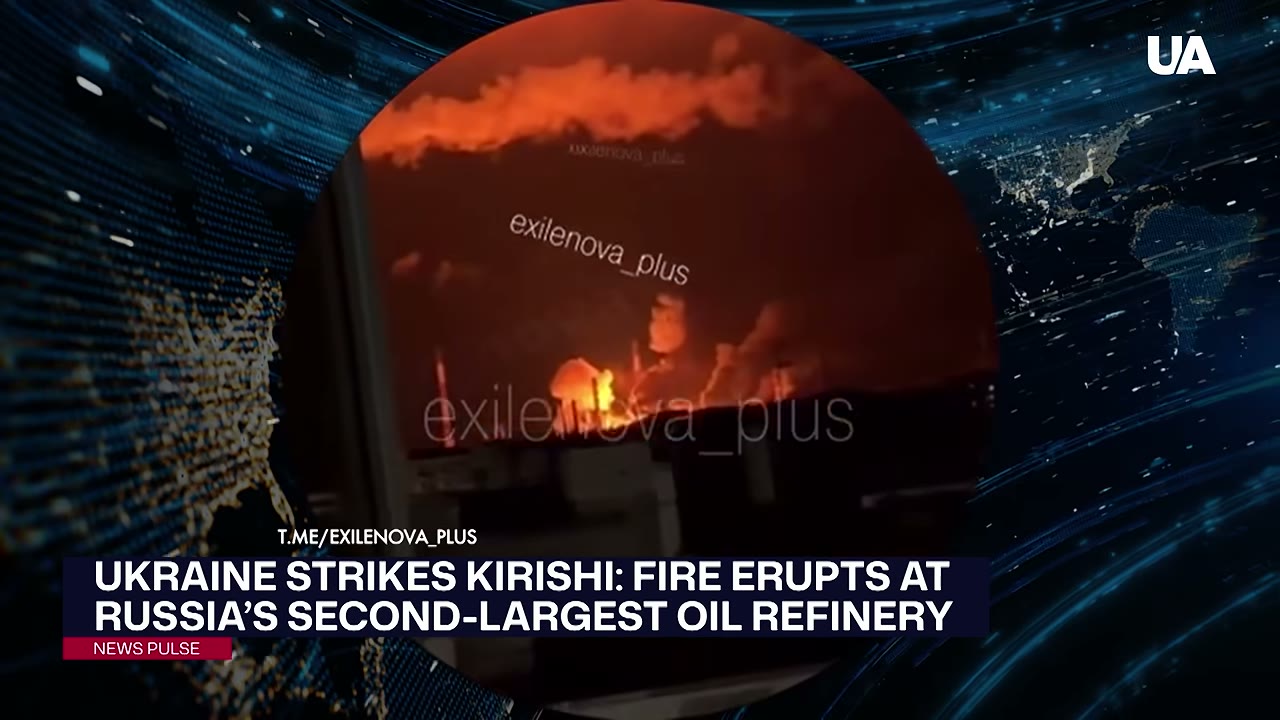
Ukrainian drones hit the Kirishi refinery in Russia's Leningrad Region, a plant with 21 million tons annual capacity. The video also covers a new GPS-free Ukrainian drone platform, Coalition 2026 drills in Poland, Neptune missile strategy, and Russia's Rassvet satellite system used for military communications over Ukraine.
1Ukrainian drones strike Kirishi refinery in Russia's Leningrad Region
Ukrainian drones hit the Russian city of Kirishi overnight, sparking a fire at an oil plant that can process about 21 million tons of crude a year. Initial reports confirmed damage to several primary oil processing units.
Leningrad Region Governor Drozdenko said 113 UAVs were shot down. Monitoring channels and OSINT analysts confirmed the fire at the facility, which belongs to the Surgutneftegaz group.
The plant supplies petroleum products across Russia's Northwestern Federal District and provides aviation kerosene to Pulkovo Airport. It has been targeted repeatedly before, and Western partners have already sanctioned it.
2Ukrainian company Sign Engineering unveils Parsika drone control platform
A single station can now coordinate up to five drones at once — without GPS. The Parsika platform, built by Ukrainian company Sign Engineering, automates routes and lets an operator watch and step in when needed.
Instead of satellite navigation, it uses communication modules that fix drone positions from radio signals, making it harder for Russian electronic warfare to jam.
Parsika is already used in military operations, including logistics. Ukraine's defense platform Brave1 says the unit using it doubled the volume of cargo transported in just one month.
3Coalition 2026 military exercises begin in Poland with 2,800 troops
Military exercises called Coalition 2026 have begun in Poland, with 2,800 personnel from 11 countries training to guarantee a lasting peace once the war ends. France and Britain are leading the drills.
The exercises simulate large-scale troop deployments and logistical support on allied territory.
The initiative, promoted by Warsaw, already brings together about 35 countries, including major powers Germany and Spain.
4Germany's Merz invites Zelenskyy to Berlin summit on November 19
German Chancellor Friedrich Merz has invited Volodymyr Zelenskyy to a key summit in Berlin on November 19, shifting military preparations into the political arena.
The meeting is set as the Ukrainian Armed Forces have radically changed their approach on the battlefield, though the details of that shift were not spelled out.
The Berlin summit puts diplomacy on the calendar weeks after coalition drills began in Poland.
5Ukraine expands Neptune missile strikes on Russian weapons factories
Ukraine's Neptune missiles are no longer aimed only at ships. Ukrainian Navy spokesman Dmytro Pletenchuk confirmed the home-made missiles now strike weapons factories inside Russia and enemy defense facilities on the occupied Crimean peninsula.
"It is better to destroy the archer than to try to stop every arrow," he said, describing the aim of blocking Russia's production capacity at the source.
Pletenchuk noted Western sanctions are holding back Moscow's efforts to replace destroyed air defense and electronic warfare systems, thanks to Russia's dependence on imported electronic components.
6Polish defense minister to meet Hegseth at Pentagon on US troop presence
Polish Defense Minister Wladyslaw Kosiniak-Kamysz will meet US Defense Secretary Pete Hegseth at the Pentagon on November 10, with the permanent presence of American troops in Poland on the agenda.
Warsaw has previously proposed a new permanent US military base on Polish territory, which Polish President Karol Nawrocki called "Fort Trump."
The talks will also cover Polish-American military cooperation, according to Polsat News.
7Blinken says Ukraine security guarantees key to talks; Abu Dhabi meetings set
US Secretary of State Anthony Blinken said security guarantees for Ukraine are one of the key issues in negotiations aimed at ending Russia's war, and voiced hope for progress at a meeting in Abu Dhabi.
He confirmed that US-mediated Ukrainian-Russian talks will take place on November 10 and 11.
The talks come as European officials push a different sequencing for any deal.
8Trump hints Ukraine's borders may change and plans China trip with Putin
President Donald Trump hinted Ukraine's borders could change, saying: "Ukraine will have a slightly different shape." He also said the war will end only thanks to him personally.
Trump said Washington continues to supply weapons to Ukraine, but now Europe is paying for them. He announced a planned trip to China, where he may meet Vladimir Putin and Xi Jinping to discuss nuclear disarmament and military operations in Iran.
On security guarantees, he said: "These are just initial thoughts, nothing is final yet."
9Europe insists on ceasefire before discussing Russia's security demands
European countries want Russia to end its war against Ukraine before discussing Moscow's demands for a new security architecture on the continent, Bloomberg reports — a position that could deepen disagreements with the United States, which proposes resolving the issues in parallel.
According to the publication's sources, European officials consider Putin's pre-war demands unacceptable, as they would effectively mean winding down NATO's presence in Eastern Europe.
They insist on a ceasefire first, with any post-war arrangements agreed by all European countries.
10Ukrainian intelligence finds new Russian Geran drone is a small cruise missile
Russia's new Geran drone is actually a small cruise missile, Ukraine's Defense Intelligence Agency concluded after studying a captured sample. It packs a turbojet engine and almost 100 foreign components.
The engine was assembled in Alabuz, Russia, using Chinese and other electronic components — most of them made by American companies, the agency said. The findings were published on the portal "War and Sanctions."
Intelligence officials say Russia keeps trying to hide component markings, which they say shows sanctions are working.
11Russia deploys Rassvet satellites for military communications over Ukraine
Russia is actively deploying its Rassvet satellite system and already uses it for military communications over Ukraine, letting its forces exchange data with drones and adjust their flight paths.
The satellite constellation is currently small and does not provide constant coverage, but Moscow plans to expand it.
The system's dangers, and how Ukraine is countering it, were detailed in a separate report.
12Russia's covert mobilization keeps Putin's partial call-up in force
Russia has not officially announced a large-scale mobilization, but Putin's 2022 decree on partial mobilization remains in effect — allowing authorities to call up anyone at any time and keep them at the front indefinitely.
The Kremlin now relies on so-called covert mobilization. The age limit for reservists was raised to 55, and an electronic register of summonses automatically restricts recipients from traveling abroad.
Human rights groups report raids and roundups across Russia in which men are forced to sign contracts with the Defense Ministry. One Russian soldier dies at the front every two minutes.
13Expert warns Rassvet enables deep strike drone video support
Russia already has at least two windows of high-quality satellite communication every day, each lasting over an hour — enough to have operational consequences, according to international security expert Mykola Zesiev, a retired major general of Ukraine's armed forces.
Ukrainian intelligence says Russian forces already use Rassvet over Ukraine for two-way data exchange with UAVs, real-time intelligence and flight adjustments for strike drones. The satellite number is still too small for constant coverage.
Even limited windows could let Russia strike deep with video support and hit moving targets, Zesiev said, making interception harder.
14Satellite debris risk threatens global space infrastructure
Destroying satellites could one day block the sun, according to warnings about a Russian project now raising alarm far beyond Ukraine. The concern is space debris: knocking out satellites can scatter a huge amount of it, endangering other spacecraft. Satellite infrastructure supports civil and military systems alike, and the fallout would not stay between two armies. "This is a matter of protecting the entire space infrastructure," the report says. Navigation services and other everyday technologies could be lost. Satellites also serve agriculture, construction, monitoring, marine navigation and air traffic control. The report warns life on the planet itself could change dramatically.
15Ukraine seeks international curbs on Rassvet and sanctions on developers
Ukraine has asked the International Telecommunication Union to cut its territory out of the Rossvet system's service area, a regulatory move rather than a switch-off. The appeal was made in September. It is not a mechanism to physically turn off satellites, but an attempt to establish international regulatory restrictions. Kyiv has also sanctioned 10 companies involved in developing and producing the system, and is seeking further US pressure on project participants. But diplomatic measures alone are not enough, the report says: Ukraine must also prepare for the military consequences of this emerging satellite network.
16Ukraine's foreign minister calls for partners to block Rassvet
Ukraine's foreign minister has called on partners to block the work of Russia's Rossvet satellites not just over Ukraine, but over other countries too. Andriy Sybiga said Russia's goal in using such satellites over Ukrainian territory is "absolutely clear and has nothing to do with civilian purposes." Writing on the social network X, he urged all partners to support Ukraine's position and take all possible measures to block the system's work over sovereign territories beyond Ukraine's own.
17Rushed Russian satellite program suffers quality problems and losses
Another Russian Rassvet satellite burned up and fell, and experts blame a program pushed to move too fast. Pressure from the Russian leadership demands the project be accelerated and strict deadlines met, the report says. "They rush the process, set deadlines, ultimatums, and 'red lines,'" it says, with that pressure coming from the Russian military command and leadership. The result, according to the report: products are not of high quality. That is what happened recently with another satellite, Rassvet. It just burned down and fell.
18UK launches Titania military observation satellite and plans more
Britain has launched its Titania observation satellite and plans to deploy more spacecraft, including Juno and Oberon. They are not Starlink analogues, but components of a military intelligence and threat detection system, the report says. Russia is not the only country expanding military capabilities in space. For Ukraine, developing its own space capabilities and strengthening cooperation with allies is becoming increasingly important. Russia's satellite group is still relatively small, but its military use has already become a reality.