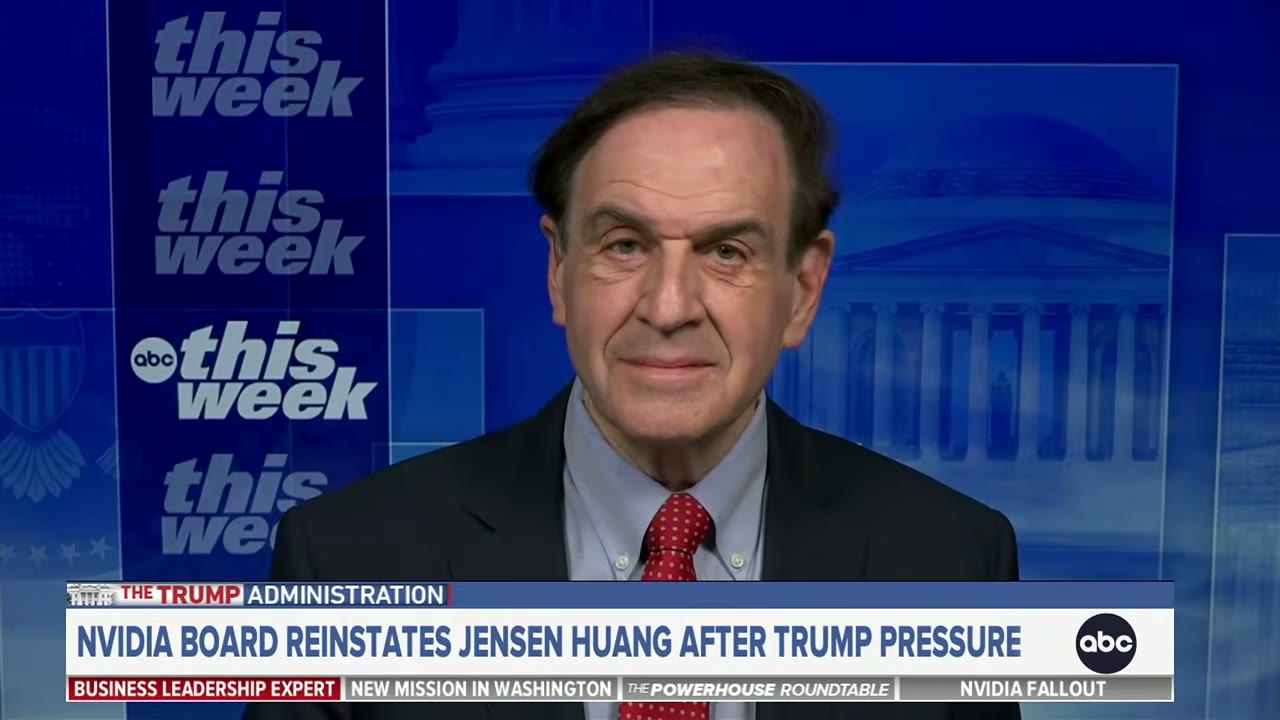
Yale's Jeffrey Sonnenfeld criticizes Nvidia's board for reinstating Jensen Huang after his exit, calling it the weakest board he has seen. He argues the company did not need Huang, questions Trump's intervention, and says the move undermines free enterprise.
1Sonnenfeld calls Nvidia board the weakest he has ever seen
Nvidia's board is the weakest Jeffrey Sonnenfeld has ever seen — and he called it "shameful."
The Yale professor told ABC News that the board that reinstated Jensen Huang looked like a boys' locker room in footage of the celebrations. He counted three, maybe four women in the crowds.
The faces cheering Huang back were a small group of tech figures with ties to him, Sonnenfeld said — Elon Musk, Sam Altman, and Travis Kalanick, the Uber founder who went through a similar exit himself, though Sonnenfeld noted Kalanick's case did not involve national security.
What struck him just as much was who stayed silent. No one from corporate America rallied to Huang's side, he said, naming Dell, Amazon, IBM, Microsoft, Eli Lilly, JP Morgan, Walmart and McDonald's among those absent.
Sonnenfeld dismissed the stock surge as "grossly overstated." The shares remain down more than 40% from their October high, and he said about two trillion dollars in shareholder wealth was lost because of the misconduct, with perhaps a trillion to a trillion and a half recovered before the air began leaking out again.
He called the return a disaster that undermines the company's credibility — and said it overshadows the strong executive team that does seem to exist.
2Sonnenfeld says Nvidia faced no risk without Jensen Huang
Nvidia did not need Jensen Huang to keep winning, according to Jeffrey Sonnenfeld.
Asked whether the company could fail without him, the Yale professor said: "No, not whatsoever."
He pointed to what happened after Huang was forced out. Five days later, CFO Colette Kress, who had stepped in as acting CEO, ran the earnings call. Sonnenfeld said she did a magnificent job, showing deep experience in technology and in talking to the financial community.
More importantly, he said, the company was up 25% on the quarter, and forecasts were up 75% — higher even than Huang's own previous forecast. He also praised her report on the new Vera Rubin chip, which he described as very high-end.
Sonnenfeld contrasted the situation with past government rescues, such as TARP help for financial institutions, stakes in General Motors, and brief support for airlines during COVID. Those, he said, were cases of great national distress where backbones of the economy were about to collapse. This was not.
He said there is no jeopardy to the company and its centrality in the economy, though he noted other companies are coming along with competitive products — still ways off, but soon to arrive.
3Sonnenfeld says Trump had no right to force Nvidia personnel change
President Trump had no right to force a personnel change at Nvidia, Jeffrey Sonnenfeld said.
The Yale professor said he respected Congressman McCaul's work critiquing the national security aspect of the case, which he called devastating. But he rejected the idea that it was acceptable to bring Huang back, or that it was merely unprecedented but within the president's rights.
"He didn't have the rights to do it," Sonnenfeld said, citing the wartime powers act, national defense acts and the War Production Boards. Nothing, he said, allows a personnel change like this to be imposed on a private enterprise.
He called the intervention an assault on the free enterprise system and a command economy. It is not conservative economics, he said — he described it as much more Maoist.
Sonnenfeld invoked Adam Smith, the economist of 250 years ago, saying the move would make him roll over in his grave. Smith wrote of the invisible hand of the market, the idea Sonnenfeld returned to as he made his case.