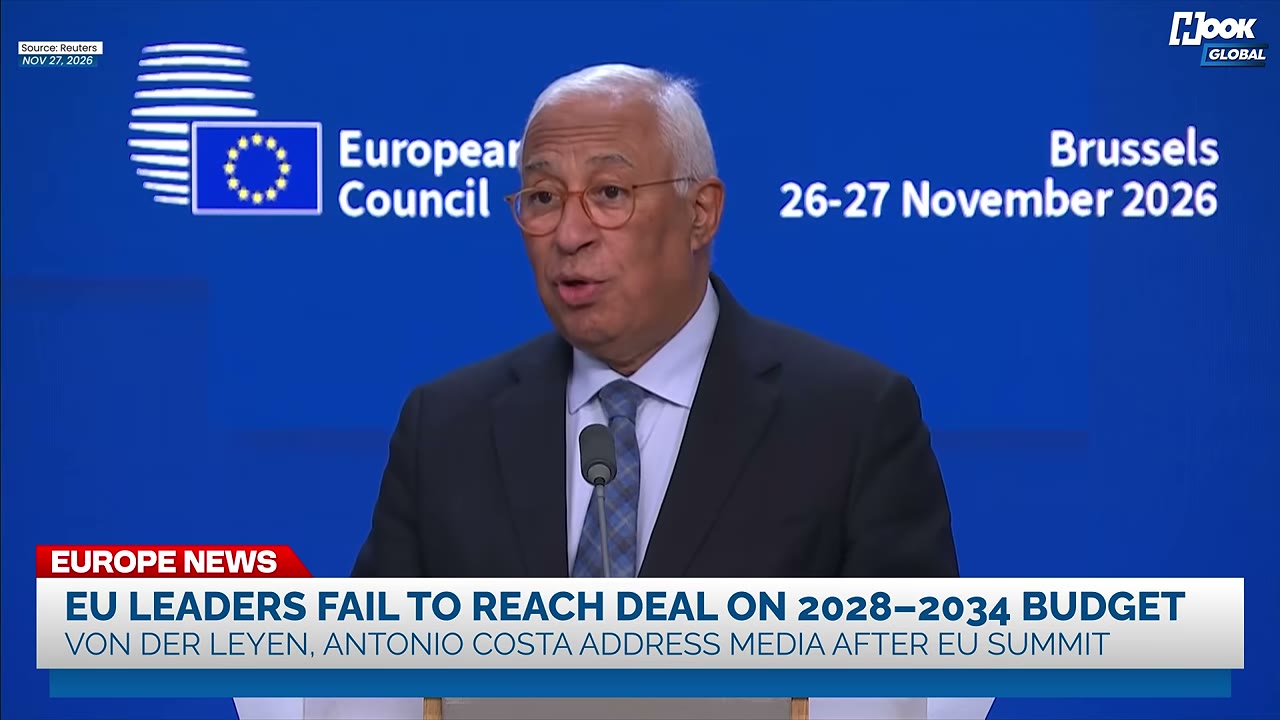
EU leaders met to discuss the bloc's long-term budget for 2028-2034, with member states divided over cuts, spending priorities and new revenue. They also backed additional credit for Ukraine and agreed to consult on a new ECB president.
1EU Council Opens Summit, Taps Pablo Hernández de Cos for ECB President
EU leaders have lined up Pablo Hernández de Cos to run the European Central Bank when Christine Lagarde's term ends. European Council President António Costa announced the Council's recommendation, alongside Laurence Boone and Markus Brunnermeier as two other members of the ECB's Executive Board.
Leaders first met Lagarde and recognized what Costa called her excellent work as ECB President. They then agreed to start consultations with the European Parliament and the ECB's Governing Council on the three candidates.
A final decision is expected at the next Council meeting in December.
224 EU States Back Extra Credit for Ukraine, Bulgaria Opts Out of Military Part
Twenty-four EU member states backed a European Commission proposal to give Ukraine additional credit, but Bulgaria will take part only in the non-military component. Costa said Bulgaria's involvement will emphasize regions with national minorities.
The support was announced as leaders met in Brussels. The issue will return to the table in December.
Costa did not give the size of the credit package in this session.
3EU Leaders Clash Over 2028-2034 Long-Term Budget Cuts
EU leaders split over the size of the bloc's next long-term budget, covering 2028 to 2034. Some member states called for further reductions, but the majority opposed more cuts, and some suggested reversing certain cuts, especially in cohesion policy.
Costa said he asked leaders to focus on three issues: the total budget, how resources are distributed between spending items, and a balanced package of new own resources.
The vast majority of member states asked not to limit funding for agriculture and cohesion policy. Work on new own resources will continue.
4Von der Leyen Touts Digital Services Tax Progress in Budget Talks
The Digital Services Tax has won broad support among EU leaders as a possible new source of revenue for the bloc's next budget, European Commission President Ursula von der Leyen said. She sees good prospects for a solid package of new own resources.
Von der Leyen said the latest negotiating package had made progress on own resources. But she warned that the two previous packages already produced significant cuts, and that leaders must stay true to priorities they agreed over past years.
Today's talks were useful, she said, but much work remains. All the pieces of the puzzle now need to be put together.
5Von der Leyen: EU Giving Ukraine Means to Negotiate From Strength
The EU is giving Ukraine 45 billion euros in 2027 to keep it negotiating from a position of strength, European Commission President Ursula von der Leyen said. The money comes through a new tool to coordinate support for Ukraine, proposed last week.
"Our strategy is clear," von der Leyen said, describing support that starts with financial and military backing. She said she was pleased to see broad support for the proposal, with 24 countries behind it.
It is now up to the Council to complete the work. Von der Leyen said the Commission will support the process until the end and keep strengthening Ukraine for the security of Europe itself.
6EU Leaders Thank Lagarde and Discuss Europe's Economic Prospects
EU leaders thanked Christine Lagarde in what was her last discussion with them as European Central Bank President. European Council President António Costa praised her skillful guidance and what he called elegant and effective leadership for Europe and the euro.
The farewell came after a morning discussion on Europe's economic prospects.
Costa said he looks forward to working with Lagarde's successor, Pablo Hernández de Cos.
7Journalist Asks If NextGenerationEU Was a Costly Mistake
A reporter put a blunt question to EU leaders: how big a mistake was NextGenerationEU? Oliver Kim of the Austrian newspaper Die Presse said Europe will pay more over the next seven years for the fund's debts than for Horizon Europe, and almost twice as much as for defense.
He asked both presidents how they plan to limit the burden of interest and debt, which he said is growing and will become more burdensome than investment in the future, defense and Ukraine.
The question framed the pandemic-era fund as a costly legacy rather than a success.
8Von der Leyen Defends NextGenerationEU as an €850 Billion Success
NextGenerationEU was a great success, European Commission President Ursula von der Leyen said, crediting the fund with saving Europe from both a sharp downturn and a slow recovery during COVID. She said investment combined with reforms was the right move.
But the 850 billion euros in payments must be repaid with interest, which she called a normal lending procedure. She reminded reporters that leaders agreed to repay it with new own resources, naming digital collection and CBAM.
Von der Leyen said there is broad consensus on CBAM in the Council, though not unanimity, and that work on the digital levy is going well.
9Costa Dismisses Frugal States' Boycott of Small Working Groups
Some frugal or modernizing countries skipped the small working groups at this summit, and a reporter asked Costa whether the move was theater or had poisoned the mood before December.
Costa said he and von der Leyen met twice in plenary and in various group formats with all member states. Some states may see no need for a second small group meeting, he said: "you need to ask them."
For Costa, the talks were very useful for defining the parameters of a possible zone of understanding in December.
10Reporter Challenges Costa: Is EU Consensus Further Apart Than Ever?
A reporter asked Costa whether EU consensus is further apart than ever after this summit. Gavin Reilly of Virgin Media News in Ireland said the frugal G7 are irritated at having their unity undermined, friends of cohesion are disappointed at zero progress, France is setting deadlines and red lines, and Ireland calls the digital tax a betrayal of earlier BEPS commitments.
Costa called the meeting a necessary step in a negotiation process, saying it is normal for parties to outline starting positions. He said everyone knows Europe cannot be let down and a new budget is needed from January 1, 2028.
That requires a final agreement by the end of this year, he said, and member states will naturally protect their national interests.
11Costa: Some States Want Deeper Budget Cuts, But Most Refuse
Some EU member states want the overall budget cut to 250 billion euros — even as most capitals refuse to go any lower.
After the meeting ended, many countries publicly demanded new cuts, with some asking for a reduction to 250 billion. Asked whether he was ready for further cuts in the next negotiating document, the Council representative said some member states had indeed requested more.
But most member states have asked for no further cuts to the overall budget, he said. The work now is to bring the positions of all member states closer together.
"Most Member States have asked for no further cuts to the overall budget," he said.