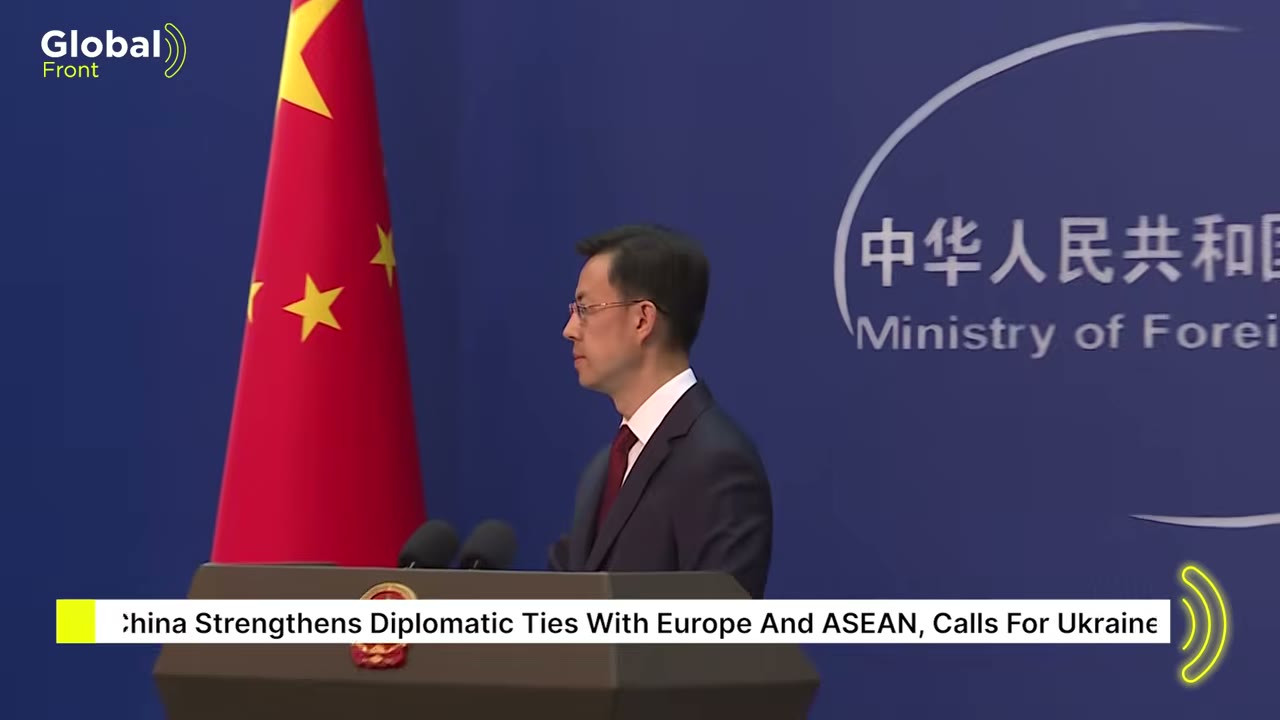
Beijing's Foreign Ministry outlined a diplomatic agenda covering Dutch and Polish visits, China-ASEAN ties and climate diplomacy. Trade with ASEAN topped $1 trillion last year, while China defended its climate record after COP31 ended without a declaration.
1China announces visit by Dutch Foreign Minister Tom Bruins
Beijing has announced a planned visit by Dutch Foreign Minister Tom Bruins, inviting him at the request of Chinese Foreign Minister Wang Yi, who also sits on the Politburo of the Communist Party's Central Committee.
The announcement drew fresh attention to China's ties with one of Europe's most important trading economies, at a time when technology, trade and economic security remain sensitive between Beijing and European governments.
China called the Netherlands an important cooperation partner, citing years of exchange in agriculture, water resources management, environmental protection, scientific research and advanced technology. The Foreign Ministry said the two countries keep regular high-level contacts and have made progress in practical cooperation.
Beijing said it hopes the visit strengthens political trust and expands economic ties, with the spokesman saying China is willing to hold in-depth exchanges on bilateral relations and issues of common concern. No new semiconductor technology agreement was announced.
2China rejects bloc rivalry and pushes multipolar world order
Beijing has rejected the idea that international relations should be built on competition between geopolitical blocs, setting out instead a vision of a multipolar system where countries hold equal status regardless of economic size or military power.
The spokesman said China does not participate in geopolitical rivalry and does not seek spheres of influence — one of the briefing's clearest political messages. Officials argued China's interactions are based on mutual respect, equality and cooperation rather than exclusive spheres of influence.
The remarks landed against the backdrop of ongoing strategic competition between Washington, Beijing and Moscow, relationships central to discussions about global security, economic stability, military developments and the future of international institutions.
Beijing reaffirmed its commitment to multilateral institutions, arguing international challenges need cooperation rather than unilateral solutions. The briefing gave no details on new arrangements for future trilateral meetings involving China, Russia and the United States.
3China declines to confirm reported Donald Tusk visit to Beijing
Beijing has refused to confirm reports that Polish Prime Minister Donald Tusk plans to visit China in early December, leaving the timing and agenda of any potential meeting uncertain.
China acknowledged the importance of high-level diplomatic exchanges, with the spokesman saying such exchanges are vital to the development of Sino-Polish relations. But Beijing added it had no further information on the proposed trip, which was reported by the media.
The questions come as European governments continue to build difficult relationships with Beijing over trade and Russia's war in Ukraine.
Poland occupies an important position in European security discussions because of its geographical proximity to Ukraine and its significant role in supporting European defense initiatives. Any future interaction between Warsaw and Beijing will draw attention not only over bilateral trade, but also over China's relations with Russia and its approach to the conflict in Ukraine.
4China-ASEAN trade exceeds $1 trillion as partnership marks five years
Trade between China and ASEAN topped $1 trillion last year, according to figures released by the Chinese Foreign Ministry — a number Beijing held up as evidence of deepening economic ties with its Southeast Asian neighbors.
Officials highlighted the China-ASEAN Comprehensive Strategic Partnership, announced in November 2021 during a special summit marking the 30th anniversary of dialogue relations. Five years on, Beijing described it as a significant diplomatic achievement and a foundation for deeper regional economic integration.
"The establishment of the China-ASEAN Comprehensive Strategic Partnership is an important milestone in our bilateral relations," the spokesperson said.
China said cooperation has expanded through trade, infrastructure, transportation, technology and cultural exchanges. Beijing also pointed to the updated China-ASEAN Free Trade Area 3.0 framework agreement as a mechanism to strengthen regional commercial integration, expected to support new industries, digital trade and supply chains.
5China touts Jakarta-Bandung and China-Laos rail projects
The Jakarta-Bandung high-speed railway in Indonesia and the China-Laos railway were held up as proof of practical cooperation, demonstrating China's growing role in regional transport networks.
The Pinglu Canal project was also mentioned as part of China's broader efforts to improve connectivity and logistics.
Beyond infrastructure, Beijing emphasized the importance of direct people-to-people contacts, including cultural exchanges, tourism and measures to facilitate international travel.
6China names AI, digital economy and energy as ASEAN priorities
Artificial intelligence, the digital economy, transport connectivity and energy security have been named by Beijing as priority areas for further engagement with ASEAN countries.
"China is ready to deepen cooperation in key areas such as artificial intelligence, digital economy, connectivity and energy security," the spokesman said.
The broader message: China sees Southeast Asia not only as a major trading partner but as an increasingly important center of technological and economic growth.
Those ambitions come as ASEAN countries struggle to balance expanding commercial opportunities with China against security concerns and their relationships with other international partners. China has presented its economic cooperation initiatives as a way to promote regional stability and prosperity while strengthening mutual trust.
7China responds to COP31 ending without political declaration
The UN COP31 climate conference in Antalya, Turkey, ended on November 22 without agreement on a general political declaration, exposing serious disagreements between governments on fossil fuels, climate finance and the pace of emissions reductions.
China insists the failure should not undermine credibility in international climate negotiations. "The trend of a global green and low-carbon transition is irreversible," the spokesman said.
Beijing stressed climate change remains a shared international challenge requiring cooperation between developed and developing economies, and defended the principle of common but differentiated responsibilities.
Vice President Han Zhen represented President Xi Jinping at the leaders' summit in Antalya, reaffirming China's commitment to peaking carbon emissions and reaching carbon neutrality, and calling for stronger international cooperation in climate governance. Beijing said its delegation engaged with other governments and sought a constructive outcome, and that it would continue to support the Paris Agreement.
8China backs International Criminal Court justice efforts
China has expressed support for international efforts to achieve justice in the Palestinian territories, while stressing that legal standards must be applied consistently.
The remarks came as the discussion turned to the International Criminal Court and its role in addressing alleged violations of international law in the Palestinian territories.
The spokesman said China supports all efforts by the international community that promote the realization of justice.