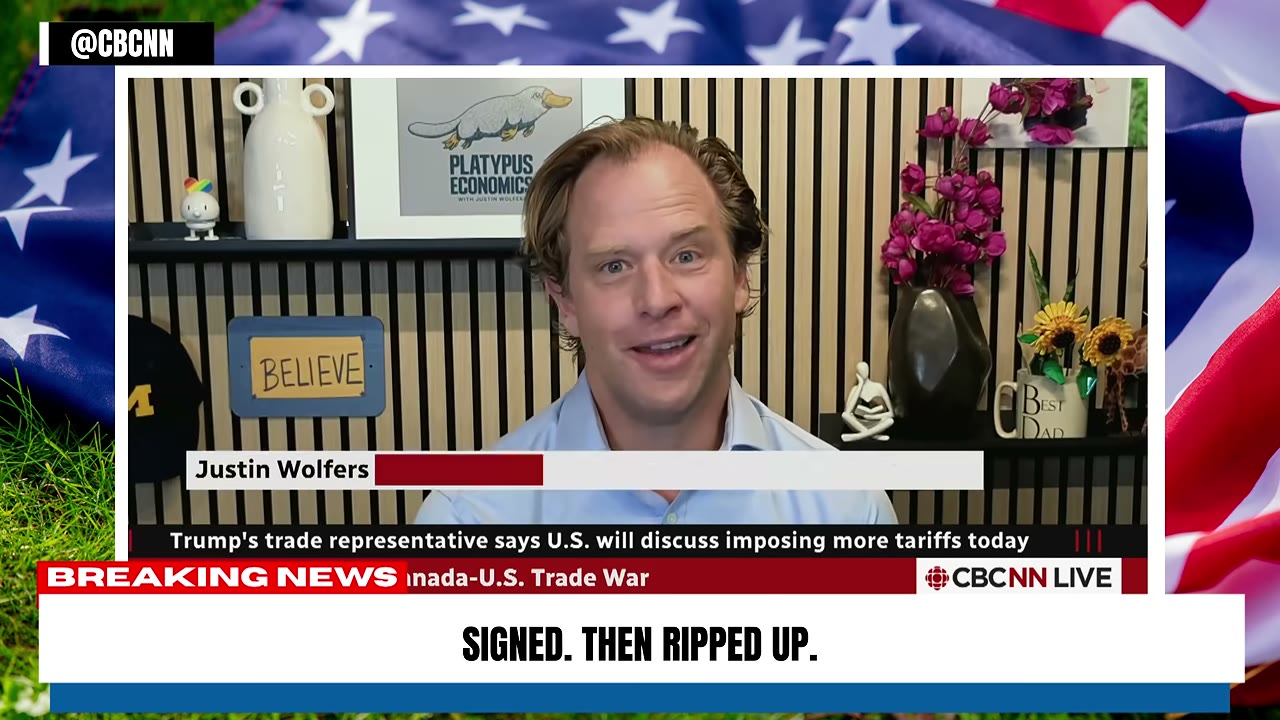
A former Canadian ambassador and an American economist debate why Canada rejected Trump's 'best offer,' calling it a threat to steel, autos and lumber. They examine counter-tariffs, who holds leverage, and who can endure the pain of a trade war.
1Analyst says Trump's concessions last only until he changes his mind
Any concession the United States makes lasts only until the president changes his mind, an analyst said, warning that this is already eroding trust in American deals.
"Any American concessions last until the president changes his mind," the analyst said, arguing that no country will make serious offers while that holds.
The pattern cited: NAFTA was ripped up, and so was the deal referred to as Kuzma. The Canadians, the analyst said, have negotiated in good faith at every point — and it isn't just Canada.
The result, the analyst claimed, is that the Trump administration will struggle to get useful deals from anyone.
2Canada rejected US 'best deal' over threat to strategic sectors
Canada rejected what the US called the best deal any country has been offered, because it threatened the viability of Canada's most strategic sectors.
The US presented the offer as the most generous it had given anyone. Canada's side judged it could be detrimental to core industries that employ thousands.
An experienced negotiator said they had never before faced a partner, American or otherwise, who failed to recognize a country cannot sign a deal that wrecks its key sectors.
The talks, the negotiator said, have moved from retaliation to retribution — "the thermonuclear weapon has been brought out."
3Kirsten Hillman explains why Canada walked away from the table
Canada walked away from the table because of what was in the draft texts — not because of the noise coming out of Washington, former Canadian ambassador Kirsten Hillman said.
Hillman, who held the post since 2019 and stepped away earlier this year, said the administration generates constant noise from many directions, often designed as a distraction.
Prime Minister Carney said what was on the table was uneconomic for key sectors: steel, autos and lumber. The US countered that it was the best deal it had given anyone.
Hillman rejected that measure. The test, she said, is not whether a deal beats other countries' — and the drafts could have been "a death warrant" for key industries.
4Hillman reframes Canadian tariffs as fair play, not retaliation
The word "retaliatory" is wrong, Kirsten Hillman said — Canada's counter-tariffs are designed to level the playing field, not to hit back for its own sake.
She said retaliation implies striking for offensive reasons. The tariffs tell a different story.
Canadian sectors that trade heavily with the US have lost access to the American market since President Trump imposed a range of tariffs. A company selling 30% of its production to the US has lost that 30%, while American competitors still reach the Canadian market.
Hillman described it as a double hit. The counter-tariffs were meant to let those companies recapture some lost sales.
5Hillman says US domestic industry pressure will shift conditions
The pressure that could reset trade conditions is building inside American boardrooms, not in Ottawa, Kirsten Hillman said.
Asked how talks can work when the president and Commerce Secretary Howard Lutnick sit above trade negotiator Jamison Greer, Hillman pointed to domestic US pressures.
Almost all of American industry consulted on the USMCA, on trade with Canada and on the tariff escalations is against them, she said.
"It may not feel like it really matters right now but it does matter," she said. It matters politically, she added, and to communities where people have jobs or may lose them.
6Canada's tariff list built from import data to target key sectors
Canada's tariff list was built by going through import data line by line — and the detail is not an accident, according to trade analysis.
The targets are industries where Canada normally sells a large share of its market to the United States. Negotiators examined what Canada produced and what was coming into the US, then hit anything significant.
The aim, the analysis said, is to show that resistance is futile and that the US intends to prevail.
That leaves the open question: can Canada stiff it out? "The Americans are betting we won't," the analyst said, adding that Canadians may have something to tell them this time.
7Economist says tariff war is about who tolerates pain, not leverage
Asking who has more leverage in a tariff war is the wrong question, an American economist said — the real test is who will tolerate hurting their own people.
Trade is fundamentally about cooperation, he argued: two parties do business hoping to be better off. Tariffs and counter-tariffs shrink that trade by design, and so create pain.
"When Mark Carney responds, he wants to punch the US in the nose, but realize he's also punching Canadians in the gut," he said.
By his reading, the side most likely to win is the one whose leader cares less about pain at home — which, he said, sounds more like President Trump — or the one with principles at stake, which he said is clearly Canada.
8Economist says tariffs are small economically but politically targeted
The tariffs themselves are not an economic big deal for either country, an economist said — but where Canada aimed them is politically pointed.
President Trump imposed $20 billion US worth of tariffs on Canada, about 4% of Canadian exports. Even a 50% US tariff that cut off trade entirely would leave Canada with 96% of its exports, the economist said.
Canada's counter-tariffs are even smaller relative to the US economy, but more targeted — apparently designed to hit the upper Midwest border states, which he called politically vulnerable for the president.
The result, he said, is not a broad US hit but a targeted one.
9Hillman disputes claim counter-tariffs target Republican districts
Kirsten Hillman said Canada's counter-tariff list does not look designed to hurt Republicans in swing districts, despite speculation about Ohio, Maine, Michigan and Texas.
Asked whether the list was politically targeted at Senate races and the midterms, the former ambassador said she was not involved in creating it, though she has worked on other lists.
This one, she said, does not seem inclined toward simply hitting industries in the districts of powerful Republicans. It appears built so Canadians shut out of the US market can sell more at home.
She did not rule out some political effect, noting Canada sells a lot to Michigan.
10Economist warns tariff wall would weaken Detroit auto industry
Tariffs on Canadian car parts would make Detroit's automakers weaker, not stronger, an economist from Michigan warns. He said Ford and General Motors mostly assemble parts made by others, and many of those parts come from Canada.
"If we put up a tariff wall between those two countries, then that's going to make the auto manufacturers in Detroit weaker, less able to compete," he said. That means less demand for parts coming from the Canadian side too.
He pointed to Jameson Greer, whom he has known a long time, as doing the work on the actual proposals. If Canada keeps saying the current terms are unacceptable but sets out where it would start talking again, the economist said talks will happen because it is the right thing for the country.
11Closing commentary: trust, the ambassador's floor and who wins
Every trade agreement is a bet on who the other side will still be in four years, the commentary argues. A treaty is two countries writing down what they will not do to each other, then living inside that promise long enough for people to build factories against it.
The American economist said no one will make important concessions anymore because everyone understands an American concession lasts until the president changes his mind. The commentary calls that a description, not an insult.
It also cites the ambassador's seven years in Washington and two administrations, saying she has never sat across from a negotiating partner who did not accept that a country cannot sign away the viability of its own industries. On who wins, the economist said it is either the leader who does not mind hurting his own people or the country willing to accept pain because something matters more.