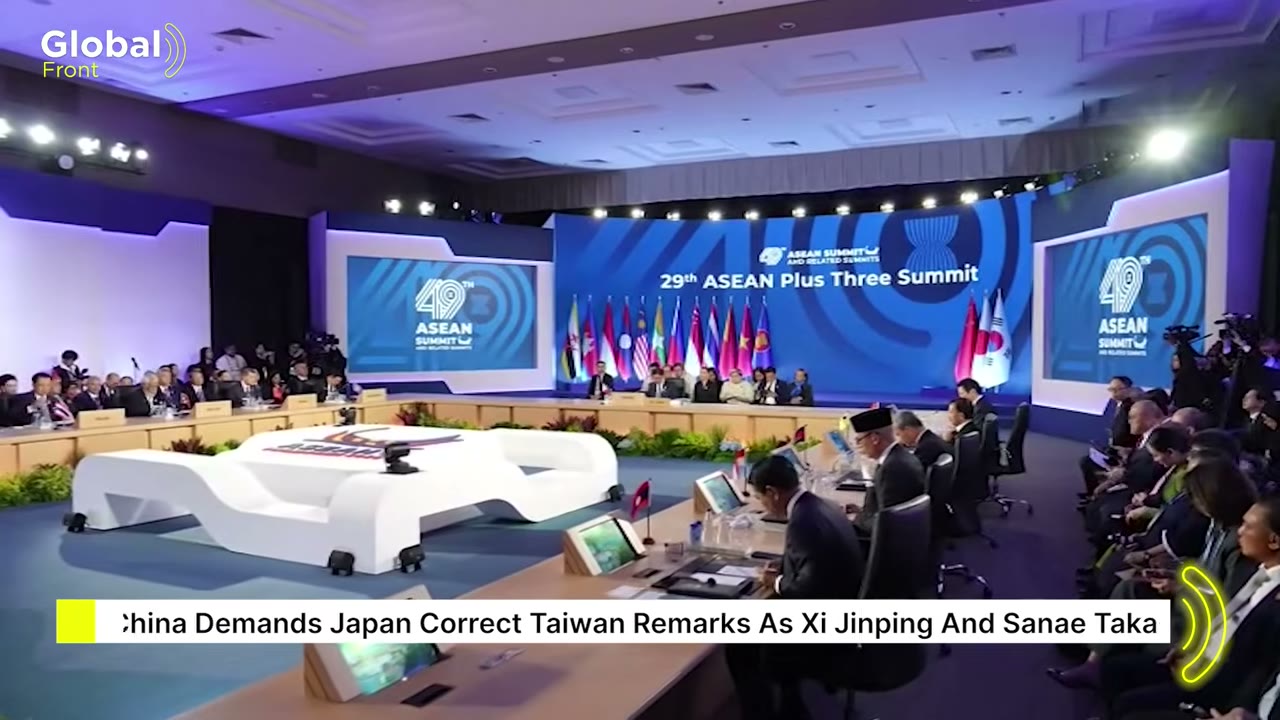
China is pressing Japan to retract Prime Minister Sanae Takaichi's comments suggesting a Taiwan crisis could threaten Japan's survival. The dispute, marked by a low-key reception for Takaichi in Shenzhen and no formal Xi meeting, has spilled into trade restrictions and strained security ties.
1China Demands Japan Retract Takaichi's Taiwan Remarks
China has demanded that Japanese Prime Minister Sanae Takaichi retract her remarks on Taiwan and rethink her approach to Beijing, as ties between Asia's two largest economies worsen.
The dispute centers on Taiwan, a self-governing island China considers part of its territory. Takaichi's earlier comments about Japan's potential response to a military crisis over Taiwan drew sharp criticism from Beijing, which calls the issue a fundamental matter of national sovereignty.
The pressure intensified after Takaichi received a noticeably lower-level reception at a regional summit in Shenzhen, while other leaders reportedly got lavish greetings — prompting questions about whether Beijing was sending a deliberate political signal.
China now wants changes in both Japan's rhetoric and its diplomatic behavior, warning that commitments in bilateral agreements must show up in practical actions. Tokyo faces a difficult balance: keeping stable economic and political ties with China while strengthening security cooperation with the United States.
2APEC Summit in Shenzhen Fails to Ease China-Japan Tensions
Xi Jinping and Sanae Takaichi shook hands at APEC in Shenzhen — but never sat down for a formal meeting, and both sides left without announcing any breakthrough.
China hosted the 33rd Asia-Pacific Economic Cooperation Leaders' Meeting in Shenzhen on November 18–19, with Xi presiding over talks on regional trade, connectivity, innovation and economic development. Takaichi's arrival drew attention: she was met by former Chinese diplomat Jiang Qihua and a relatively modest delegation, which Japanese media read as a sign of the tense political atmosphere.
US President Donald Trump and Russian President Vladimir Putin reportedly received more diplomatic attention during their visits. A lower-level reception alone does not prove Xi ordered a snub — receptions can vary by protocol and schedule — but the political context made the treatment sensitive.
The two leaders exchanged greetings and shook hands at official events, including a ceremonial banquet. Takaichi confirmed the brief conversation and said Japan remains interested in engaging China.
3Takaichi's November 7 Remarks on a Taiwan Crisis Threatening Japan
Sanae Takaichi told Japanese lawmakers that a crisis involving Taiwan could be seen as a situation threatening Japan's survival — a phrase with real legal weight.
The remarks came on November 7, 2025, during a parliamentary committee discussion on the implications of a possible military conflict involving Taiwan.
Under Japan's postwar constitution, the use of military force is restricted. But security legislation passed in 2015 allows limited collective self-defense in certain conditions, including when an armed conflict involving a closely related country threatens Japan's survival and poses a clear danger to its population.
Takaichi's statement suggested a serious Taiwan crisis might meet those legal conditions. It did not imply an automatic obligation to intervene militarily — Japan's response would depend on the circumstances, legal requirements and decisions made by the government at the time.
4Beijing Calls Takaichi's Comments Unacceptable Interference on Taiwan
Beijing called Sanae Takaichi's Taiwan comments an unacceptable suggestion that Japan could be drawn into a military conflict over what China considers an internal matter.
China has repeatedly demanded that Takaichi retract her statements. For Beijing, Taiwan is one of the most sensitive issues in its foreign policy: the government insists the island is part of China and says unification is a national goal.
Taiwan, meanwhile, has its own democratically elected government, military forces and political institutions. Beijing does not exercise control over the island, and Taiwan's future remains a major source of regional tension.
The gap between those positions helps explain why the dispute has proven so hard to defuse.
5Yonaguni's Proximity to Taiwan Raises Security Stakes for Japan
Japan's westernmost inhabited island, Yonaguni, sits about 110 km from Taiwan — close enough that any large-scale conflict could reach Japanese territory.
That proximity gives Tokyo special reasons to watch the Taiwan Strait. A major conflict could affect Japanese territory, nearby shipping lanes, commercial aviation and the security of US military installations in Japan.
The US maintains a significant military presence in Japan, and the two countries are bound by a long-standing security alliance. That raises difficult questions about how Tokyo might respond if Washington became embroiled in a conflict over Taiwan.
Japan must balance regional stability, legal constraints on military operations and its obligations to its closest ally. For Takaichi, discussing these possibilities is part of preparing for a potentially serious emergency. For Beijing, public suggestions that Japanese forces might intervene cross a political line.
6China Imposes Mineral and Seafood Restrictions on Japan
Beijing has hit Japan with restrictions on exports of critical minerals and Japanese seafood, and is discouraging Chinese citizens from traveling to Japan.
The measures extend the diplomatic dispute into economic relations, raising commercial and political pressure on already strained ties.
The stakes are high because the two economies are tightly linked through manufacturing, trade, investment and regional supply chains. Japanese manufacturers rely on Chinese suppliers for a variety of industrial materials and components, while Chinese businesses benefit from Japanese technology, investment and consumer demand.
A prolonged standoff could therefore create problems for companies and consumers in both countries — and potentially beyond them.
7Takaichi Reaffirms Japan's 1972 Taiwan Position Unchanged
Sanae Takaichi says Japan's position on Taiwan has not changed since 1972 — drawing a line between Tokyo's long-standing diplomacy and its talk of security emergencies.
At a press conference in Shenzhen on November 19, Takaichi reaffirmed Tokyo's commitment to the framework set when Japan and China normalized relations in 1972. She stated that there had been no change in this position.
She was referring to the 1972 Japan-China Joint Statement, one of the main documents governing relations. Under it, Japan recognized the government of the People's Republic of China as the sole legitimate government of China and took note of Beijing's stated position on Taiwan.
Tokyo's argument is that discussing the consequences of a Taiwan crisis does not mean abandoning those 1972 commitments.
8China's Guo Jiakun Says Japan Must Correct Taiwan Words and Actions
Beijing wants more than words from Tokyo. Chinese Foreign Ministry spokesman Guo Jiakun said Japan must turn its commitments into concrete actions.
Guo stated that adhering to the four political documents between China and Japan is a political responsibility and a legal obligation Japan must fulfill — reflected not only in statements but translated into concrete actions.
He added: "For the Japanese side, the most urgent priority is to correct erroneous words and actions on the Taiwan issue, adopt a correct attitude towards historical issues, and develop a truly objective and rational understanding of China."
The mention of historical issues reflects long-standing disagreements over Japan's wartime actions and their shared history, which have repeatedly complicated relations even during periods of growing economic cooperation.
9Earlier Xi-Takaichi Goodwill at 2025 APEC Summit in South Korea
Xi Jinping and Sanae Takaichi once voiced support for a constructive, stable relationship — which makes the current standoff over Taiwan all the more striking.
Their interaction at the 2025 APEC summit in South Korea raised hopes the two governments could resolve differences through dialogue. The dispute over Taiwan has made that task increasingly difficult.
The Shenzhen summit offered another chance to ease tensions, but the absence of a formal leaders' meeting showed how far apart their positions remain.
Both leaders face domestic political pressure. For Takaichi, retracting her comments could create political difficulties at home and call Japan's national security approach into question. For Xi, accepting Japan's explanations without further changes could be seen as condoning statements Beijing considers unacceptable interference in its sovereignty.