Young people took to the streets in India, France, Italy and Albania in October, protesting education funding, corruption and political power. The BBC examines what connects these movements and why they are spreading online.
1Indian students protest exam leak and voter list deletions
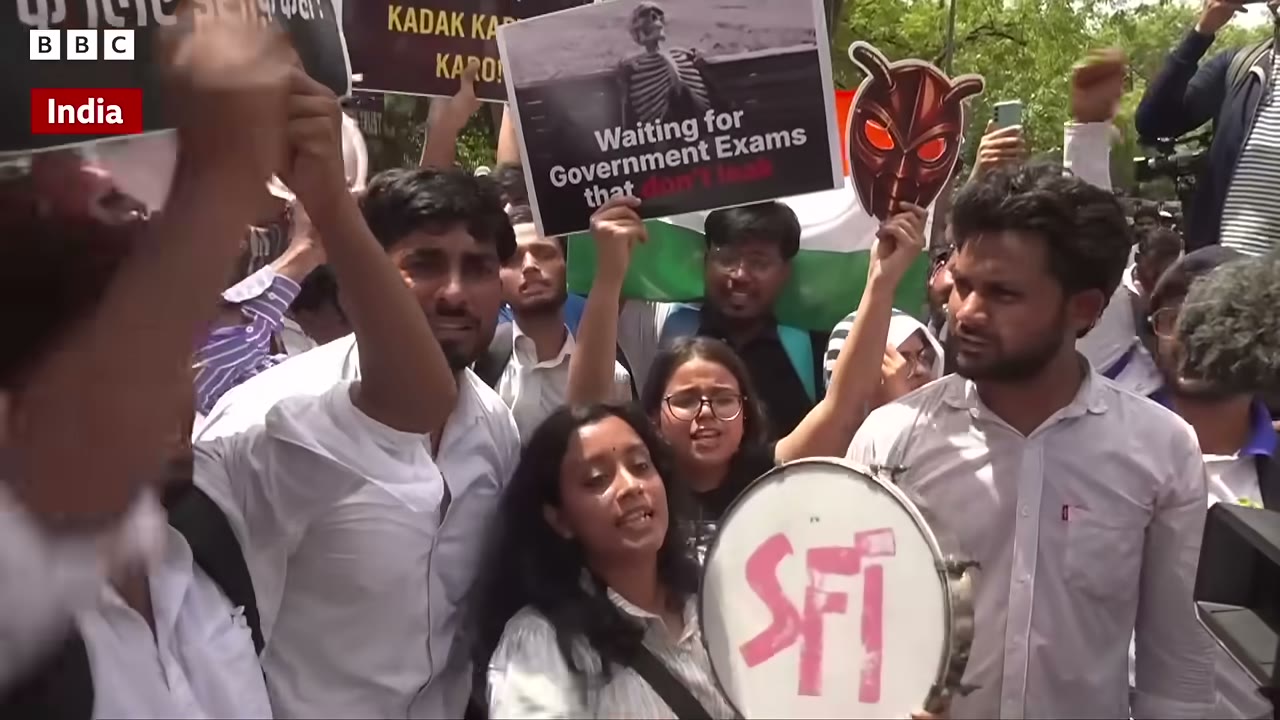
Police arrested the leader of India's Cockroach Janta Party on 16 October — the same day his group had planned a major rally demanding the election commissioner's resignation. The protest centres on 130 million names removed from voter lists.
The government says the deletions target duplicate voters, or people who have died or moved. Protesters say the removals were done to help the party in power, the BJP.
The Cockroach Janta Party began online as satire, then became a real movement. In the summer, it led student street protests after questions leaked from the national medical entrance exam. In July, the education minister resigned.
Now the group is back — this time over the voter lists.
2French students block schools over conditions and teacher shortages
Students blocked hundreds of French schools within weeks of a single protest at one high school on the edge of Paris on 21 September. They are protesting a lack of teachers, schools full of rats, and buildings that are too hot, too cold or falling apart.
On 6 October, unions and teachers joined them. At the weekend, some protests turned violent and thousands of people have been arrested.
The dispute began over conditions inside schools, then widened as unions and staff joined the students.
3Italian students march against Meloni in 'No Meloni Day'
Students in Rome, Milan, Turin and other Italian cities called a 'No Meloni Day' on 16 October, marching against Italy's prime minister. They demanded more teachers, more funding and better school buildings. Clashes broke out in several cities.
The action followed the wave of school protests in France, which has now crossed the border. Italian protesters said they were following France.
The marches tied school conditions — staffing, money and buildings — directly to the government led by Giorgia Meloni.
4Albanian protests over Kushner-backed resort turn anti-corruption
Protesters in Albania carried pink flamingos to oppose a luxury resort on the southern coast backed by President Trump's son-in-law, Jared Kushner, saying the development would put the birds in danger. The demonstrations began in the summer and grew into wider anger about corruption.
Last week, students walked out of classes over fees and university conditions. In Tirana, police fired tear gas and some people reported being hit by rubber bullets. Some protesters threw stones and petrol bombs.
The prime minister says he will not resign. He says governments change through elections, and he blamed what he called 'foreign hands' for the unrest.
5Earlier youth protests toppled governments in Bangladesh and Nepal
Students in Bangladesh forced out the prime minister in 2024. In 2025, protests in Nepal that began over corruption and a crackdown on free speech on social media brought down the entire government.
Since then, youth-led protests have hit Indonesia, the Philippines, Morocco, Madagascar, Peru and Mexico.
The two earlier cases show what youth-led movements have achieved: a prime minister ousted, and a government toppled.
6Common thread: youth anger at underinvestment in services
Many of the countries seeing youth protests share rising unemployment, a lack of jobs, and too little investment in healthcare, hospitals and education. The countries are disparate, with very little in common — collapsing all their concerns into one or two sentences would be wrong.
But broadly, young people are protesting against a lack of government investment in services and policies that affect their lives. They organise online, often with no clear leader. Some openly copy others.
7Social media lets Gen Z protesters organise and copy each other
Open TikTok or Instagram and you can see reels from people in Madagascar, Morocco or Albania — in real time. That reach is unprecedented in the history of modern communication, and it lets young people see each other as peers.
Protesters in Italy said they were following France. Social media collapses some of the traditional boundaries that make it difficult to communicate with people across the world, and it lets Gen Z show solidarity across borders.
8Key differences: demands, tactics and results vary by country
In France and Italy, the demands are about schools and spending, and unions have joined the students. In Albania and India, the focus is also on corruption.
Some protests, like India's, have been largely peaceful, while parts of France have descended into looting and chaos. Results differ too: India's education minister resigned, and in Nepal and Bangladesh, governments fell.
Some protests have been brutally repressed, some placated, and others simply ignored.
9Large governments can ignore or outlast Gen Z protests
In larger countries, governments are much more likely to try to move on, quash the protesters and deal with the issue at the next election. In a country like India, which is so massive, it is a little easier for the government to try to move on.
That gives big governments an advantage that smaller ones lack: the ability to wait protesters out until voters next go to the polls.