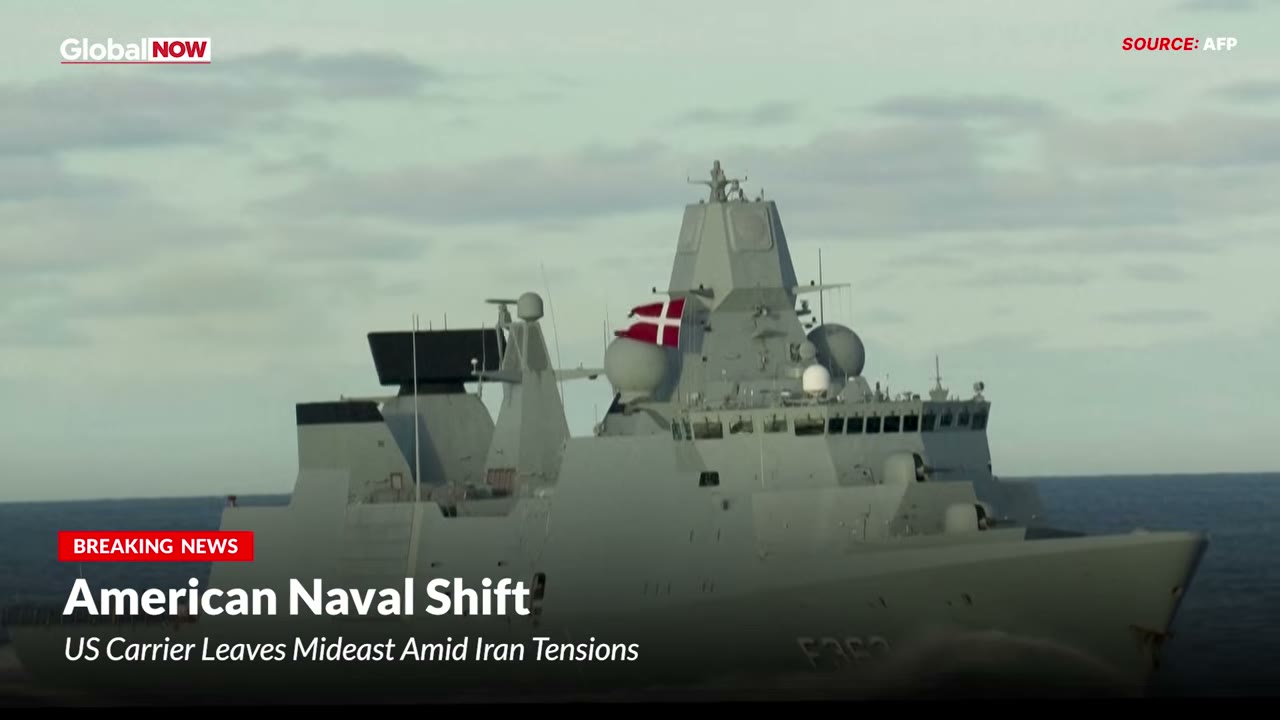
The USS George Washington has left the Middle East after three months, returning to the Pacific Fleet as two other US carriers remain in the region. The move comes amid Iranian activity near the Strait of Hormuz, maritime incidents, and stalled nuclear negotiations.
1USS George Washington Departs Middle East After Three Months
The USS George Washington has left the Middle East after about three months of military operations tied to Washington's long-running standoff with Tehran.
The nuclear-powered aircraft carrier's departure comes at a sensitive moment. Iranian military activity around the Strait of Hormuz is intensifying, and fears are growing about another major regional conflict.
The move is drawing international attention as a significant shift in American naval deployments amid rising US-Iran tensions.
2Pentagon Says Carrier Exit Is Planned Rotation, Not Iran Pressure
The USS George Washington's departure was part of a planned carrier rotation, not a retreat under Iranian pressure, according to the US Pacific Fleet.
On November 18, the Fleet confirmed the carrier had left the Middle East and returned to its operational command. Commander Katie Koenig, a spokeswoman for the Fleet, said the ship is conducting scheduled operations in the Asia-Pacific region.
There is no official confirmation that Iranian military pressure forced the carrier to leave. The timing, however, remains strategically important.
3Two US Carriers Remain as Washington Keeps Pressure on Tehran
Two American aircraft carriers remain in the region after the USS George Washington's departure — the USS Theodore Roosevelt and the USS George H.W. Bush, backed by additional warships and aircraft.
The Roosevelt entered the Middle East in mid-November. For a short period, three US carriers supported operations in the wider region.
The continued presence indicates Washington has not abandoned its military campaign against Tehran. Instead, it appears to be reallocating maritime resources while maintaining significant military pressure on Iran.
4Carrier Rotations Reflect Logistical Strain of Long Deployments
Even nuclear-powered aircraft carriers have limits that make periodic rotations necessary.
The USS George Washington arrived in the Arabian Sea in August after being redeployed from the South China Sea. Its deployment was part of efforts to keep a strong US military presence near Iran while reducing the burden on other naval forces — including the USS Abraham Lincoln, whose prolonged deployment highlighted the logistical challenges of continuous operations.
Keeping these ships at sea for long periods requires significant resources, technical support and personnel support. Thousands of sailors work aboard, and aircraft and critical equipment need regular maintenance.
5Iran Counters US Naval Power With Asymmetric Capabilities
Iran is betting on drones, coastal defense systems, small naval vessels and long-range military systems to challenge American operations.
The Islamic Revolutionary Guard Corps places significant emphasis on naval operations around the Strait of Hormuz — one of the most strategically important waterways in the world.
The strait connects the Persian Gulf with the Gulf of Oman and serves as a critical corridor for international energy supplies. Disruptions there could have economic consequences far beyond the Middle East.
6Strait of Hormuz Disruptions Threaten Global Energy Supplies
Iran does not need to disable a large American warship to complicate Washington's military operations.
Iran's geographical location gives Tehran significant regional influence. Despite America's technological superiority, maintaining security near Iranian territory poses significant challenges.
Continued maritime disruptions, heightened security threats and uncertainty about commercial shipping could put additional pressure on the United States and its regional partners.
7IRGC Reports Two Oil Tankers Hit Naval Mines in Strait
Two oil tankers encountered naval mines while passing through the Strait of Hormuz, the IRGC Navy said on November 25.
The circumstances of the incidents require careful examination, but the statements have further heightened concerns about maritime safety in the strategic waterway.
The reported incidents demonstrated how quickly tensions around the strait can escalate.
8Two Italians Die in Kuwait Facility; Italy and Kuwait Blame Iran
Two Italian citizens died in an incident at a facility in Kuwait on November 26 — and Italy and Kuwait have blamed Iran.
Tehran has categorically denied any involvement. The conflicting accounts highlight the uncertainty surrounding the regional standoff and the importance of distinguishing independently established facts from military allegations.
The deaths made an already sensitive situation even more volatile.
9Iran Deputy FM Says Tehran Is Not Cuba or Venezuela
Iran is not Cuba, which can be blockaded, nor Venezuela, which can be forced to surrender, Iran's deputy foreign minister for legal and international affairs, Qasem Jori Babadi, said in a strong response to Washington's strategy.
Washington's naval blockade remains central to its approach, restricting Iranian maritime trade and energy exports to increase economic pressure and win concessions through negotiations.
Iran has repeatedly rejected the restrictions as an unacceptable attempt to undermine its sovereignty and economic independence. The standoff intensified after the United States and Israel launched large-scale military operations against Iran on February 28.
10Military Exchanges Hit US Facilities in Bahrain and Kuwait
Iranian military operations involving US facilities in Bahrain and Kuwait were reported in November, while Washington conducted a limited military operation against an Islamic Revolutionary Guard Corps facility on the Iranian island of Qeshm.
The exchanges show diplomatic discussions have not eliminated the possibility of further military escalation.
Washington continues to enforce maritime restrictions while Tehran responds with military warnings and demonstrations of its capabilities. Each development increases uncertainty and complicates diplomatic progress.
11Gulf States Fear Wider Conflict Could Endanger Infrastructure
Gulf countries hosting American forces are watching the standoff with particular worry.
Bahrain is home to the headquarters of the US Navy's Fifth Fleet, and Kuwait hosts important US military facilities. Regional governments also depend heavily on stable energy exports, maritime security and international commercial activity.
A wider confrontation could endanger critical infrastructure and undermine economic confidence throughout the Gulf.
12Trump Says US Wants a Real Deal, Iran Will Never Get Nuclear Arms
President Donald Trump says Washington remains open to negotiations with Iran — but only on terms acceptable to his administration.
"We want to make a real deal, not a fake deal," Trump said at a White House press conference on November 20. He also confirmed his administration opposes Iran obtaining nuclear weapons: "Iran will never have nuclear weapons."
Experts quoted in the media say Trump's statements highlight the difficult balance Washington is trying to maintain between diplomatic engagement, economic pressure and military deterrence.
13Iran FM Araqchi Seeks Lasting Agreement as Gaps Remain
Iran says it wants a lasting agreement that prevents a new military conflict — not a temporary arrangement that could collapse in a few months.
Foreign Minister Abbas Araqchi said his government remained interested in diplomacy despite the ongoing standoff. Tehran insists its nuclear program is for peaceful purposes and continues to demand the lifting of economic restrictions.
Disagreements over uranium enrichment, economic sanctions, maritime restrictions and security guarantees continue to hinder meaningful progress — which is why the deployment of American aircraft carriers remains strategically important.
14Carrier's Return Shifts US Focus Back to Indo-Pacific
The USS George Washington is back in the Pacific, and Washington is counting on it. Based in Yokosuka, Japan, the carrier plays a critical role in US naval operations across the region, and its return lets Washington address security issues involving Japan, Taiwan and the South China Sea.
The shift comes as the USS Theodore Roosevelt and the USS George H.W. Bush keep giving Washington military flexibility without relying entirely on ground facilities in neighboring countries.
The Pentagon now faces a harder task: meeting commitments in multiple regions without putting undue pressure on its personnel and equipment.
15Analysts Warn Carrier Exit Is Not Proof of Iranian Victory
Do not read the USS George Washington's departure from the Middle East as proof of an Iranian military victory, analysts warn. Naval power is not measured by carrier counts alone.
Geography, operational readiness, intelligence, logistics and economic resilience all shape the outcome of protracted conflicts.
Still, the analysts say ignoring Iran's ability to keep threatening regional maritime security would mean ignoring important developments.
16Hormuz Uncertainty Could Raise Insurance and Energy Prices
The Strait of Hormuz is the pressure point. For international shipping companies, the most pressing issue remains the safety of commercial vessels passing through it.
Prolonged uncertainty could push up insurance premiums, disrupt supply schedules and add pressure on global energy prices.
Those costs can reach businesses and ordinary households thousands of kilometers from the region. How the confrontation develops will depend largely on diplomatic negotiations.
17Diplomacy Seen as Deciding Factor Before Next Regional Incident
Washington and Tehran both say they are willing to negotiate. The question is whether they can turn that into a lasting deal before another incident at sea changes everything.
Regional mediators are looking for ways to prevent another major escalation, even as Washington tightens maritime restrictions and Tehran keeps up economic resistance. Fundamental differences remain unresolved.
The USS George Washington has left the Middle East, but America's broader military presence remains significant, and there is no confirmed evidence the carrier was forced out by an Iranian military operation.