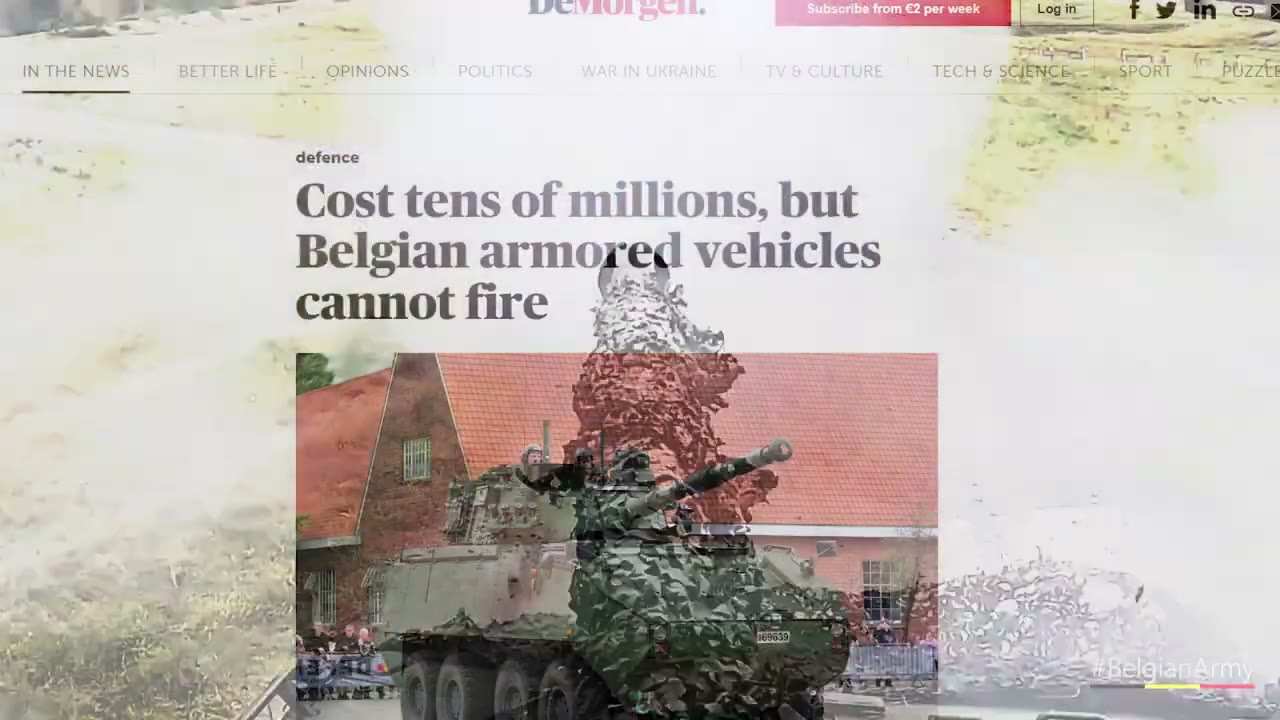
Belgium is rebuilding its land forces around French equipment and doctrine, replacing Piranha and Dingo vehicles with over 400 Griffon APCs and 60 Jaguar recon vehicles. The STAR plan adds Caesar howitzers, MEPAC mortars and revived air defense by 2030, deepening integration with the French army.
1Belgium's army gains a new niche: supplementing the French Army
Belgium's army is carving out a new niche: supplementing the French Army through tactical and procurement integration. The force has a reputation for being understrength and for making controversial procurement and divestment decisions, despite infantry that look the part in FN gear.
That reputation has not stopped deeper ties with France. The integration is both tactical and in procurement, according to the account of Belgium's medium infantry.
The structure runs from squad to battalion, with the Piranha at the base of Belgium's heavier infantry. What that "Frenchification" means in practice is the question hanging over the force.
2Belgium's Piranha IIIC Fusilier APC and its crew
Belgium introduced the Piranha IIIC, a wheeled 8x8 armored personnel carrier, in 2008 to replace the Leopard 1, M113 and AIFV. The troop-carrying variant is called the Piranha Fusilier.
It is armed with an M2HB .50 caliber heavy machine gun mounted on an ARROWS remote weapon station.
The vehicle is crewed by the assistant vehicle commander, the driver and the weapon system operator.
3How a Belgian 7-man infantry section is organized
A Belgian dismounted section is 7 soldiers, commanded overall by a Sergeant and split into two three-man teams. Team A has the Second-in-Command, a Grenadier and a light machine gun.
Team B has a Marksman in place of the 2IC. Both teams are equipped the same.
The section rides in the Piranha Fusilier, crewed by the assistant vehicle commander, driver and weapon system operator.
4Belgian section tactics and vehicle commander dismount options
On dismount, a Belgian section generally maneuvers as two parts, with the section commander moving between them.
The vehicle commander can also dismount and join the section, turning it into two 4-man teams. That happens depending on the situation, such as when the Piranha has been left at a hide site.
In other cases, like when the Piranha occupies an observation post physically separated from the section, the commander can dismount to provide local security to the APC.
5Belgian infantry weapons: SCAR-L, Minimi, FN Five-seven and M72
Most Belgian infantry carry the FN SCAR-L, made by Fabrique Nationale in Belgium itself. The Marksman and Deputy get Trijicon ACOG optics; most other section members carry unmagnified Aimpoints.
Grenadiers add an FN40 grenade launcher, and the light machine gunners use Minimi Mk 3s. In what was described as a purest display of excess, everyone also gets an FN Five-seven pistol.
Each section carries roughly two M72 light anti-tank weapons.
6Fusilier platoon's 5-man support section and weapons locker
Three sections form the core of a Fusilier Platoon. A support section of 5 soldiers rides in the Platoon Commander's Piranha.
It runs a weapons locker concept, bringing up different weapons teams depending on the situation. It can provide one tripod-mounted .50 caliber machine gun, or one 60mm mortar.
It can also field a mix of 2 Minimi 7.62 machine guns, 2 SCAR-H DMRs and 2 RGW-90 MATADOR anti-tank weapons.
7Platoon command, deputy and vehicle assignments
The fourth Piranha carries the Platoon Commander, an Aidman, Radio Operator, Driver and weapon system operator. Based on conversations with Belgian soldiers, loaders in a two-man team carry a MATADOR.
The Deputy Platoon Commander, nominally a 1st Sergeant but often a Sergeant, rides in 3rd Section's vehicle. Typically the Platoon Commander dismounts with the platoon while the Deputy stays mounted to control the vehicles.
So 3rd Section also lacks an assistant vehicle commander, because there is no need for another person to take over command.
8Fusilier company team and its combat attachments
Three Fusilier Platoons are the close combat elements of a Fusilier Company, alongside the headquarters. The HQ has at least two Piranha command vehicles in combat, though exact vehicle figures were not given.
In combat configuration the company takes attachments. The Belgians call their Company Team's Combined Arms Tactical Subgroups — English for the French term sous-groupement tactique interarmes.
The company is usually reinforced by 1 Piranha recovery vehicle, 2 ambulances and 3 engineer vehicles from an engineer platoon. That does not include logistics.
9Direct Fire Platoon: DF90 assault guns and DF30 vehicles
Standard practice is to trade one of a company's Fusilier Platoons for a Direct Fire Platoon from the Battalion's Support Company.
These platoons consist of two DF90 assault guns — Piranhas with a Cockerill 90mm turret — and two DF30 infantry fighting vehicles.
The DF30s carry Elbit 30mm and 7.62 remote weapon stations.
10DF90's APFSDS round retired and HESH becomes its real use
The DF90 does have an APFSDS round, but it has not been used since 2019 to reduce barrel wear and maintenance load — and it was limited to engaging light or medium armored vehicles anyway.
Some sources list the vehicles as recon platforms, but their true role is direct fire support for infantry.
The DF90's real utility lies in its anti-structure HESH round.
11Exercise Rampant Lion 2014 shows reverse company team setup
The company team setup can work in reverse when Belgium generates a Direct Fire Company. During Exercise RAMPANT Lion in 2014, Belgium formed an infantry battalion task force with the Netherlands.
A Company was a Dutch airmobile company mounted on Bushmasters. B Company was a Belgian infantry company mounted on Dingos.
C Company was a Dutch mechanized unit mounted on CV90s. D Company was a Belgian Direct Fire Company Team with two Direct Fire Platoons and 1 Fusilier Platoon.
12Belgium's five infantry battalions split between Flanders and Wallonia
Belgium has 5 conventional infantry battalions and 3 special operations battalions, split roughly equally between French-speaking Wallonia and Dutch-speaking Flanders.
In Wallonia are the Ardennes Chasseur Battalion, 1st/3rd Lancers Battalion and 12th/13th Line Battalion, all French-speaking. In Flanders are the Bevrijding/5th Line Battalion and Carabineers/Grenadiers Battalion, both Dutch-speaking.
Three are equipped with Piranha APCs and two ride Dingo infantry mobility vehicles. These form the core of the Motorized Brigade, Belgium's conventional ground army.
13Battalion structure and the 1st/3rd Lancers' cavalry traditions
Piranha battalions generally have a staff and service company, two Fusilier Companies and a Direct Fire Company, though this does vary. Some battalions also have an operational reserve company.
The 1st/3rd Lancers are a little different because they carry cavalry traditions.
So they have squadrons rather than companies.
14Direct Fire Companies to be reorganized like French support companies
Belgium's Direct Fire Companies will be reorganized along the lines of a French Support Company, absorbing elements currently in the HQ company. The new structure will include a recon platoon, a Raven unmanned aircraft team, a sniper detachment, and probably some weapons teams as well. The move folds reconnaissance, drone and sniper assets into the direct fire units.
15Motorized Capability plan: 400 Griffons and 60 Jaguars replace Belgian vehicles
Belgium will replace its Dingos and Piranhas with over 400 French Griffon APCs, and its Direct Fire variants with 60 Jaguar armored recon vehicles. The Motorized Capability initiative is linked to the French Scorpion program. The Jaguar is replacing the AMX-10RC in French service. All five battalions are to be reorganized under the plan.
16Why the Piranha DF90 failed as an anti-tank platform
The Piranha DF90 was meant as a financially economical replacement for the Leopard 1, but in practice it has little anti-tank capability because its APFSDS round basically breaks guns. Even if it didn't, the 90mm would be inferior in that role to contemporary main battle tanks like the Leopard 2, and also to the Leopard 1s it replaced. The direct fire units do have dismounted ATGM teams that can destroy all known tanks, but these are defensive in nature.
17Belgium lacks main battle tanks despite deterrence commitments
Belgium has international commitments that involve deterring countries that have main battle tanks, and it has no MBT capability of its own to afford niche vehicles. One argument holds that 90mm in general is geared towards the infantry support role. But that leaves the tank-deterrence commitment without a tank force behind it.
18Belgium tried to sell off its 18 DF90s and failed
The Belgians almost immediately cut down their DF90 order significantly and tried to sell off the 18 vehicles they had already received by 2008, but that failed. They have been left with a zombie platform ever since. Measured in platoons, the fleet is still only in the single digits.
19Jaguar seen as logical replacement for DF30 and DF90
The DF30 is probably the more viable platform, since its 30mm autocannon is sufficient for a majority of infantry fire support roles. Replacing both the DF30 and DF90 with the Jaguar, which has a 40mm autocannon and on-board ATGMs, seems fairly logical assuming tanks are out of the question. Just by having mounted ATGMs, the Jaguar is already a more capable anti-tank vehicle than what the Belgians currently field. It is a reconnaissance vehicle, and the Belgians plan on at least one squadron from the 1/3 Lanciers.
20STAR plan: four Griffon infantry and two Jaguar cavalry battalions by 2030
Belgium's STAR plan, published in May 2022, lays out a transformation of the current maneuver battalions into 4 Griffon-mounted infantry battalions and 2 Jaguar-mounted cavalry battalions by 2030. The 1st/3rd Lancers will convert from infantry to cavalry, and a second battalion, probably a Dutch-speaking unit like the 2nd/4th Lancers, will also be reactivated. That amounts to an expansion of one battalion.
21Belgian battalions move toward French-style infantry and cavalry split
Belgian battalions will go to a more French-style structure, where infantry and direct fire recon are in separate regiments. In French service, the light cavalry regiments provide both offensive reconnaissance and direct-fire support capabilities to the infantry. This is a separate development from Belgium's high level recon, intelligence and surveillance battalion, which will ideally have its Pandurs replaced by the winner of France's VBAE procurement by 2030.
22Two MEPAC 120mm mortar batteries planned, one per language
Belgium will field two self-propelled mortar batteries, one per language, equipped with the MEPAC, a French semi-automatic 120mm mortar mounted on the Griffon. Each battery has two platoons, and each platoon will directly support an infantry battalion.
23Caesar 155mm howitzers to fill Belgium's long-range fires gap
A battalion's worth of France's Caesar 155mm howitzers will fill a long-range fires gap that has existed since Belgium canned the M109. They were initially going to order 9, but as of June 2022 they stated intent to order another 19 eventually, for a total of 28. At this point only the initial order of 9 has actually been funded, while the rest are intended to be ordered after 2027.
24Belgium's weak artillery battalion today
Belgium's current Artillery Battalion has only a single 8-tube 105mm howitzer battery and one 120mm mortar battery with 4 to 5 platoons of 2 to 4 mortars each for direct support of infantry battalions. The planned capabilities combined will upgrade that low-capability unit.
25Mistral air defense battery to return by 2030 with counter-UAS role
The Artillery Battalion's Mistral air defense battery, disbanded in 2017, will be reactivated by 2030 with an additional counter-UAS capability. The Belgian Land Component hasn't had any air defense systems since the Mistral's divestment.
26Belgian brigade integrated with French 7th Armored Brigade
Belgium's tactical infrastructure and defense procurement will be heavily integrated with the French. A stated benefit of the partnership is the seamless deployment of a Belgian company within a French battalion task force, as it recently did to Romania. The Belgian Motorized Brigade is the sister unit to the French 7th Armored Brigade. Their idea is to have enough forces to deploy a combined arms battle group at all times, or deploy one whole brigade within 30 days but less sustainably.