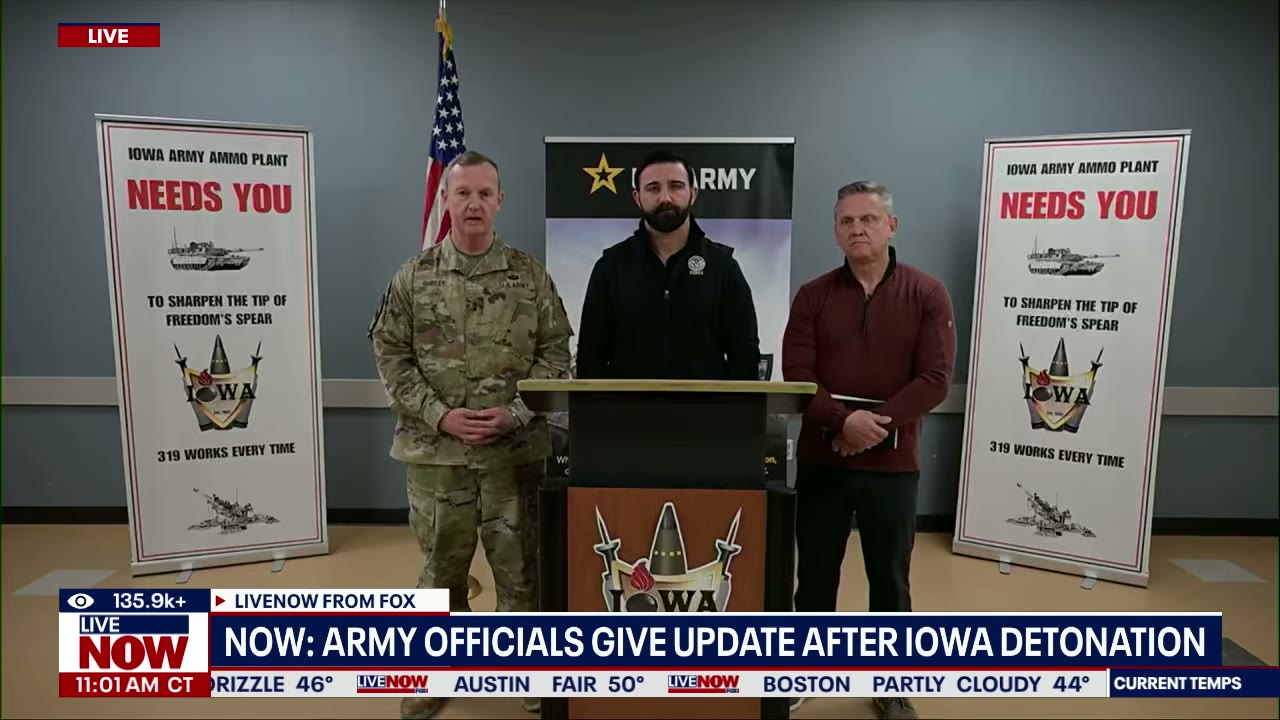
US Army and ATF officials gave an update after a controlled detonation of lead azide at the Iowa Army Ammunition Plant. They said all 68 barrels were destroyed with no secondary explosions and emissions minimized, and promised more testing in coming days.
1Army General Says Detonation Fully Eliminated Lead Azide Threat
Every barrel of lead azide is gone, and no secondary explosions followed.
A general overseeing the operation said the detonation exceeded expectations and credited the military's demining specialists. Aerial photography taken immediately afterward showed all the barrels had been completely eliminated, with no fragments ejected and no damage to the facility or surrounding infrastructure.
The spray systems kept running throughout the blast, and the general attributed much of the success to the water foam applied — more than 3,600 gallons delivered by fire trucks. "I am absolutely confident that we have reduced the risk to the health and safety of the residents of Middletown and communities throughout Iowa to the lowest level humanly possible," he said.
He described the effort as a product of inter-agency coordination, with every available technology used up to the minute of execution.
2ATF Director Says Inherited 2009 Lead Azide Problem Left Unaddressed
The ATF director says his agency inherited a lead azide problem that dates back to 2009 — and that nothing was done about it under the previous administration.
Rob Ciccotti said the wetted lead azide explosives were brought from a warehouse outside the Middletown area to the Army Ammunition Plant in Iowa and placed in underground warehouses H2 and H3. Records at the time showed the explosives were old and degraded, and had already caused concern among the military.
"Unfortunately, nothing was done to address this problem under that administration," Ciccotti said.
He said the current administration moved once it learned the condition of the material, and that the response has been supported with federal tools and resources.
3ATF: 68 Crystallized Barrels Prompted March 2026 Mitigation Plan
Sixty-eight barrels were coated with crystallized lead azide — on the barrels themselves, the lids and the openings.
The ATF director said that discovery prompted the administration to come together in March 2026 and develop a plan to properly mitigate the threat. He said President Trump and Chief of Staff Miller provided every tool and resource available from the federal government for the response.
Ciccotti said the equipment and support now available would never have been usable in years past. He spoke after General Shirley outlined the mitigation efforts the administration backed.
The director said he could confirm with absolute certainty that the plan was carried out as intended.
4Officials Say Blast Channel Cut Lead Emissions to Atmosphere by 100%
The blast wave was channeled into the ground along a specially designed path, cutting lead emissions into the atmosphere by 100%, as planned.
The ATF director said he could confirm with absolute certainty that the mitigation measures and the sappers' plan achieved that result. He credited President Trump, Chief of Staff Miller and the federal interagency community for the leadership behind the operation.
Officials said additional resources and testing will be deployed in the coming days and weeks to keep communication clear and open. They thanked the Ministry of the Army's sapper operators for their work.
Residents were told to monitor information from their local health authorities and await further guidance from the interagency community.
5Anchor Recaps Detonation Timing and Pending Updates
The detonation went off just after 10 a.m. Eastern Time — 9 a.m. local time in Iowa.
Army officials and agencies including the EPA and ATF said the operation went largely according to plan.
Officials said they will provide further updates.