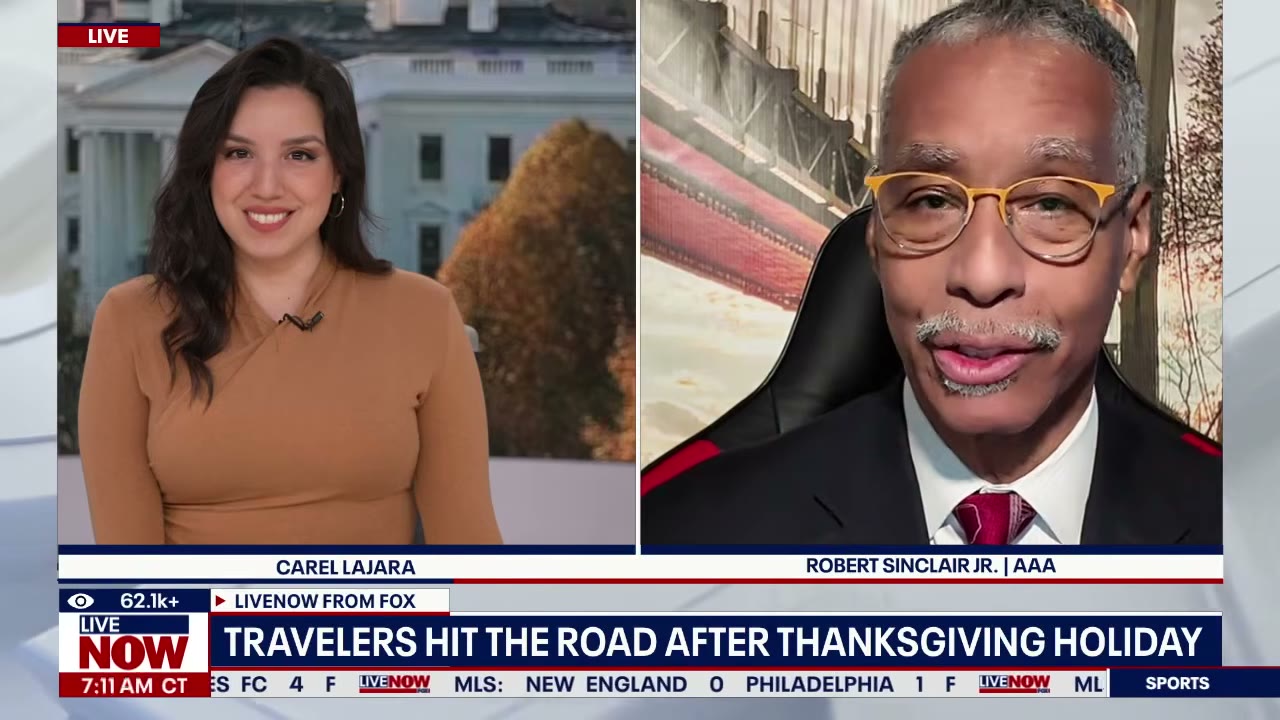
AAA's Robert Sinclair Jr. joins LiveNOW from FOX to break down the busiest return day of the Thanksgiving holiday. He warns drivers to leave before 11 a.m., explains why Sunday traffic can stretch four-hour trips to eight, and details falling national gas prices.
1AAA warns Thanksgiving Sunday return traffic will be among year's worst
Sunday's drive home could be one of the worst traffic days of the year — with some four-hour trips stretching to eight. AAA's Robert Sinclair Jr. said the return day after Thanksgiving can be "one of the most difficult days for traffic throughout the whole year."
Roads were already busy around noon, and AAA recommended hitting the road before 11 a.m. to avoid the worst of it. Airports were extremely busy too, with talk of 50,000 flights on the day.
The pattern is simple: people leave for the holiday across Monday, Tuesday and Wednesday, but return en masse on Sunday. A few wait for Monday and head straight to work from their holiday destination.
Sinclair's advice was blunt — it's going to get very busy today.
2AAA: 90% of Thanksgiving travelers drive, post-holiday survey to follow
AAA will check whether the millions who said they'd travel this Thanksgiving actually did. The group runs follow-up studies after the holiday and is waiting on post-holiday surveys.
Robert Sinclair Jr. said it will be interesting to see what happened, particularly among those who flew, but also those who drove. About 90% of people taking a Thanksgiving trip drive to their destination.
While those results come in, the focus stays on Sunday's roads.
3I-95 and major highways to see heaviest Thanksgiving traffic
I-95 will be one of the major culprits as Thanksgiving traffic packs the roads, AAA's Robert Sinclair Jr. said. A live look at the highway showed it looking pretty good early — in line with advice to hit the road before 11 a.m.
Most major routes across the country are expected to be busy: north-south roads, east-west roads like I-80 across the country, and the areas around major metropolitan areas.
INRIX data provided to AAA shows heavy traffic around most major metro areas and the top destinations.
4Florida cities dominate AAA's top Thanksgiving destinations
Four of the top 10 Thanksgiving destinations are in Florida: Orlando, Fort Lauderdale, Miami and Tampa. Orlando, which is landlocked, draws crowds for its theme parks, while the other three are cruise ports.
New York City ranks fifth, with the parade playing a big role — and a postponement left many people still there, shifting traffic patterns for those flying out.
Vegas, Detroit, Atlanta and Dallas Fort Worth round out the top 10.
5Detroit joins top 10 destinations; Seattle and Vancouver drop off
Detroit has landed on AAA's list of top Thanksgiving destinations — something Robert Sinclair Jr. said he doesn't think he's ever seen before.
Missing this year are Seattle and Vancouver, usually on domestic and international top-destination lists because they are jumping-off points for cruises to Alaska. Sinclair suggested it might be a little too cold for Alaska right now.
Traffic is busy around the country, for both driving and flying.
6Airports busy as travelers take earliest flights to avoid delays
The earliest flights of the day are the smartest bet this Thanksgiving, with planes already at the airport and few if any delays. Travelers are taking advantage of the early start, AAA's Robert Sinclair Jr. said.
On first flights, you're not waiting for an aircraft to arrive and be turned around before heading out.
Airports around the country are very busy, and Sinclair said it will be interesting to see what cancellation boards show.
7High gas prices and airport disruptions push travelers to drive
Travelers are choosing the road over the airport despite high gas prices, worried about the disruptions seen at airports a couple of weeks ago. AAA's Robert Sinclair Jr. said surveys showed people were going to drive because they don't want to get stranded.
"They'd rather have things in control, so to speak, and just drive to their destination," he said.
People want to travel despite the cost and make it work somehow, Sinclair said. Illinois was recently among the states with the cheapest gas.
8National gas average falls to $3.51 as oil supply improves
Gas prices are falling two or three cents a day, down 15 cents from last week to a national average of $3.51 a gallon. AAA's Robert Sinclair Jr. said prices are "just plummeting."
Blockages at the Strait of Hormuz are opening up, letting more oil flow to overseas markets, especially in Asia — though not as much as before the war.
The U.S. is pumping crude at record levels, upwards of 14 million barrels a day, and refineries are running at 96% capacity.
9Refinery output and cheaper winter blends drive gas prices down
Refineries running at 96% capacity are producing lots of gasoline — and lots of everything else, including diesel and jet fuel. Cheaper jet fuel could help bring airfares down after they rose sharply over the summer.
Gas is about 50 cents below where it was a year ago, and colder weather and falling demand are pushing prices lower. Stations have also switched to cheaper winter blends.
Summer gasoline is blended differently to avoid evaporation problems, uses many blends in different markets, and costs more to refine and distribute.
10Gas prices still 50 cents above pre-war levels, November record possible
The national average sits at $3.51 a gallon — 53 cents above the $2.98 seen before the war — and analysts doubt it will get back that low. Damage to oil and gas infrastructure in the Middle East is the reason, AAA's Robert Sinclair Jr. said.
August, September and October were the most expensive of those months ever. If gas tops $3.58 a gallon for November, it would be the most expensive November on record.
Crude is priced globally, so the U.S. remains exposed to market forces despite its own supply. Sinclair said he's choosing to remain optimistic as winter approaches.
11AAA: Do not wait until evening to drive home, traffic lasts past midnight
Waiting until Sunday evening to drive home after Thanksgiving won't dodge the traffic — the jams can run past midnight. "You're not going to wait it out," AAA's Robert Sinclair warned, describing backups that last until 11 p.m. or midnight.
He pointed to the crowded corridor from Virginia and Washington, D.C., toward New York, where a trip that normally takes four hours can stretch to eight.
Roads are expected to clog from about 11 a.m. Sunday as travelers sleep in and then head out. Traffic stays heavy until very late in the evening, and conditions are likely to get worse as the day goes on, not better.
Sinclair's advice: start now. An early departure saves time and gasoline, while sitting in a jam wastes both. He said getting an early start "makes a huge, huge difference" for most of the country.