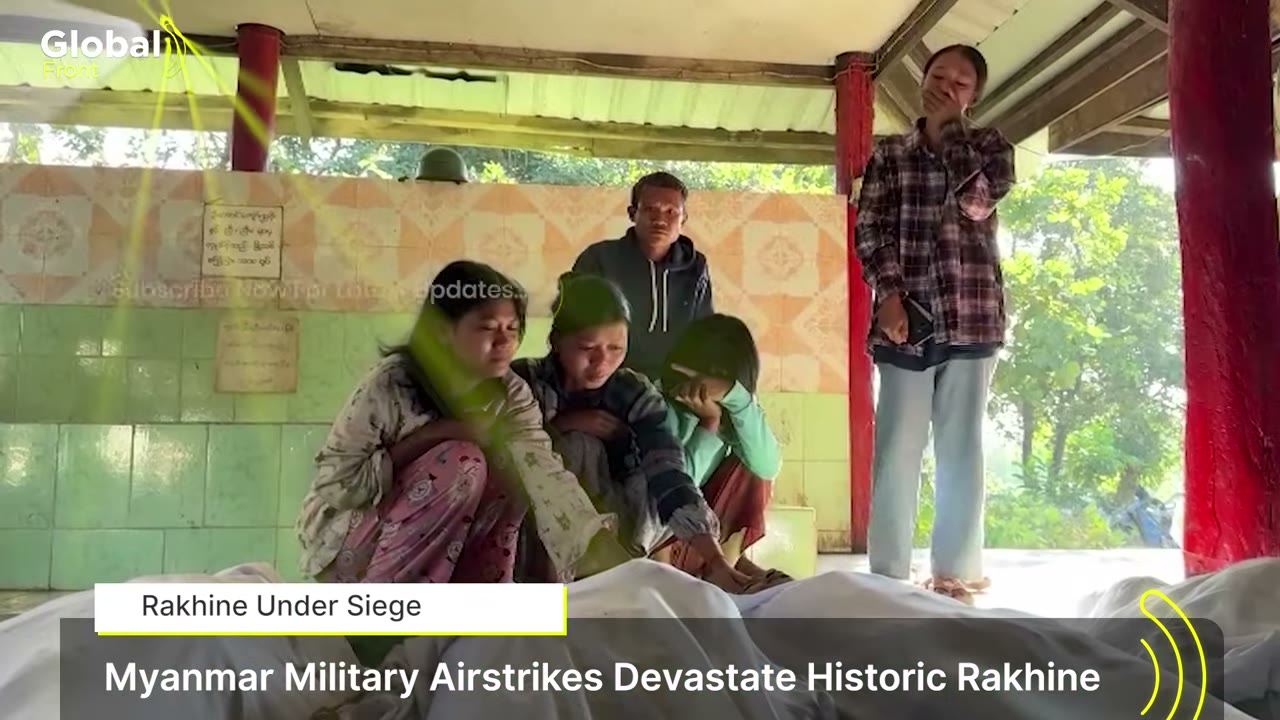
Two military airstrikes on the historic town of Mrauk-U in Rakhine State destroyed homes and killed at least 24 civilians, according to rescue workers. The strikes come days after the ICJ found Myanmar responsible for genocide against the Rohingya, intensifying scrutiny of President Min Aung Hlaing's government.
1Myanmar Airstrikes Hit Mrauk-U, Killing at Least 24 Civilians
Two military airstrikes have killed at least 24 civilians in Mrauk-U, the historic town in western Myanmar's Rakhine state. Footage from the area shows damaged homes, scattered debris and residents picking through the rubble of collapsed buildings.
The strikes hit on November 28, 2026, amid fighting between the military and armed resistance groups. Initial reports counted 19 dead in the second strike; a senior rescue worker now puts the toll from both at at least 24, with more than two dozen injured.
Wai Khan Aung, a senior Rakhine state rescuer, warned the death toll could climb much higher. The final figure remains unknown as emergency teams struggle to establish how many people were affected.
2Displaced Father Hla Than Aung Loses Teenage Daughter in Strike
A 62-year-old displaced man ran toward the airstrike calling his teenage daughter's name. Hla Than Aung's only thought, he said, was to save her life. She did not survive.
His loss is one story from Mrauk-U, where residential communities and areas essential to daily civilian life were reportedly hit. For residents, the strikes are a personal tragedy, not just another military development.
Many displaced people across Rakhine live in increasingly difficult conditions, with limited money and unstable access to healthcare, food and other basic services. Finding a safe place to live has become a daily concern.
3Myanmar Military Offers No Response on Reported Civilian Casualties
Myanmar's military-backed government has not publicly responded to the reported airstrikes on Mrauk-U. The military has previously said its operations target legitimate military targets and armed resistance organizations.
Local reports of civilian casualties continue to raise concerns about the protection of residents not taking part in hostilities. The exact military objectives of the recent operations have not been established by independent sources.
The silence leaves open the question of whether civilians can find real protection in areas engulfed by fighting.
4Arakan Army Controls Rakhine as Territorial Power Shifts
Rakhine State has been under the control of the Arakan Army since February 2024. The ethnic armed group has expanded its influence over much of the state, significantly changing the balance of power in western Myanmar.
Its territorial gains are a serious challenge for the central government, which continues to try to reassert control over regions held by opposition forces. The group seeks greater autonomy for Rakhine.
But territorial control does not erase legal protections for civilians. Under international humanitarian law, all parties to a conflict must distinguish between civilians and combatants and take all possible measures to minimize harm to civilians.
5Mrauk-U's Ancient Heritage Threatened by Repeated Clashes
Mrauk-U was once the capital of the powerful Mrauk-U Kingdom, home to ancient temples and archaeological sites reflecting centuries of Rakhine history. It has long been considered one of Myanmar's most important historical sites.
Today, international attention focuses on the suffering of its inhabitants rather than its history. Recurrent military clashes have transformed security in the region.
Destroyed homes can leave entire families homeless. Damage to commercial areas could disrupt food and essential goods, while health service disruptions can cut vulnerable residents off from treatment.
6Conflict's Toll: Homeless Families, Food Shortages and Lost Schooling
Destroyed homes and damaged commercial areas are pushing families in Rakhine toward homelessness and food shortages. Damage to shops could disrupt the supply of essential goods, and health service disruptions can leave vulnerable residents without treatment.
For children, the consequences include interrupted education, forced displacement and prolonged psychological distress. The elderly and those with chronic illnesses may need care that becomes increasingly unavailable during conflicts.
Myanmar's humanitarian crisis did not begin with the latest incident. The country has faced widespread political instability since February 1, 2021, when the military ousted the elected government.
7Myanmar's Crisis Traces Back to 2021 Military Coup
Myanmar's military ousted the elected government led by Aung San Suu Kyi on February 1, 2021. The coup provoked large demonstrations across the country, with citizens demanding the restoration of democratic governance.
As the political conflict escalated, armed resistance organizations emerged, joining ethnic groups already in long-standing disputes with the central government. The crisis grew into a nationwide conflict involving multiple armed groups and fragmented territorial control.
Min Aung Hlaing, who led the coup, is now president. He took office in April 2026 after elections criticized by opposition groups and international human rights organizations.
8Min Aung Hlaing Takes Presidency After Criticized Elections
Min Aung Hlaing became president of Myanmar in April 2026, after elections that faced widespread criticism from opposition groups and international human rights organizations. The coup leader now leads a military-backed government.
That formal political transition has not ended the conflict. Large parts of the country remain engulfed in fighting, and opposition organizations continue to question the legitimacy of the system established under military rule.
In Rakhine, the Arakan Army seeks greater autonomy, while the military-backed administration emphasizes national unity and territorial integrity. The confrontation shows no sign of a quick resolution.
9ICJ Finds Myanmar Responsible for Genocide Against Rohingya
The International Court of Justice found Myanmar responsible for genocide during military operations against the Rohingya, a predominantly Muslim minority in Rakhine State. The landmark ruling came on November 19, 2026.
The decision capped a multi-year legal process initiated by Gambia in November 2019. The case concerned allegations of military repression that forced hundreds of thousands of Rohingya to seek refuge in neighboring Bangladesh.
For many displaced families, the ruling was an important recognition of the suffering they had endured.
10Min Aung Hlaing Rejects Some ICJ Demands
President Min Aung Hlaing says his administration will not accept all the demands imposed by the International Court of Justice. He said Myanmar would act as a responsible state but would not comply with demands it considers inappropriate.
He did not specify which demands his administration rejects. The court ordered Myanmar to address the consequences of the violations, including facilitating the safe return of displaced Rohingya, providing adequate compensation and protecting the community from further persecution.
The court also called for accountability through investigations and trials against individuals reasonably suspected of involvement in previous atrocities.
11ICJ Genocide Ruling Does Not Settle November 28 Strike Legality
The ICJ's genocide ruling does not automatically establish the legal circumstances of the November 28 airstrikes. Those events require separate consideration and independent investigation.
The court's findings concern the previous Rohingya crisis, not the recent reports from Mrauk-U. Meeting the court's requirements remains a significant challenge as long as the armed conflict continues and political differences persist.
Still, recent reports of civilian suffering have heightened concerns about the humanitarian situation across Rakhine State.
12Rakhine's Border Location Gives Crisis Regional Reach
Rakhine State borders Bangladesh and faces the Bay of Bengal, so instability there can spill beyond Myanmar's borders through refugee displacement, humanitarian pressures and disruption of economic activity.
Bangladesh continues to host a significant number of Rohingya refugees, many of whose families have spent years in displacement camps. Their ability to return home remains closely linked to security conditions inside Myanmar.
Sustainable return would require guarantees of safety, protection from discrimination and access to basic rights and essential services. Ongoing hostilities make creating those conditions increasingly difficult.
13UN Reports 3.6 Million Internally Displaced Across Myanmar
About 3.6 million people were internally displaced across Myanmar as of August 2026, according to a UN report, while millions more were experiencing acute food shortages.
The figures show the enormous scale of the country's problems. Humanitarian organizations trying to support affected communities face restrictions, security concerns and difficulties reaching areas controlled by various armed groups.
In Rakhine State, those challenges have become particularly pronounced.
14Movement Limits and Hospital Shelling Strain Rakhine Health Care
A hospital in Myanmar's Rakhine State was shelled in December 2025, renewing fears that medical care itself is becoming a casualty of the conflict. The MROU's general hospital was hit, the latest serious incident for a facility already short on resources.
Restrictions on movement and limited transport stop families from reaching hospitals, buying essentials or fleeing to safer areas. Each new emergency piles more pressure on exhausted healthcare workers.
International humanitarian law gives special protection to medical facilities and personnel, subject to narrowly defined exceptions. Access to urgent treatment remains critical for wounded civilians, and communities will need long-term support beyond emergency aid.
15Rebuilding Homes and Livelihoods Will Take Years
Rebuilding Rakhine's shattered homes and livelihoods will take years, not months. Damage to houses, businesses and trade has left entire communities facing financial hardship.
Emergency aid alone won't be enough. Restoring livelihoods and helping displaced families return to stable living conditions will require significant time and resources, according to the account.
For families already displaced multiple times, recovering from another devastating incident grows harder with each round. Local businesses that lose property and trade drag whole communities down with them.
16Access Limits Leave Casualty Figures Uncertain and Unverified
Casualty figures from Myanmar's conflict can differ between rescue workers, local organizations and armed groups, and limited access is a big reason why. Journalists and human rights investigators struggle to document events across the country.
Communication difficulties make it hard to collect complete information about individual incidents, the account says. That helps explain why preliminary tolls diverge.
The discrepancies don't diminish the gravity of the humanitarian situation, but they do highlight the importance of carefully verifying what information is available.
17UN Reports Document Abuses by Both Military and Arakan Army
United Nations human rights reports have documented serious allegations against both the Myanmar military and the Rakhine State Army over the treatment of Rohingya communities. The responsibility to protect civilians lies with each party in the conflict, the account says.
Restrictions on movement and interference with essential services show why accountability matters, regardless of which organization holds power in a given area.
The allegations put both sides under scrutiny as international pressure over civilian protection grows.
18ASEAN Diplomacy Struggles to Reduce Violence in Myanmar
Regional diplomacy has repeatedly failed to deliver a lasting settlement in Myanmar. ASEAN has tried again and again to encourage dialogue and reduce violence, but a coordinated, effective response remains out of reach.
Divisions between political and military organizations are deep-rooted. The international community still faces difficult questions about how to push meaningful political progress.
Without real cooperation between the parties, diplomatic initiatives alone will struggle to change the situation on the ground, the account says.
19Airstrikes Deepen Scrutiny of Min Aung Hlaing's Government
New reports of civilian casualties in Rakhine are raising fresh questions about military operations, and they land on President Min Aung Hlaing at a difficult moment. His government's response to the international genocide ruling is already drawing considerable attention.
Any solution, the account says, must address political representation, regional autonomy, protection of civilians and the fundamental rights of Myanmar's diverse ethnic communities.
For the Arakan Army, controlling large parts of Rakhine brings responsibility for the civilians living there, including humanitarian access and protecting minorities.
20Rakhine Residents Need Shelter, Medical Care and Food
Behind every loss figure from Rakhine is a family facing irreparable loss. For ordinary residents, the priorities are simple: safe shelter, medical care, food and reassurance their families are not in further danger.
Images from the historic city show the devastating effects of fighting that has repeatedly disrupted daily life. Rescue efforts continue and more information is emerging about the events of November 28.
Questions remain over the final death toll, the circumstances of the military operations and what will be done to prevent further civilian suffering.