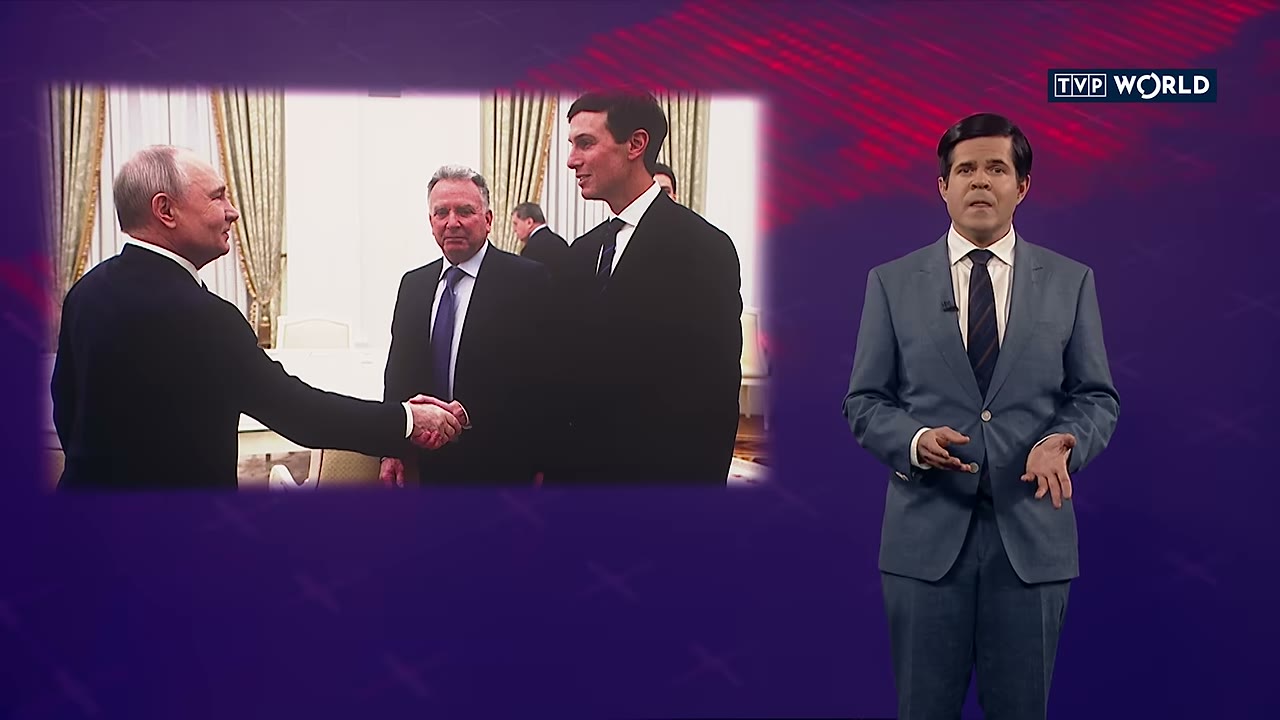
TVP World's Break the Fake examines Steve Witkoff and Jared Kushner's repeated Moscow visits, arguing Putin has no incentive to end the war. It also covers Russia's gasoline shortages and Rosneft's fuel quotas after Ukrainian drone strikes on refineries.
1Trump Envoys' Repeated Moscow Trips Yield No Real Peace Progress
Steve Witkoff and Jared Kushner have flown to Moscow so often that critics joke they will soon qualify for permanent residence in the Russian capital — and peace in Ukraine has still not advanced. The special envoy and the president's son-in-law have made the shuttle a routine, but the results are described as contradictory.
Critics call the latest meeting a "copy-paste" of old clichés, with no substantive change. The Kremlin presented the agreement to evacuate Konstantinovka as the only small step forward it is willing to take — a gesture one analysis likened to a bone thrown to the dogs rather than a serious move toward peace.
Moscow holds firm elsewhere, declaring it will achieve its goal one way or another. The argument is that as long as Washington keeps knocking on the same closed door, Vladimir Putin has no incentive to stop the war. Previous hints of a carrot-and-stick approach, such as Lindsey Graham's act, have faded, and after the failed diesel deal the whip is missing.
Kushner said the proposals are not carte blanche for Russia and come with conditions, including full respect for the sovereignty, territorial integrity and independent decision-making of the nations involved. He also said Europe needs a seat at the negotiating table.
The cycle repeats: Kushner goes to the Kremlin, Putin offers compliments, the head of a Russian investment bank, Kirill Dmitriev, talks big business, and everyone disperses — while victims in Ukraine mount every day.
2Russia's Fuel Crisis Returns as Rosneft Imposes Sales Quotas
Rosneft has capped how much fuel drivers can buy at its stations across Russia: no more than 30 liters per fill-up inside city limits, and 50 liters on rural roads. The country's leading fuel giant imposed the restrictions as the gasoline shortage returns.
The timing was awkward. The quotas coincided with another visit by unidentified drones to a Rosneft regional oil refinery — the fourth in the past 10 days. Ukraine has resumed systematic attacks on the Russian oil refining industry, and Russia is again in a fuel crisis, breaking what was described as a forced pre-election minimum caused mainly by political pressure from Washington.
Social networks have flooded with anger from drivers complaining about queues, quotas and being unable to properly refuel in a country that for years boasted of rivers of oil. The outrage targets gas station owners, local officials and speculators — but, the commentary notes, Russians stubbornly avoid the main question: why won't Vladimir Putin end the war, after which the refineries would instantly stop burning?
Ordinary drivers count every kilometer while the cause sits in the Kremlin, one line of argument runs. Putin, with his fleet of limousines and entourage, faces no such limits — unlimited fuel, no "only 50 liters today."