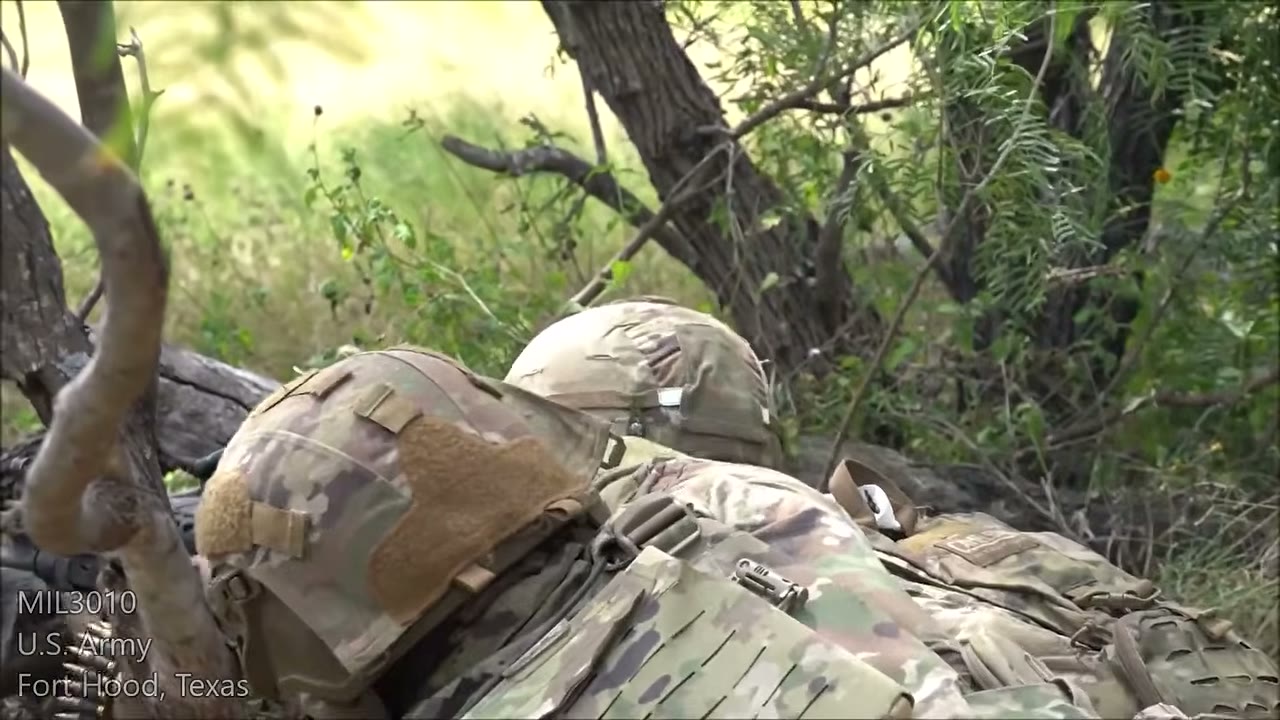
Soldiers at Fort Hood run live-fire and anti-armor drills, including bounding drills, small-arms engagements and a call to destroy a BTR. The footage shows squad-level tactics and radio coordination during training.
1Soldiers zero weapons and practice three-round bursts on first target
Soldiers at Fort Hood zeroed their weapons and drilled three-round bursts on the first target, with safety drilled into every rep. A range instructor walked the line, calling for a lower hold and reminding troops to keep the weapon on safe and their finger away from the trigger. The command "Three five round burst" set the rhythm before the order "On first target" sent rounds downrange. It was marksmanship fundamentals under live-fire discipline: hold, burst, then safe the weapon. The same routine — weapon on safe, finger off the trigger — framed the drill from start to finish.
2Squad advances and engages targets 200 meters ahead with rapid fire
A squad pushed forward at Fort Hood, calling out targets 200 meters ahead and switching to rapid fire. "Let's push. Let's push. Let's go," the order came, followed by "Lucille, go on the left." A soldier announced a shift to rapid rate of fire and engaged target six. Then the call: "Targets up ahead, 200 m." The squad kept the volume up, directing Gazo forward and ordering a two-round burst — "two round double tap" — before the command to fire two and get down. Movement, communication and volume of fire, all in one advance.
3Soldiers reload and shift fire between left and right sides
Reloads and shifting fire kept the squad busy, with orders flying between the left and right sides. "He's reloading," someone called, then "Pick up your weapon, fire with me." Fire was directed right, then left: "Our left side, shoot. Left side down." A reload call went up, and the squad answered with "Right side down, left side" and a final "Right side." Troops managed their magazines while keeping fire on both flanks — the kind of drill that tests coordination as much as aim.
4Leaders review sight picture and low-aim corrections after firing
After the firing, leaders worked through sight picture and aim — and the correction was to aim lower. "I saw them they were going high. So, I had to go lower and lower," one soldier said. Another admitted he couldn't give a correction because he couldn't see the shooter. The fix was simple: rounds were landing high, so the hold came down. Then the focus shifted to a new order — destroying a BTR.
5Soldiers receive orders to destroy a BTR with a SAL low-ball hot fire engagement
A soldier received orders to destroy a BTR to stop it from flanking the position. "I need you to destroy that BTR in order to prevent them from flanking our position," the order came, clearing the soldier to engage with a SAL low-ball hot-fire mission once the unit crossed phase line Alabama. The soldier read back a BTR at grid Romeo Papa Victor 2313 6880 and confirmed the SAL low-ball would come after Alabama, with a call of engagement complete to follow. The sequence was tight: cross the phase line, call IP1 inbound, fire, then report the engagement complete.
6Radio traffic confirms coordinates and engagement phase line
Radio traffic confirmed the strike plan: a SAL low-ball engagement tied to phase line Alabama, with a call of engagement complete to follow. The next checkpoint, IP 2, came back as "10-4 3500." Coordinates and phase lines were read back to keep the anti-armor mission on track.