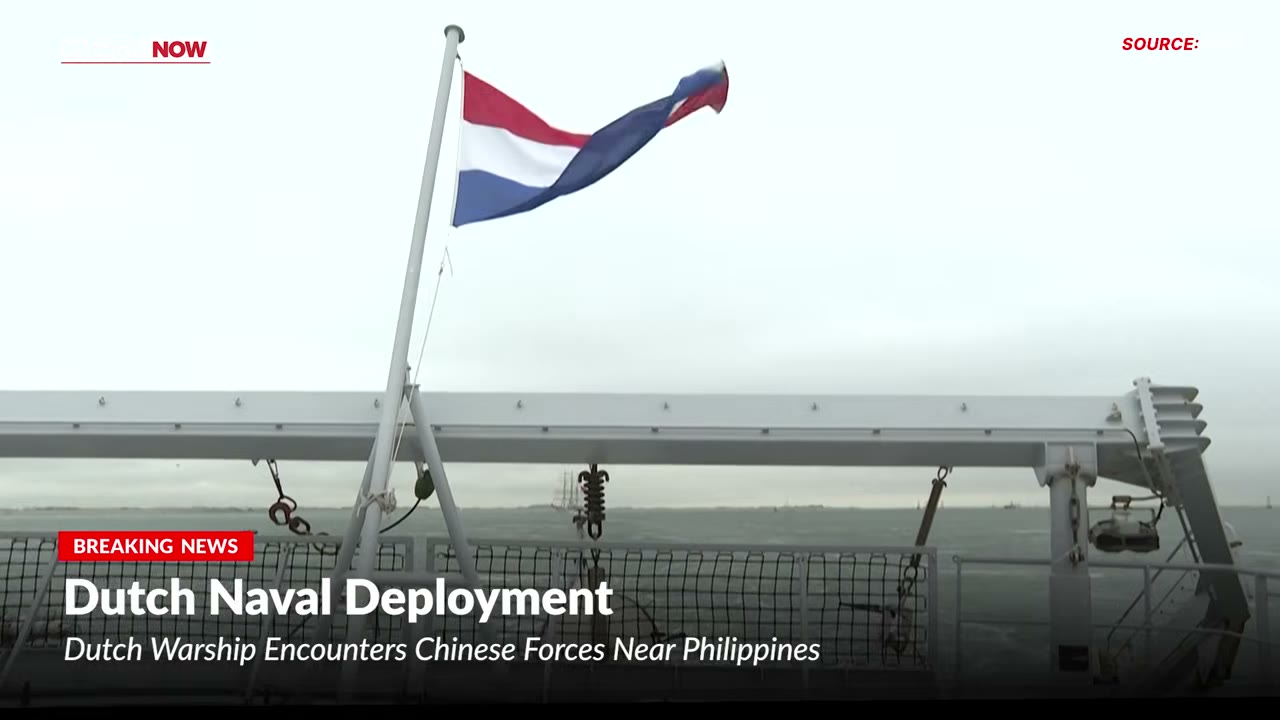
A Dutch navy frigate visited Manila to mark 75 years of Philippines-Netherlands ties, but its deployment led to confrontations with Chinese forces near the Paracel Islands. The incidents highlight Europe's growing role in South China Sea tensions and Manila's expanding defense partnerships.
1Dutch Frigate HNLMS Tromp Arrives in Manila for Goodwill Visit
A Dutch warship has arrived in Manila for the first time, carrying Europe's growing stake in the South China Sea. The Royal Netherlands Navy frigate HNLMS Tromp reached the Philippine capital on May 22, 2026, for a three-day goodwill visit marking 75 years of diplomatic ties between the Philippines and the Netherlands.
The deployment showed Europe's expanding strategic interest in the Indo-Pacific, where freedom of navigation, maritime security and international law have become priorities.
The visit also came amid rising maritime tensions between the Philippines and China. What began as a goodwill mission led to clashes with Chinese military forces, exposing differences between Beijing and European governments over maritime rights.
2Chinese Helicopter Approaches Dutch Warship in West Philippine Sea
A Chinese military helicopter approached a Dutch frigate passing through the West Philippine Sea before the ship reached Manila. The aircraft came to establish its identity, and the two sides communicated. The encounter ended without further escalation.
Commander Roger de Wit, who commanded HNLMS Tromp during the deployment, described the interaction as professional, saying the Chinese personnel asked for identification before departing. "They asked who we were, we answered, and that was enough," he said.
No territorial warnings were recorded during the first encounter, and the frigate continued to Manila. The Netherlands said the deployment was not meant to assert territorial claims but to support international maritime law and safe commercial trade routes.
3HNLMS De Ruyter Deployment Part of Operation Pacific Archer
A Dutch air defense and command frigate has been deployed on a mission originally planned to last five months, carrying an NH90 naval helicopter aboard. HNLMS De Ruyter is a De Zeven Provinciën-class ship equipped with modern surveillance, communications and defense systems.
The helicopter allows the crew to conduct surveillance and support broader maritime security operations. The deployment was part of Operation Pacific Archer, which included diplomatic activities, international naval exercises and cooperation with regional security partners.
Commander Roger de Wit emphasized the mission's purpose: "We are here to promote freedom of navigation."
4Dutch and Philippine Navies Exchange Maritime Experience in Manila
Dutch and Philippine navy personnel used the Manila visit to swap professional experience, improve coordination and strengthen understanding of each other's maritime procedures. The exchange gave the Philippine Navy a chance to develop operational capabilities while expanding cooperation with countries beyond its traditional security partners.
The visit came as the Philippines continued to widen its defense partnerships amid maritime tensions with China.
5China Accuses Dutch Frigate of Invading Paracel Islands Waters
China's military announced it deployed naval and air forces against Dutch warships near the disputed Paracel Islands on May 27, days after a Dutch frigate arrived in Manila. Beijing accused the frigate HNLMS De Ruyter and its helicopter of invading territorial waters and airspace claimed by China.
The Chinese military command said it issued a warning and took additional measures to force the Dutch ship to leave. Zhai Zhijian, spokesman for the Southern Command of the People's Liberation Army, issued a stern warning to the Netherlands: "We strongly oppose this and strongly urge the Dutch side to immediately cease its violations and provocative actions."
The Netherlands insists its frigate acted in accordance with international law, and Dutch authorities reported their helicopter had a potentially dangerous incident involving Chinese military aircraft. China's claim that it forced the frigate away has not been confirmed by independent sources.
The Paracel Islands, controlled by China, are also claimed by Vietnam and Taiwan, making naval and air activity there particularly sensitive.
6Netherlands and Philippines Deepen Defense and Maritime Cooperation
The Netherlands and the Philippines have laid the groundwork for deeper defense and maritime security cooperation, according to Mariel Lajarret, who was Dutch ambassador to the Philippines during the frigate's visit. The Netherlands has since appointed Roderick Wallace as its ambassador to Manila.
No confirmed arrangements exist for a permanent Dutch military presence in the Philippines, despite Dutch interest in expanding security cooperation.
On May 18, Philippine Foreign Secretary Maria Teresa P. Lazaro met Dutch Foreign Minister Tom Bruijnen in The Hague. Both sides reaffirmed plans to expand cooperation in defense, maritime and cybersecurity, trade, investment and renewable energy, and backed peaceful resolution of disputes and the 2016 South China Sea arbitration award.
7Netherlands Backs 2016 South China Sea Arbitration Award
The Netherlands has backed the 2016 South China Sea arbitration award, the ruling that stated China has no legal basis to claim historical rights to marine resources beyond the limits set by the UN Convention on the Law of the Sea.
The tribunal did not determine sovereignty over the disputed islands, but its findings were a major legal victory for the Philippines. China rejected the decision and continues to insist on its extensive maritime claims.
Dutch support for the ruling shows the importance Amsterdam attaches to international law in its relations with Manila.
8South China Sea Trade Routes Vital to Dutch and Philippine Economies
The South China Sea is one of the world's most important commercial waterways, linking Asia's manufacturing centers with markets in Europe, Africa and the Middle East. Ships carry huge volumes of energy, industrial equipment, consumer goods and agricultural products through it every year.
Any significant disruption could raise transportation costs, delay international shipments and put heavy pressure on global supply chains.
For the Netherlands, home to the major port of Rotterdam, stable maritime trade routes are tied directly to national economic interests. For the Philippines, the stakes are more immediate: fishing communities depend on access to marine resources, and energy security and future economic development are closely linked to offshore interests.
9Philippines Reports 48 Chinese Vessels and H6 Bomber in November
The Philippines reported 48 Chinese naval and coast guard vessels in selected areas of the West Philippine Sea between November 17 and 23, up from 19 in the previous monitoring period. The Armed Forces of the Philippines recorded the sightings.
Philippine authorities also confirmed a Chinese H6 strategic bomber over the West Philippine Sea, while the Philippine Coast Guard reported another dangerous maritime incident near Panat Island.
Under President Ferdinand Marcos Jr., Manila has expanded defense ties with the United States, Japan, Australia and several European countries. The November sightings showed tensions remain unresolved despite diplomatic engagement.
10Marcos and Wang Yi Discuss Reducing Maritime Tensions at APEC
Diplomatic channels remain open even as maritime confrontations continue. President Ferdinand Marcos Jr. discussed reducing maritime tensions with Chinese Foreign Minister Wang Yi during the APEC summit in Shenzhen.
On November 25, Dutch Foreign Minister Kaspar Veldkamp met Wang Yi in Beijing, where the two governments agreed to maintain diplomatic contacts and expand economic cooperation.
The meeting showed the Netherlands continues to seek constructive relations with China despite earlier disagreements on maritime issues.
11Debate Over Foreign Naval Cooperation in Contested Waters
Manila rejects any suggestion that a Dutch frigate's visit marks a new November deployment, insisting the Philippines has the sovereign right to build international security partnerships. Supporters of wider naval cooperation say such ties strengthen maritime security, deter coercive behavior and give smaller nations more diplomatic and strategic options.
Critics warn more foreign military activity could create fresh chances for misunderstandings and dangerous incidents.
Beijing keeps opposing foreign military operations it sees as threatening its sovereignty and national security.
For Manila, the partnerships are about protecting maritime rights under international law. The debate now turns on whether more foreign navies in contested waters calm the region or raise the risk of a clash.
12Dutch Deployment Shows Limits of Single Mission in Maritime Disputes
A single Dutch frigate cannot undo decades of South China Sea disputes — and its Manila visit showed how fast calm can turn. A first encounter between a Chinese helicopter and HNLMS De Ruyter was handled with professional communication that prevented unnecessary escalation.
Then a confrontation near the Paracel Islands showed how quickly circumstances change when military operations meet competing territorial claims.
For Manila, international partnerships remain central to its maritime defense strategy. Amsterdam says its Indo-Pacific engagement protects commercial interests, open shipping lanes and international legal principles. Beijing views the growing foreign naval presence as another challenge to its strategic objectives.
The visit has ended; the questions it raised have not.