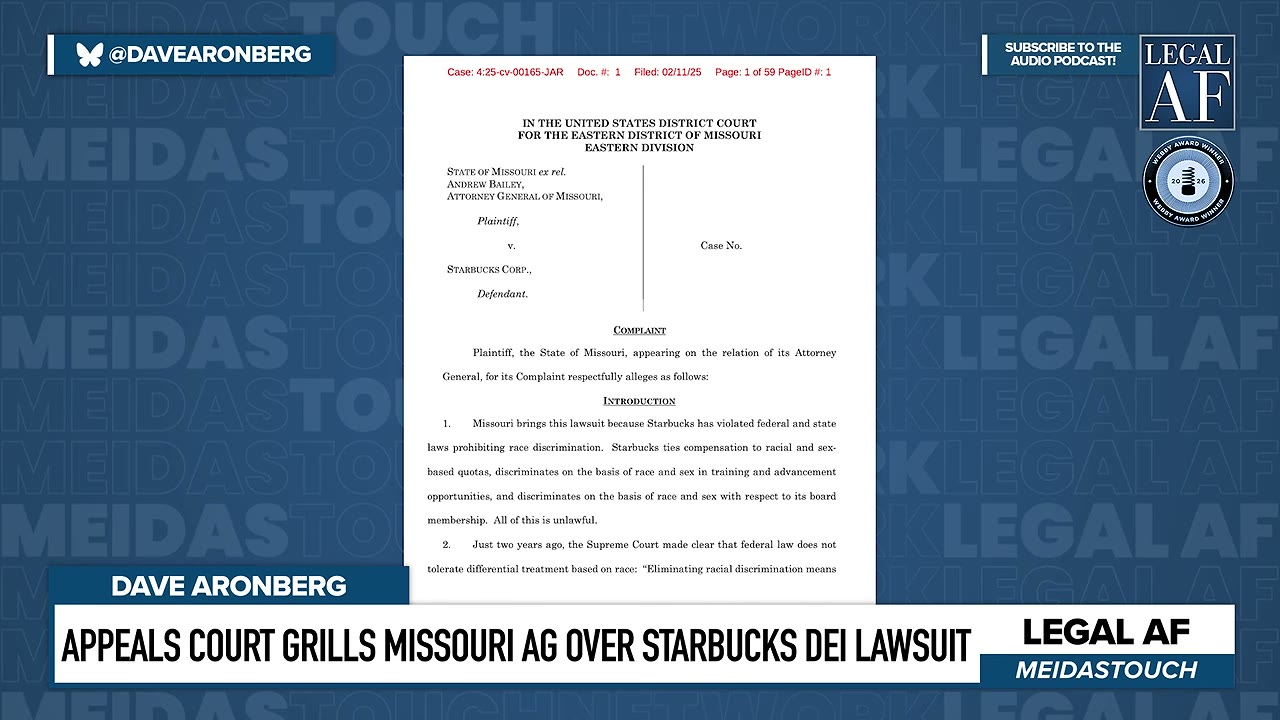
Missouri's Republican attorney general sued Starbucks over its diversity policies, but a federal judge dismissed the case for lacking an identifiable victim. On appeal, three judges all appointed by Donald Trump questioned whether the state simply targeted a company it disliked.
1Missouri AG sues Starbucks over DEI policies, alleges quotas
Missouri sued Starbucks over its diversity policies — without naming a single person who was allegedly harmed. Then-Attorney General Andrew Bailey filed the lawsuit last February, accusing the coffee giant of unlawful discrimination through its DEI policy.
The state alleged Starbucks tied executive compensation to racial and gender quotas, favored certain demographic groups for career advancement, and sought greater racial diversity on its board of directors. Missouri argued the policy violated federal and state civil rights laws.
Bailey later joined the Trump administration as co-deputy director of the FBI. The Civil Rights Act protects everyone, and being denied a promotion because of your race can be grounds for a lawsuit. But there is a difference between a diversity initiative and actually committing unlawful discrimination.
2Judge dismisses Missouri lawsuit for failing to name one victim
A federal judge threw out Missouri's lawsuit against Starbucks in a 47-page decision — because the state could not identify a single Missouri resident who was harmed.
U.S. District Court Judge John Ross found Missouri failed to properly determine damages to, in his words, "at least one Missouri resident." There are over 200 Starbucks locations in Missouri.
Not a barista, not a store manager, not a job applicant was named. The law requires proof that someone was harmed before the doors of court open. Missouri appealed.
3Three Trump-appointed judges grill Missouri on appeal
Missouri's appeal landed before three Eighth Circuit judges — all appointed by Donald Trump. It did not go as the state hoped.
Judge Daniel Traynor reportedly asked whether the attorney general was simply looking for a company to target, and whether Starbucks was singled out for being considered "woke." Judge Stephen Grass questioned the lack of factual details in the lawsuit.
Judge Ralph Erickson wanted to know why the state had not identified the individuals allegedly discriminated against, and why those people could not file their own lawsuits.
4Host says life-tenured judges can stay independent of politics
Three judges appointed by Trump — the panel Missouri likely counted on — turned skeptical of the state's case. Article III judges are appointed for life, and that independence can outlast the politics of the president who picked them.
Judges appointed by Democrats and Republicans alike, including Trump himself, have acted as safety nets when the legislative branch abandoned its role as a check on power, the argument goes. When one branch pulls back, pressure builds on the judiciary to restrain the executive.
Instead of home field advantage, the Missouri attorney general seemed to be booed by his own people.
5Missouri says it will find discrimination evidence after suing
After the tough questions, Missouri's answer was essentially: give us time, and we'll find the victims later.
The state argued it would be able to identify individual cases of discrimination once litigation moved forward. In practice, a motion to dismiss tests whether you have enough before you get there.
First you investigate, then you sue — not the reverse, the argument goes. Evidence disclosure is powerful but costly and comes later. Without a factual basis up front, officials could drag disfavored companies through court as punishment, win or lose.
6Legal doctrine parens patriae and standing explained
At the heart of the case is a Latin doctrine: parens patriae — the state acting as protector of its residents' interests. It lets attorneys general sue over the health, safety and economic well-being of citizens.
The power is not limitless. A state cannot simply claim to represent the people of Missouri and walk into federal court. It must establish standing — the legal right to sue.
The judges are questioning whether Missouri sufficiently proved its residents suffered actual harm. Missouri does not have to prove everything at the filing stage, but it needs enough factual allegations to get through the door.
7Florida and 19 states back Missouri; Florida settles own case
Twenty states, led by Florida, filed a petition backing Missouri's bid to revive the lawsuit. Florida's Republican attorney general had already run its own case against Starbucks.
Florida settled its suit in September for a million dollars and a commitment to the company's employment practices, without admitting guilt.
Many Republican attorneys general have a vested interest in the outcome. For years conservatives have complained about activist lawyers, activist judges, frivolous lawsuits and government overreach — and the legal system used as a weapon.
8Host warns of government weaponization against companies
The appeals court has not ruled. But the questions from the bench suggested Missouri is heading for a major defeat.
Judges sometimes press lawyers who ultimately win. These questions looked different — skeptical of the whole approach, essentially asking: where is the real harm? Where is the victim?
Going after a company just because you dislike it raises the same abuse-of-government-power concern for Democrats and Republicans alike. If Missouri cannot prove harm, the case will not last long.