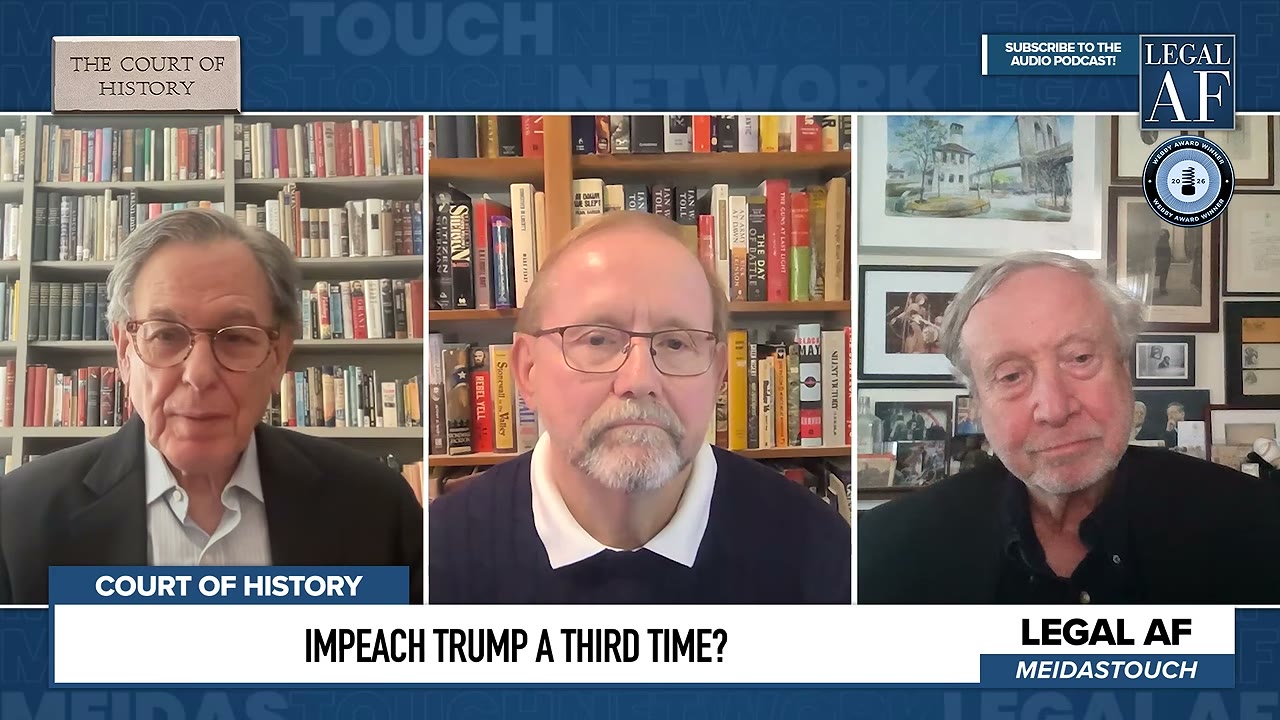
A law professor who testified during Bill Clinton's impeachment says there are grounds to impeach Donald Trump a third time, citing at least a dozen acts in his second term. He also warns conviction is unlikely and Democrats should not open with impeachment.
1Professor Bowman argues Trump's third impeachment is constitutionally justified
A law professor who testified during Bill Clinton's impeachment says there are grounds to impeach Donald Trump a third time. Frank Bowman, professor emeritus at the University of Missouri School of Law, makes the case in a book due out in January titled "Great and Dangerous Offenses: The Arguments for and Against Trump's Third Impeachment."
Bowman was a federal prosecutor for almost 10 years and worked in the U.S. Attorney's Office in Miami. He is also the author of "High Crimes and Misdemeanors: A History of Impeachment in the Age of Trump," published in 2019.
The Supreme Court's ruling on presidential immunity may have created obstacles to considering Trump's crimes in office, Bowman said. The question is whether that makes impeachment more necessary or harder given the political risks.
2Bowman says Trump violated the Constitution's anti-monarchy design
The Constitution was written in 1787 to make sure the new American government would not be a monarchy. Bowman argues Trump has violated that design in countless ways.
In his book, Bowman focuses on Trump's behavior during his second term. He says Trump's offenses all fall under one umbrella: violating the anti-monarchical structure of the U.S. Constitution.
The framers built in provisions to stop the chief executive from holding the powers of the English monarch, including control over Parliament through corruption. Bowman says Trump has violated countless of those provisions and was essentially trying to turn himself into an unelected autocrat. He points to Congress' power over the purse and the federalist system of quasi-sovereign states as structural restraints the framers created.
3Bowman says Supreme Court immunity ruling is unoriginalist madness
The Supreme Court's ruling that presidents have criminal immunity for almost every official exercise of power is "madness," Bowman said. He called it the most unoriginalist position one can take.
Bowman argued the Constitution's text clearly conveys that a president can be both impeached and convicted for the exercise of official authority. The impeachment clause limits the Senate penalty to removal and disqualification, but allows trial in the regular courts.
That means the framers understood a president could commit treason, bribery or other high crimes that are also violations of criminal law, Bowman said. He called the immunity doctrine a complete fabrication that destroys the justices' claim to be textualists or originalists.
4Bowman lists a dozen impeachable acts by Trump in his second term
Bowman says Trump committed at least a dozen acts in his second term that qualify as high crimes and misdemeanors. He lists them in his book.
Among them: discriminating against "blue" states in favor of "red" ones, which Bowman calls a direct attack on federalism and equal protection. He says Trump attacked Congress' control over the power of the purse, imposed taxes by decree through tariffs, and refused to spend money as the law required.
Bowman also cites deadly boat strikes in the Caribbean that he says Trump approved, and the transformation of the Justice Department into an instrument of revenge against Trump's enemies. He points to massive personal corruption, particularly regarding cryptocurrencies.
5Bowman and hosts debate whether selling pardons counts as bribery
Selling pardons is bribery, Bowman said, and he says Trump did exactly that. He called it documented and visible everywhere.
But bribery is a tricky charge. Bowman noted current bribery laws are quite limited and technically difficult to prove. Congress would need to conduct more investigations than it has to prove Trump's bribery, he said.
He also argued the framers meant something broader than just bribery when they used the term in the impeachment provision. As one example, Bowman cited the dropping of criminal corruption charges against New York City Mayor Eric Adams in exchange for his cooperation in ICE raids, which he said could be called bribery.
6Bowman says Trump is far worse than Nixon in abusing power
Trump's abuse of power is "infinitely worse" than Richard Nixon's, Bowman said. He called it an order of magnitude bigger, almost on another level.
Nixon abused his power for political gain, spied on enemies and requested tax audits, Bowman said. He got caught covering up the Watergate break-in and committed related crimes including bribery and obstruction of justice.
But Nixon fundamentally believed in the system he worked in, Bowman said. When the Supreme Court told him to hand over the tapes, he handed them over. Trump, by contrast, does not consider himself obligated to obey the law at all, Bowman said, and is consciously trying to change the nature of the American constitutional order.
7Bowman says Trump and the Supreme Court's six justices share a unitary-executive vision
Six Supreme Court justices share a vision that elevates the executive branch above all others, Bowman said. He counts them among the forces helping Trump reshape the constitutional order.
Bowman said Trump's view of his almost godlike power coincides with the Court's embrace of the unitary executive. The six conservative justices sometimes disagree with Trump and try to contain him, he said, but their concept of executive power meshes with his self-perception.
Trump does not feel limited by the Constitution, law or norms, Bowman said. He said Trump has no idea of the national good and that everything revolves around himself, and perhaps his family.
8Bowman contrasts Nixon-era healthy GOP with today's unwilling party
Impeachment got rid of Richard Nixon. Republicans came to Pennsylvania Avenue to tell him he faced impeachment in the House and conviction in the Senate, and he resigned within 48 hours.
The key was a healthy Republican Party willing to participate in the investigation and disavow Nixon once the facts were known, Bowman said. Today's Republican Party is unwilling to do any of it, he said.
Except for a tiny handful, Republicans would not vote against Trump even when the evidence was irrefutable, Bowman said. He noted the most critical vote came after January 6, which he described as a concerted attempt by Trump and his accomplices to overthrow American democracy.
9Trump is provoking Democrats into a third impeachment, Bowman says
Trump appears ready to force Democrats to impeach him, even though they have openly said they don't want to. Bowman described the strategy as leaving them only that path.
Trump appointed Stephen Miller as his chief of staff and promoted Jim Jordan, whom Bowman called Trump's accomplice in the January 6 coup, to minority leader in the House. Trump has also issued decrees declaring parliamentary oversight illegal and unconstitutional, Bowman said.
The question, Bowman said, is whether Congress can restore constitutional balance in the new Congress without being provoked into a third impeachment. The last chapter of his book is devoted to that question.
10Bowman doubts a third impeachment can win 67 Senate votes
Conviction in the Senate requires 67 votes. Democrats will have 56, so they would need 11 Republicans. Bowman highly doubts they can find them.
House impeachment is likely if Democrats start an inquiry, he said, because the investigation would pile up evidence of impeachable behavior. But the Senate is the problem.
If the count says conviction is impossible, Bowman asks whether proceeding makes sense or simply hands Trump a political victory and fuels his narrative about being a victim. He said the midterm elections make conviction a little more likely, but he still doubts 11 Republicans would vote to convict.
11Bowman says impeachment subpoenas won't compel Trump to comply
Trump's administration did not provide a single witness or a single document during his first impeachment, despite numerous subpoenas. Bowman said that won't change.
Impeachment theoretically gives Congress expanded coercive powers to overcome claims like executive privilege, Bowman said. But Trump will still refuse to comply.
Congress' tools to enforce compliance are limited, he said. Criminal contempt requires the Justice Department to file a case, which it won't do. Civil contempt takes years: the fight over Don McGahn took more than two years before a settlement, by which time Trump was already gone. Practically speaking, Bowman said, impeachment powers won't get Congress anything more.
12Bowman advises Democrats against opening with a third impeachment
Bowman's conclusion: Trump is constitutionally impeachable "in the tenth degree," but it probably doesn't make sense for the new Democratic Congress to begin by announcing an attempt to impeach him.
He said Democrats should divide their time between doing things that tangibly benefit the American public and using their other powers to block Trump's political excesses. They should investigate, he said, but use ordinary oversight powers, since they won't get more either way.
To the public, another impeachment would look like the same thing again, Bowman said. He said voters would ask why Democrats can't focus on the things that matter to them.
13Bowman says Trump's standing may erode enough to make impeachment viable
Trump's political standing could erode enough that a Senate impeachment conviction becomes possible, according to Bowman. He said it's "entirely possible" Trump's support deteriorates even within his own party, calling the president's conduct increasingly repugnant to the public and his government increasingly dysfunctional.
If conditions in the country keep worsening in ways blamed on Trump, Bowman asked whether it might be worth trying to impeach him in the Senate. He said yes, perhaps — but he wouldn't start there.
He pointed to J.D. Vance as the problem with removing Trump, warning of "jumping out of the fire and into the flames." Instead, he argued Pete Hegseth is the one to take on, saying he could get a two-thirds Senate vote to remove him. Bowman was less confident, saying he doesn't know how far Republicans will separate from Trump.
14J.D. Vance succession question echoes Andrew Johnson's 1868 acquittal
Andrew Johnson escaped Senate conviction by a single vote in 1868 — and one reason was worry about who would replace him. Johnson had no vice president, so under the succession rules of the time, Senate President Ben Wade, a Radical Republican, would have become president.
Many in the country, including Republicans, didn't want Wade in the White House, not least because he would complicate their plans to nominate Ulysses S. Grant. It was often said in the press then that Johnson was acquitted only because Wade would have become president.
The hosts applied that history to J.D. Vance: do Republicans really want to make him president, and the likely party nominee, through Trump's impeachment? They suspect many would not.
15Republicans may resist impeachment to avoid handing Democrats a Vance nomination
Republicans may resist impeaching Trump because the process could replace their upcoming primaries and effectively deprive GOP voters of the right to choose Trump's successor. That would let Democrats choose J.D. Vance, who may or may not be popular with Republicans.
The argument came as the hosts weighed whether Republicans would really want to make Vance the likely nominee by making him president through Trump's impeachment. They said they suspect many would not want to do this.
The point builds on the historical parallel to Andrew Johnson, whose acquittal was often attributed to senators' reluctance to install Ben Wade as president.
16Edmund Ross, the decisive Johnson vote, was reportedly bribed by Seward and Weed
Edmund J. Ross, whose vote was decisive in the Andrew Johnson impeachment, was included by John F. Kennedy in his book "Profiles in Courage" as one of the brave men worth honoring. Historical research later showed he was bribed, the hosts said.
They named William Seward and Thurlow Weed as the bribers in that case, calling it a shocking fact from a historical perspective.
Ross's vote helped save Johnson from conviction in the Senate, where he escaped removal by just one vote.
17Hosts close the Court of History session and promise future impeachment coverage
The Court of History session has been declared closed. The hosts said they could continue the discussion indefinitely and will return to it over time, citing many issues and possible impeachments of cabinet members they want to discuss.
They invited listeners back and called them a friend of the court.
The session was closed on behalf of the host and co-host Sean Trendle.