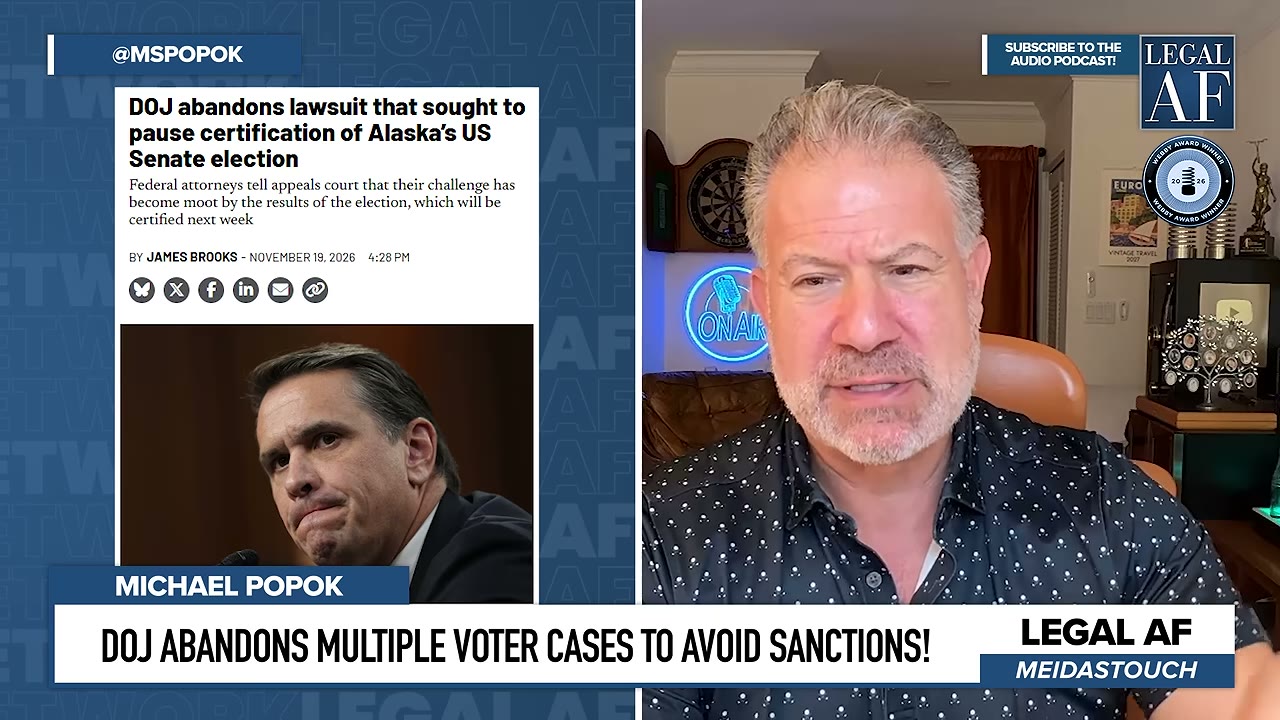
The Justice Department is under pressure in the Ninth Circuit after filing what critics call baseless lawsuits targeting voters in Alaska and California. Alaska parties seek sanctions over a meritless appeal in Mary Peltola's win, while a California judge rebuked DOJ for attacking him after dropping its case.
1DOJ Faces Sanctions Bid in Ninth Circuit Over Alaska Peltola Case
The Justice Department could be fined over an appeal it filed and then let sit. In Alaska, parties are now seeking sanctions against the DOJ for a frivolous appeal in the case involving Mary Peltola's campaign, which received 51% of the vote.
A federal judge dismissed the case, and the appeal is without merit, according to the sanctions bid. DOJ official Stan Woodward is among those who could face a fine.
The same pattern played out in California, where prosecutors tried to nullify 20,000 votes through prosecutor Bill Esseli, who had already been disqualified as a U.S. attorney by a judge in the same district.
The Ninth Circuit now wants to know what the DOJ is doing with the appeal it filed there.
2Mark Elias Calls DOJ Alaska and California Suits Closest to Democracy Loss
Voter rights lawyer Mark Elias says the Justice Department's Alaska and California cases are the closest the country has come to losing its democracy.
Elias, who is handling 90 cases, said there are currently 200 active voting rights cases pending. He noted the DOJ's 2026 actions in Alaska and California, aimed at dictating who wins and who loses.
The cases were unsuccessful lawsuits from unsuccessful prosecutors, but they may not have led to voter interference.
Elias said the country has not lost its democracy yet.
3Alaska Case: Peltola Accused of Recruiting Second Dan Sullivan
Mary Peltola was accused in the New York Times of someone in her campaign trying to recruit a second Dan Sullivan to run against incumbent Senator Dan Sullivan.
Alaskans were not confused by the two Sullivans, and candidates are allowed to run for office for any reason if they meet the requirements. Peltola received over 50% of the vote and defeated the incumbent Republican Dan Sullivan and the other Dan Sullivans combined, making the case moot.
A federal judge in Alaska found the Justice Department had no legal standing and dismissed the lawsuit. The DOJ then appealed to the Ninth Circuit in United States v. State of Alaska.
Now Peltola's campaign or the state of Alaska are seeking sanctions.
4Stan Woodward Defends DOJ Against Alaska Sanctions Motion
Stan Woodward asked why sanctions should be imposed on the Justice Department, saying it tried to protect the vote.
"We should not be punished with sanctions," Woodward said. "We tried to protect the vote."
The response from critics: the DOJ tried to interfere in voting and dictate the winner, arguing Mary Peltola should be removed from the ballot and the victory given to the DOJ and Donald Trump's chosen person.
Mark Elias has called the effort the closest thing to an election being hijacked.
5Mark Elias Interview: DOJ Tried to Dictate Which Ballots Count
Mark Elias calls the Alaska and California cases the most direct attacks on democracy he has ever seen from the former Justice Department.
In California, he said, the DOJ tried to dictate which ballots could be counted. "If we send you a list, California, of people we don't allow to vote, we expect you to follow our list," he described the department's position, adding that it threatened a civil lawsuit and a criminal investigation. The DOJ lost that case, and Judge Carter wrote about it.
The Alaska case was perhaps even more baseless, Elias said, because the DOJ sued to tell Alaska which candidate was likely to win. That case was also dismissed.
Elias's firm represented the Peltola campaign and the Democratic Senatorial Campaign Committee. The DOJ filed a notice of appeal but took no steps to enforce it, and the appeal sat in the court registry. Common Cause and the League of Women Voters of Alaska, which intervened, filed a motion for summary judgment and for sanctions.
6DOJ's 14-Page Sanctions Response Draws Only Two Signed Paragraphs
The Justice Department's 14-page response to Alaska's sanctions motion contains only two paragraphs signed by Stan Woodward, the third person in the department.
On page 13, the filing argues there is no basis for sanctions, saying the United States' appeal of the district court's decision on legal standing is "far from without merit." It also argues that a request for sanctions on the claims filed in district court is not the proper forum.
That is the entirety of the response to Alaska's sanctions request.
7California Case: Esseli Disqualified as DOJ Pursued 20,000 Ballots
California's case was handled by Bill Esseli, a disqualified first assistant U.S. attorney who was impersonating a U.S. attorney.
Judge Carter in the Central District of California denied the injunction. The Ninth Circuit rejected it twice, and the U.S. Supreme Court also rejected it, so the votes of 20,000 people who voted in California were not annulled by the Justice Department.
The DOJ then filed a notice of voluntary withdrawal of the lawsuit. Normally that is a one-sentence filing. Instead, the department used it to attack the judge.
8DOJ Withdrawal Filing Attacks Judge Carter Over Ballot Segregation
Instead of a one-line withdrawal, the Justice Department used its filing to attack Judge Carter and defend its case.
The filing said the United States sought a targeted and modest measure to have California segregate ballots mailed in by people likely not citizens until state officials could confirm citizenship, arguing every legal vote is nullified by an illegally cast vote. It noted the court did not timely grant relief, set a preliminary injunction for November 13, and that the Supreme Court denied the petition on November 2.
On page two, the DOJ said that in light of the Supreme Court's denial, it is evaluating how best to ensure the protection of Americans' votes.
Because the department attacked him, Judge Carter decided to fight back in his decision.
9Judge Carter Rebukes DOJ for Disrupting Elections and Undermining Trust
Judge Carter wrote that the lawsuit was intended to disrupt the ongoing elections and create confusion and uncertainty for both voters and election officials.
"The right to vote is sacred," he stated, as well as trust in democracy.
After the Justice Department gave notice of its unilateral withdrawal, the expedited hearing scheduled for Friday was canceled as irrelevant.
That led the appeals court to act. A three-judge panel — Bennett, Bomet and Sanchez, two appointed by Trump and one by Biden — wants an answer within 10 days on what the DOJ will do with its appeal.
10Ninth Circuit Panel Demands Answer on DOJ's Abandoned Appeal
A three-judge Ninth Circuit panel has given the Justice Department 10 days to explain what it will do with an appeal it lost.
The DOJ closed the case but left the appeal unresolved, prompting the panel — Bennett, Bomet and Sanchez — to demand an answer.
The department had pursued headlines about illegal voters and election fraud. Now it must tell the court what happens to the appeal it filed and abandoned.
11Bill Esseli Claims Evidence of Voter Fraud and Ongoing Investigations
A disqualified US attorney says his office has already prosecuted a voter-fraud case — and more charges are coming. Bill Esseli said last month his office brought a case against an individual accused of paying homeless people to register to vote using fabricated information.
"This is not a theory," Esseli said, pushing back on media coverage that there is no evidence of voter fraud.
He said numerous similar investigations are underway and that some are at an advanced stage and ready for indictment, while others are new. He declined to say which government agencies, if any, are under investigation, citing department rules and the need to protect people who are never charged.
Esseli said he believes the work will lead to criminal charges in the near future.
12DOJ Quietly Drops Voter Cases After Spotlight Fades
The Justice Department is closing voter-interference cases now that public attention has moved on, according to Legal AF. The show says the department is telling the American people the cases had no basis and were irrelevant.
"We noticed it," the show said, adding that it put everything together as the spotlight faded and no one else was watching.
The claim follows reports that the department was dropping cases it had once pursued. No further details on which cases or how many were given.