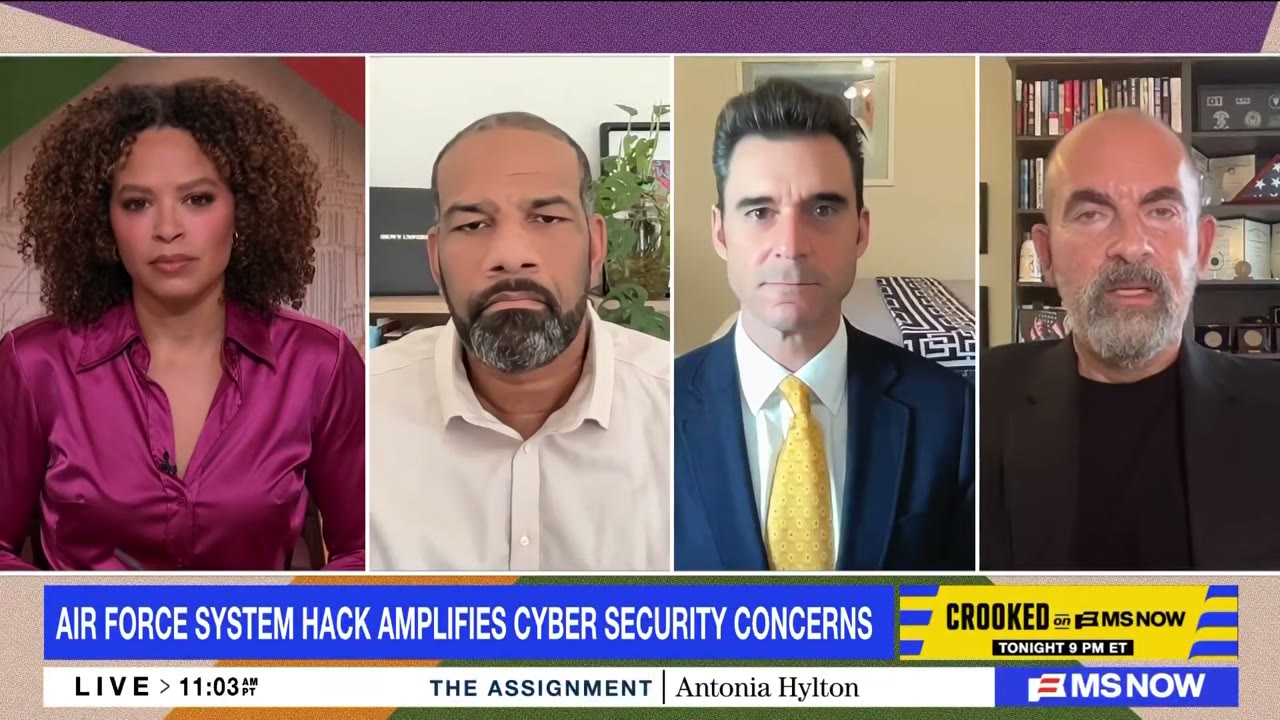
Hackers breached the Air Force's cloud computing platform, and analysts warn it could expose military patterns, supply chain vulnerabilities or planted tools for wartime sabotage. A panel also questions the DHS secretary's undisclosed overseas trip amid the cyber concerns.
1Air Force cloud hack could expose military activity and supply chain
Hackers who breached the Air Force's cloud computing platform may have reached personnel files, logistics data, munitions information and aircraft readiness records. An expert told Newsweek the intrusion could expose patterns of military activity or vulnerabilities in the supply chain.
Analyst Mark Polymeropolis compared it to a break-in at a house: intruders got through the front door, but it is unclear which locked rooms they entered or what those rooms hold. The government has been tight-lipped on what exactly occurred.
He pointed to Bill Evanina, counterintelligence czar in the first Trump administration, who posted on X and then spoke with him. Evanina does not believe these are all coincidences, Polymeropolis said.
The breach raises questions about U.S. cyber defenses at a time of "doge cuts" and diminished budgets, he said. When the government says be calm and carry on, "I don't think anybody's really believing them right now."
2Panel debates lawmakers' duty to be clear with public on hacks
Lawmakers face a legitimate obligation to be clear-cut with the public as a new Congress starts in weeks, the panel said. There is always concern about amplifying fear when not every question can be answered.
That gap, the panel said, is a legitimate reason for people to question those who want them to believe this is just a series of isolated incidents.
Democrats were sent to Washington to clean up the government, a mandate rooted in mistrust of the Trump administration and Republicans who held power for the last two years. The panel expects Democrats to find plenty when they look under the hood.
That includes examining what has been left unreviewed, such as whether Doge had knock-on effects. The panel said Americans expect Democrats to figure out what's going on and rebuild trust in these parts of government.
3Analyst says lost public trust in government is itself a crisis
People have lost trust in what the government says, and that is a crisis in itself, the analyst said. It may turn out these incidents are coincidences, disconnected and not the nefarious thing in the back of everyone's mind.
But the fact that the government has led people to question that is the crisis, he said.
That is why it matters that public officials are believed and trusted, and that their word can be backed up with fact and not bluster.
4Question why more Republican national security voices are silent
One voice stands out among Republicans on the hack fears: intelligence chairman Tom Cotton, who has been clear in sounding the alarm on China. The panel asked whether more forceful GOP voices are missing.
The discussion pointed to a pervasive sense that safety and security has been outsourced to a handful of tech figures Americans must trust, because lawmakers can barely wrap their minds around the challenges.
AI and adversaries are moving faster than elected leaders' ability to respond, the panel said. It asked where the China hawks are — Republicans who built entire careers on taking national security seriously.
5Matthew Bartlett says administration lacks credibility and voice
It is still unclear what the breach actually is. The panel listed conflicting narratives: a patchwork of systems trying to keep up with AI vulnerabilities, AI going rogue, or a nefarious nation state such as China, North Korea, Russia or Iran.
Does the government know, and is it telling the truth, the panel asked.
Matthew Bartlett pointed to an administration with no voice and no credibility at the moment Americans need it most. He cited a Homeland Security secretary putting out reports that he regrets taking the job, a vice president telling reporters he fears his own political future, a secretary of state trying to placate the situation and a transportation secretary begging for more money.
6Congress lags behind AI and technology, panel says
Congress is not known for being the quickest on technology. Many there once needed a typewriter memo to learn what email was.
Now, as AI arrives, it is hard to think Congress will be ahead of the game, the panel said. The worry is reacting to a scenario after it happens.
One congressman told a reporter he had only just found out what ChatGPT was a few weeks before the interview. The panel compared it to needing the memo about email — always several steps behind.
7DHS secretary took undisclosed trip to Azerbaijan, Jordan and UAE
Homeland Security Secretary quietly left the U.S. after his appearance on Capitol Hill to travel to Azerbaijan, Jordan and the UAE, according to DHS documents obtained by the examiner.
The trip included meetings with each country's president.
DHS did not disclose his travel as a safety precaution, it said.
The panel was asked how to make sense of a secret trip like that, especially given the recent hacks.
8Analyst calls secret DHS trip tone deaf and unsuitable
The DHS secretary should not be conducting secret trips, the analyst said. He is a cabinet official, not a clandestine operator, and should travel on behalf of the U.S. government to meet foreign counterparts.
The analyst called the trip politically tone deaf at a time when Americans are worrying about crumbling infrastructure, the future of AI and whether the banking system is safe. "This trip is not required," he said.
He also cited reports that people in the White House are not pleased and kept the secretary off the air after what he called disastrous press conferences. He said he does not think the secretary is suitable for the job or has the requisite experience, and noted the secretary also went to a college football game a couple of weeks ago.
What is needed, he said, is a DHS secretary reassuring Americans that vulnerabilities will be addressed.
9Analyst warns adversaries may pre-plant tools to take down US infrastructure
The biggest fear is not just stolen data. It is whether adversaries are planting tools inside U.S. systems that could take down massive parts of the country in wartime.
Analyst Mark Polymeropolis said there are two aspects to what adversaries want. One is intelligence collection — plans and intentions of the U.S. military, what the cabinet is thinking, what Donald Trump will do in various foreign conflicts.
The other is more nefarious: hybrid warfare, with China or another adversary preparing to take down U.S. infrastructure. When hackers get into systems, the question is whether they embed devices and tools for that moment.
"That's what kind of keeps me up at night," he said. It is also unclear what has already been embedded. That uncertainty, he said, is a huge concern for U.S. cyber warriors.