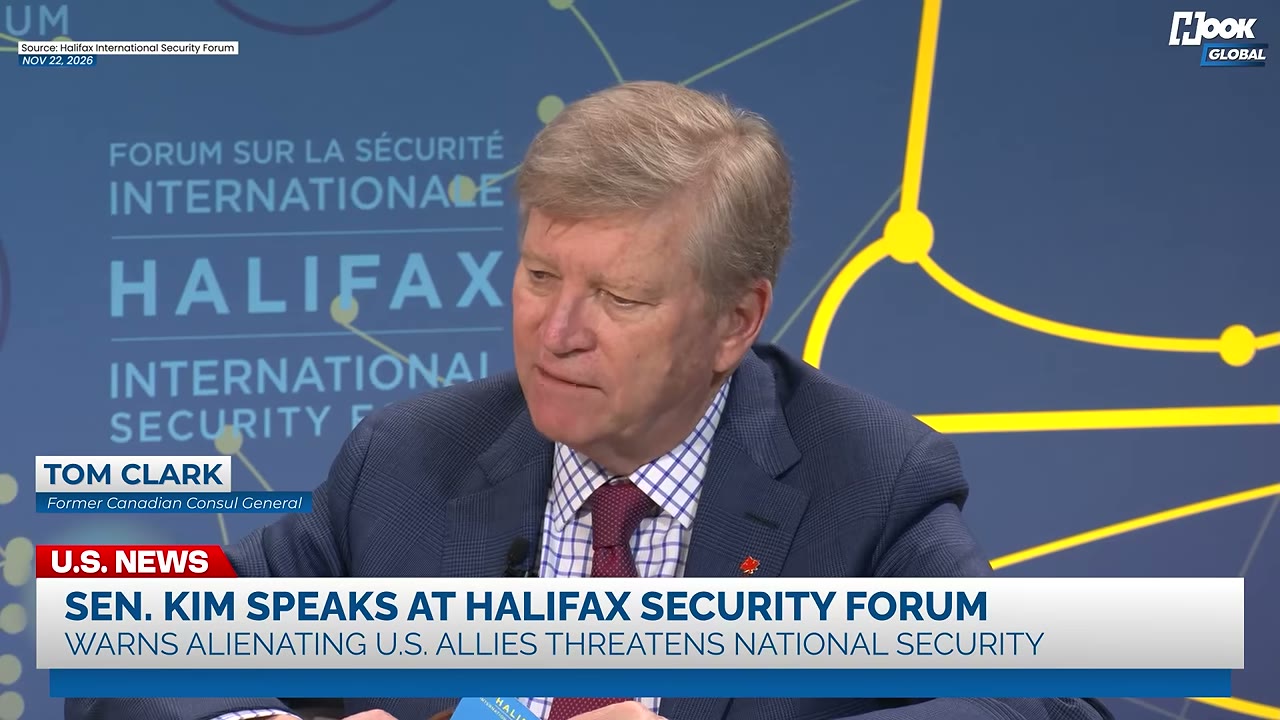
Sen. Andy Kim acknowledges that allies' doubts about U.S. reliability contain 'some truth' after midterm elections. He argues America must show it cares, rebuild multilateral defense supply chains, and restore deterrence through predictability.
1Sen. Kim says allies' doubts about U.S. reliability contain 'some truth'
A U.S. senator says there is 'some truth' in the claim that allies can no longer rely on America. Senator Andy Kim made the remark after a panelist quoted a stark statement that the era of relying on America is over.
Kim said the line confused him a little. 'I'm not sure how true that is. Maybe that's true at the moment,' he said.
He was asked what lessons alliances hold even as the world order is reorganized or reformatted. Kim did not dispute the doubt directly, saying only that there may be truth in it at the moment.
2Kim cites Ukrainian essayist's lesson on people's will to fight
A Ukrainian woman's essay became the moral anchor of a panel on the world order. Senator Andy Kim said he was inspired by her account of leaving everything in her life to fight for Ukraine.
Kim said the essay, by a woman he identified as Ms. Shipovych, covered technologies and other issues. But he said her most important lesson was about people.
'The most important lesson she gave was people, people's will to fight, and people's support,' Kim said. He urged the room to connect its talk of strategies and policies with the rest of the world.
3Kim says voters feel government doesn't work for them after midterms
One woman's question stuck with Senator Andy Kim after the U.S. midterm elections: 'What about us?'
Kim said he was asked at almost every meeting what the midterms meant for America. In one conversation about the war in Iran and the high cost of living, a woman looked at him and asked exactly that.
Kim said the biggest divide now is that most people feel government and institutions don't work for them. He called connecting with people and delivering at a grassroots level the challenge facing the U.S. and the world.
4Kim says AI job fears, not advanced models, drive loss of control
For the average American, losing control over AI isn't about advanced models. It's about losing their job.
Senator Andy Kim said the fear he hears is that AI will take people's jobs and they have no control over how it affects them. That, he said, is what the loss of control means to them.
His remarks followed a panel discussion on AI and regulation, the loss of control and the inadequacy of leading-edge models. Kim said that gap worries him the most.
5Kim draws on father's Alzheimer's to define care versus security
A senator who spent a decade fighting terrorism and now cares for a father with Alzheimer's says national security is missing a word: care.
Senator Andy Kim said the two experiences brought care to the forefront, a word rarely heard in such forums. He has spent two days thinking about the difference between care and safety.
Security is the feeling of being protected, he said. Caring asks whether you feel valued and supported. A person alone in a bunker would feel safe, he said, but not cared for.
6Kim says world asks if it can count on America, vows 'we care'
The world keeps asking Senator Andy Kim one question: can it count on America?
Kim said America's reliability was perhaps the most important question for many people he spoke with over the weekend. He said he tells his father with Alzheimer's a simple phrase: 'You can count on me.'
He said the answer isn't about timely foreign military sales or sanctions compliance. 'Ultimately, this is the question: Does America care?' he said, adding that he hopes people take away a deep sense that 'yes, we care.'
7Kim concedes 'some truth' to America-is-over claim but says story continues
A sitting U.S. senator says there is 'some truth' to the claim that America's era of reliability is over — but insists the story doesn't end there.
Senator Andy Kim said the line pains him to read, then conceded: 'There is some truth in this.' But he argued relationships are not a Shakespearean drama that ends after three acts.
'Our story will continue. This story has no end,' he said. He said relations develop in waves, especially during the wars of the last 100 years, and that the American people have given lawmakers a mandate to change direction.
8Audience asks panel how to balance sovereign defense industry with coalitions
Every NATO country is rebuilding its defense industry, and many are insisting on buying at home. An audience member asked the panel where that leaves coalitions.
The questioner noted Britain's push to buy British and America's 'buy American' strategy. He asked what the pragmatic balance is between sovereign investment and coalition building.
He pointed out that a nation can only build capacity as fast as its own sovereign base allows. The panel was then asked who else wanted to answer.
9Kim warns 'America First' is seen abroad as 'America Alone'
'America First' is heard abroad as 'America Only' or 'America Alone,' Senator Andy Kim warned, and he said the U.S. must shed that perception.
Kim said building together is necessary partly because America cannot do it all alone. He compared U.S. growth to a tall skyscraper without the stability to withstand earthquakes.
He said technologies built on a supply chain of critical minerals and rare earths leave big vulnerabilities. No country can fix that alone, he said, calling it a project requiring coalition effort.
10Kim says critical minerals supply chain leaves U.S. tech vulnerable
America's tech boom sits on a supply chain that can't hold it up, Senator Andy Kim warned, comparing it to a skyscraper built without stability for earthquakes.
Kim said critical minerals and rare earths leave big vulnerabilities, and no country can solve that alone. He pointed to shipbuilding, where the U.S. turns to South Korea and Japan, and to Canada and Finland for support.
Those are coalition efforts, he said, not advanced technology but a fundamental element to build on. He called it the basis for a new multilateralism built on a strong foundation.
11Kim says deterrence hinges on U.S. intentions and predictability
Deterrence rests less on weapons than on whether adversaries believe the United States will actually use them, Sen. Andy Kim said. He told a panel that America's politics now leave "very little understanding of our intentions, our resolve right now, our state as a country."
Kim, who began his career at USAID, said deterrence underlies all foreign policy and involves more than military action. Equipment and resources matter, he said, but restraint is built on intent and determination — on whether a country is willing to use the tools it has.
That makes reliability and predictability critical, he argued. The Constitution requires the branches of government to back decisions on the use of force, he said, pointing to that structure as part of the problem.
The U.S. holds enormous resources, especially militarily, Kim said. But he described deterrence as a difficult task precisely because the country's intentions are so unclear at home.
12Kim says defense base must adopt tech-speed flexibility
The American defense-industrial base needs to move at the speed of technology, and flexibility is the word for it — one Kim said is not at all associated with that base or many U.S. government agencies.
Kim pointed to Ukraine and others as examples of what is possible, and said he has seen movement in that direction, especially in cybersecurity. Artificial intelligence is pushing the shift further, he said.
He has been involved in efforts to protect financial institutions and society from vulnerabilities, he said. Moving quickly carries risks: disruptions and outages have followed, and he said those lessons are being learned very fast.
Kim admitted he does not have all the answers. Many Americans, he said, are working on the same problem inside the defense-industrial base.