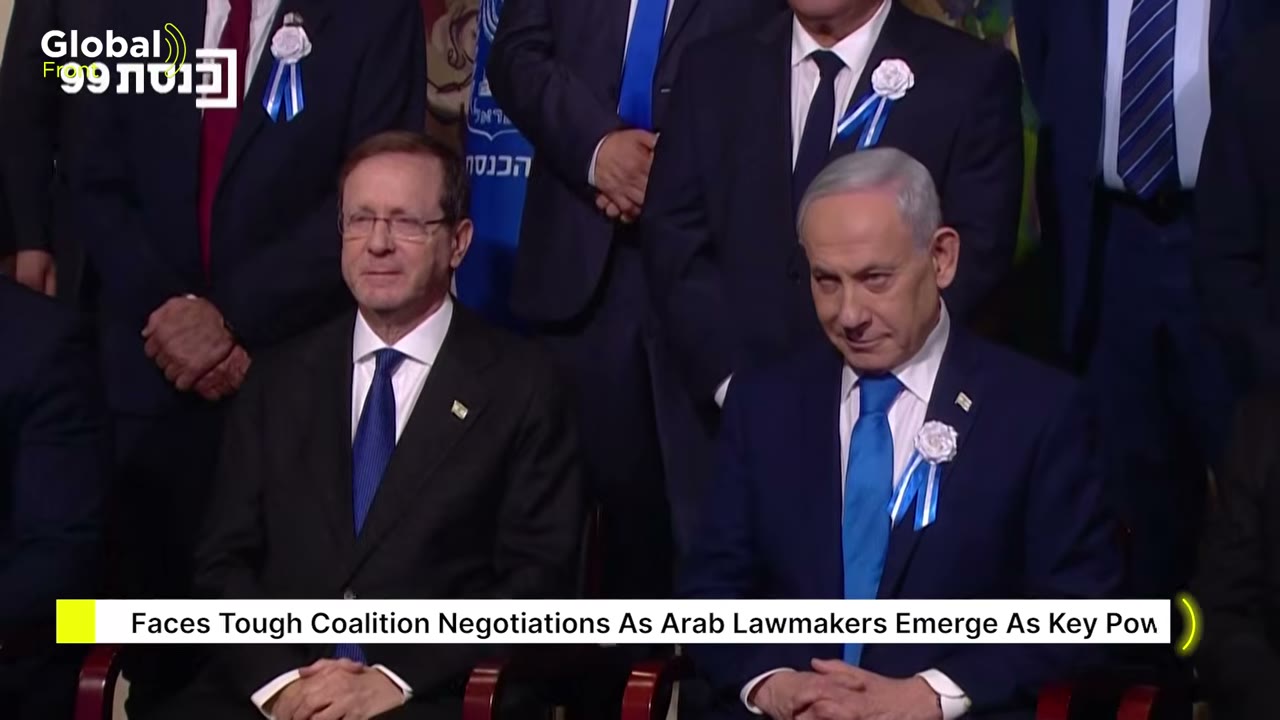
After October 27 elections, President Herzog tasked Gadi Eisenkot with forming a government, but his allies control only 48 seats. Arab parties with 19 seats could decide whether Netanyahu's long rule ends, while security-service controversies and coalition demands complicate talks.
1Eisenkot Tasked With Forming Government After Netanyahu's Bloc Falls Short
Israel's president has handed opposition leader Gadi Eisenkot the task of forming a government — a move that could end Benjamin Netanyahu's long run in power. On November 8, President Yitzhak Herzog formally tasked Eisenkot, head of the Yasar party and a former army chief of staff, after 67 Knesset members backed him against 46 for Netanyahu.
The math is harder than the headline. Eisenkot's immediate allies hold just 48 of the 120 seats; Netanyahu's bloc holds 53. The remaining 19 belong to two Arab factions now cast as potential kingmakers.
Their support could decide whether Israel changes power or slides back into deadlock.
2Arab Parties Win Record 19 Seats as Jabarin Sees Chance for Change
Arab parties won an unprecedented 19 seats in Israel's parliament, giving them a possible kingmaker role in the fight over the next government. The Joint List, led by Professor Yousef Jabarin, took 11 seats; Mansour Abbas's Ra'am won eight.
Jabarin says the result is more than a parliamentary milestone. He sees a chance to change Israel's political course and improve conditions for Palestinian citizens of Israel.
He credits exceptionally high Arab voter turnout for creating that opening, arguing participation should not just decide who becomes prime minister but bring real improvements to daily life.
3Jabarin's Background: Law, US Civil Rights Study and Equality Focus
The politician who may hold Israel's next government in his hands studied America's civil rights movement to understand how deeply rooted discrimination can be undone. Yousef Jabarin was born and raised in Umm al-Fahmi and studied law at the Hebrew University of Jerusalem before heading to the United States.
He earned a master's degree from American University and completed doctoral studies at Georgetown University, focusing on human rights, minority protection and constitutional equality. His research compared Palestinian citizens of Israel with African Americans during the US civil rights movement.
Jabarin said that history strengthened his belief that societies can transform even when discrimination runs deep.
4Joint List Ready to Back Government From Outside, Not Join Cabinet
Yousef Jabarin's party is ready to prop up an alternative Israeli government from the outside — without sitting in its cabinet. He said the Joint List would support an alternative administration while staying outside the coalition, helping it pass critical parliamentary votes while keeping independence on key disagreements.
That sets him apart from Mansour Abbas's Ra'am, which has shown willingness to join governing coalitions directly. Jabarin calls the distinction fundamental: joining the cabinet, he argues, would make his party collectively responsible for decisions on the occupied West Bank, settlements and military operations that contradict its program.
His goal is influence over the government's formation and survival without owning its every decision.
5Jabarin Demands Crime Crackdown, Arab Municipal Funding and Housing
Arab lawmakers' support for Israel's next government comes with a price list at home: a crackdown on organized crime, more money for Arab municipalities, housing and industrial investment. Jabarin called removing the Netanyahu administration his party's top priority, but says Arab legislators will also demand practical gains for the communities they represent.
The demands land amid concerns about violence in Arab communities and long-standing inequalities in public services and spending.
He argues Arab legislators can help replace the government while delivering for their voters at the same time.
6Jabarin Accuses Smotrich and Ben-Gvir of Inciting Hatred
Jabarin accuses two of Israel's most prominent right-wing ministers of inciting hatred between Jews and Arabs. He criticized Finance Minister Bezalel Smotrich and National Security Minister Itamar Ben-Gvir, arguing that Palestinian citizens of Israel have faced deteriorating security and political marginalization under Netanyahu's government.
These are Jabarin's political assessments. Netanyahu's allies strongly reject that characterization of their government.
The dispute runs alongside the coalition arithmetic, where Arab lawmakers' 19 seats could decide who governs.
7Netanyahu's Bloc Falls Eight Seats Short of Knesset Majority
Benjamin Netanyahu's political alliance entered the election with a majority and came out with just 53 seats — eight short of the 61 needed to control the 120-seat Knesset. The result significantly weakened his parliamentary position.
That arithmetic is why Arab politicians now matter so much. With neither side able to reach 61 alone, the 19 seats held by Arab factions could tip the balance.
Eisenkot, meanwhile, has been tasked with forming a government after 67 lawmakers backed him over Netanyahu's 46.
8Opposition Elects Matan Kagan as Knesset Speaker Over Likud
Israel's opposition has already proven it can cooperate inside parliament: on November 17, lawmakers elected Matan Kagan of Eisenkot's Yesh Atid party as Knesset speaker, ousting Likud's Amir Ohana by 66 votes to 52. The result gives Netanyahu's opponents greater influence over parliamentary procedures.
It also showed that opposition factions can work together to force significant changes even before a new government takes office.
That cooperation matters as Eisenkot tries to convert his 67 backers into a working coalition.
9Eisenkot Weighs Ultra-Orthodox, Likud or Arab-Backed Coalition Paths
Eisenkot is weighing three routes to a cabinet: ultra-Orthodox parties, a broader unity deal with Likud, or relying on Arab lawmakers from outside the coalition. Ultra-Orthodox support could let him govern without depending solely on Arab factions. A Likud deal was also discussed, though it would contradict Eisenkot's stated opposition to cooperating with Netanyahu.
Jabarin argues an Arab-backed arrangement is the more reliable path. He points to the 1990s, when Arab parties supported Yitzhak Rabin's government while staying outside the coalition.
That precedent, he says, shows outside support can steady a government without full policy agreement.
10Gaza and West Bank Policy Disagreements Could Test Arab Support
The coalition being built could break over the issues most likely to spark a crisis: Gaza and the West Bank. An Eisenkot administration may pursue security policies the Joint List strongly opposes, testing whether Jabarin's party keeps supporting the government during a serious national crisis.
Jabarin offered no unconditional support. He stressed that any political agreement must bring meaningful change, and that his party cannot make unlimited commitments to a government whose decisions it does not control.
Those unresolved questions hang over the coalition talks.
11Jabarin Backs Two-State Solution Based on Pre-1967 Borders
Jabarin wants an independent Palestinian state alongside Israel, based on the borders that existed before the 1967 war. Beyond coalition talks, he is calling for a broader rethink of Israel's relations with the Palestinians.
He argues a lasting settlement requires negotiations, international involvement and recognition of Palestinians' right to self-determination, and that constant reliance on military force cannot provide lasting security for Israelis or Palestinians.
Jabarin points to the Arab Peace Initiative, first presented in 2002, as a possible basis. It proposed normalizing relations between Israel and Arab countries in exchange for an agreement on Palestinian statehood and other outstanding issues.
12Jabarin Says Arab Lawmakers Face Questions Over Legitimacy
Arab legislators in Israel still face questions over whether they are legitimate political partners at all. Jabarin argues that attempts to portray them as illegitimate undermine the principle of equal citizenship.
He says differences over national security and Palestinian statehood should not stop Jewish and Arab representatives from cooperating on internal affairs.
His party's stance on Palestinian political representation and the security arrangements for any deal remains part of the debate — one more dispute straining already tense relations.
13Shin Bet and Police Probed Over Alleged Election Interference
Israeli media reports have raised questions about the Shin Bet security service and police investigating alleged foreign interference in October's elections. Shin Bet Director David Zini reportedly tried to investigate several Arab political leaders; Attorney General Gali Baharav-Miara blocked the proposed interrogations because not enough evidence was provided.
Later reports said investigators found only limited evidence for some initial suspicions. The reports do not prove criminal actions by Netanyahu or senior security officials.
Jabarin demands a criminal investigation and public inquiry into the Prime Minister's Office and the security services, arguing state institutions must act independently of party interests.
14Jabarin Pushes for Arab Representation in Israel's Public Sector
Arab citizens make up about a fifth of Israel's population, yet Jabarin says government institutions should hire in a way that reflects that reality. He is pushing for greater Arab representation in the public sector.
Jabarin argues that expanding representation in public administration, professional institutions and decision-making bodies can improve both economic opportunity and public trust.
His push comes as the political situation changes very quickly.
15Eisenkot Outlines Three Government Paths as December 6 Deadline Looms
Eisenkot laid out three possible paths to forming a government on November 20 — and warned that the future of Israel is at stake.
The options: an agreement with ultra-Orthodox parties, a broader arrangement involving Likud, or a national salvation government that could depend on the support of Arab lawmakers.
Eisenkot made clear negotiations cannot go on indefinitely and signaled he is willing to form a minority government if broader agreements fail. That possibility remains controversial even inside his own opposition bloc. Yisrael Beitenu leader Avigdor Lieberman has expressed strong opposition to a government dependent on Arab parties' support.
Netanyahu continues to advocate for a national unity government, warning that Israel's security challenges require a broad governing alliance.
16Eisenkot's Mandate Expires December 6 With Minority Government Vote Possible
Eisenkot's mandate expires on December 6 — and a parliamentary vote of confidence in a minority government could come before then.
President Herzog can grant an extension of up to 14 days.
Reports indicate that Yaşar is preparing for a possible vote of confidence in the minority government before the deadline if talks with other parties fail to produce an agreement.
17Israel's Political Future Hinges on Whether Compromise Beats Division
For Jabarin, the coming days are a rare chance to turn unprecedented Arab voter turnout into political influence. For Eisenkot, they test whether he can unite parties divided by ideologies, security policies and competing political commitments. For Netanyahu, the outcome could decide whether he stays in office or permanently loses control of the government.
Israel's political future now depends not only on which leader has the largest party, but on whether the warring factions can agree on the compromises.