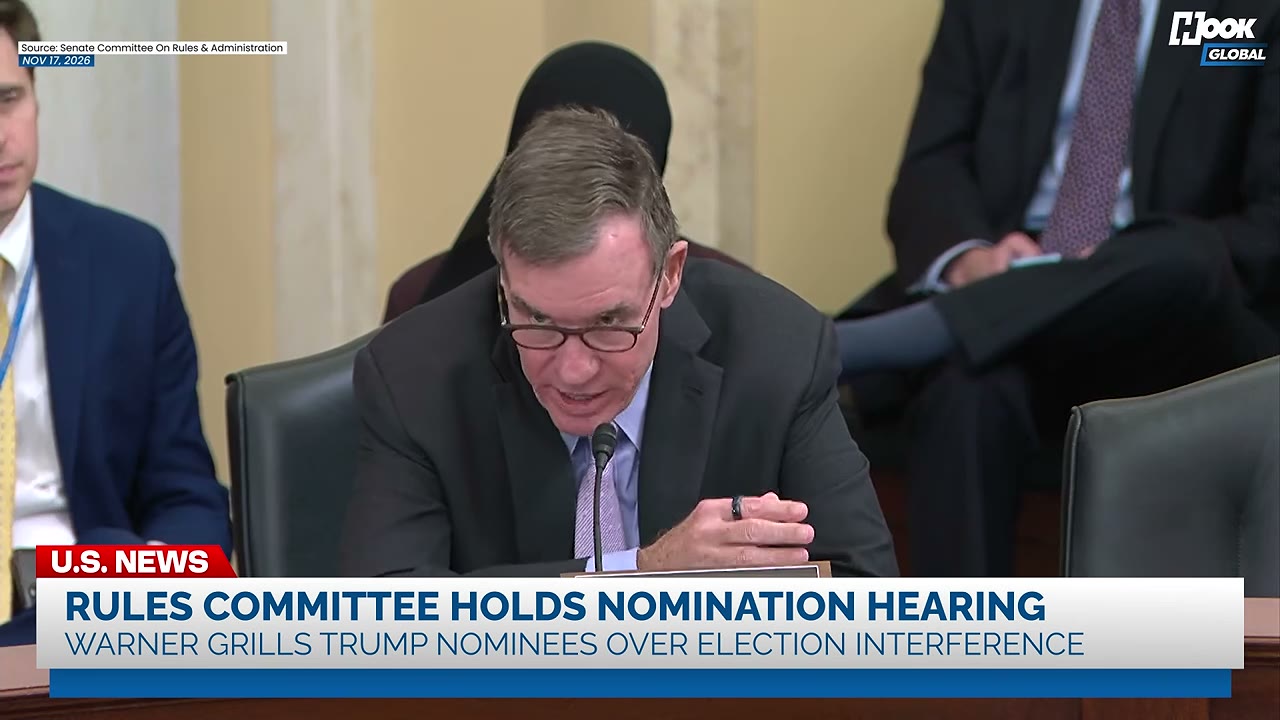
At a Senate hearing, FEC nominees were pressed on whether they would evaluate cases involving President Trump impartially. Senator Warner also raised concerns about the president's removal of FEC chair Ellen Weintraub and pushed for disclosure of who pays for political ads and influencers.
1Warner Warns Trump Is Undermining Free and Fair Elections
Senator Mark Warner accused the Trump administration of attacking mail-in voting and local election officials, and of raising "constant cries of fraud without any evidence." He said he has been "extremely concerned" about the president's efforts to undermine free and fair elections.
Warner, who has chaired the Intelligence Committee, pointed to the president's July speech as the clearest example. He said it claimed massive foreign interference using information that had already been declassified.
He stressed that state and local election officials from both parties have done a really good job, and that elections must be free from foreign influence.
The remarks came as the Federal Election Commission's own website was being discussed. Warner said 54 million in total won't be found there.
2Warner Questions Trump's Unprecedented Removal of FEC Chair Ellen Weintraub
No president in the history of the Federal Election Commission had ever removed its chairman — until Trump removed Ellen Weintraub, Senator Mark Warner said.
Warner called the removal unprecedented and noted that Weintraub was appointed by President Bush. He pressed the point directly to the nominees before him, saying they knew the history better than he did.
"No president in the history of the FEC has ever removed the chairman of the commission?" Warner asked.
He then used the removal as the starting point for his first question to the nominees.
3FEC Nominees Pledge Impartiality in Cases Involving Trump
Asked whether they would judge a case involving President Trump solely on facts and law, a nominee told Senator Mark Warner: "Yes, Senator Warner. I pledge that."
Warner asked the nominees to commit to evaluating any case involving Trump, his political committees or a person associated with his administration without regard to the president's political interests. He noted Senator Padilla may have already asked the same question.
The nominee said that if confirmed, the duties would be discharged impartially, with "unwavering devotion to the First Amendment," upholding the law as enacted by Congress and interpreted by the courts.
A second nominee gave the same answer: "Same answer, Senator. Yes, sir."
4Nominees Asked How They Will Prove Independence From Political Interference
Pressed on how they could prove to both sides they won't be swayed by political interference, the nominees pointed to the FEC's founding purpose after Watergate.
One nominee said the independent agency was created to ensure one party does not set the rules, make the decisions and punish political opponents. The nominee called that history a priority and promised to do the job regardless of anyone else's party affiliation.
"I promise you that I will treat everyone who comes to the agency exactly the same," the nominee said.
The second nominee, Stowe, said they will take an oath and pledged to uphold it with impartiality and fairness.
5Warner Revives Fair Advertising Act to Reveal Who Pays for Political Ads
A bill to force public disclosure of who pays for political ads — the Fair Advertising Act — stalled despite what Senator Mark Warner called a perfectly logical premise.
Warner said he introduced it with the late Senator Graham and Senator Klobuchar after 2016, when there were a series of Russian attempts to influence or bribe people, and it was never revealed.
The bill said that if you run a political ad, the public has the right to know who's paying for it. Warner said he would like to try again in the future.
He warned that foreign governments and foreign entities will keep trying to influence elections.
6Warner Calls for Disclosure of Who Pays Political Influencers
Some influencers are paid hundreds of thousands of dollars to appear independent while a structure is actually paying them, Senator Mark Warner warned.
Warner said the public also needs to know who is paying influencers, even when those influencers are Americans. He said Americans should have the right to know whether something is a political advertisement or a paid endorsement dressed up as independence.
He said he wants to work with the chairman and a senior committee member on legislation, and asked both nominees to comment.
One nominee replied that Congress makes these decisions and that congressional authorization is needed to act in this area.
7Nominees Say Influencer Payment Rules Need Congressional Guidance
There is "no way to know who the political influencers are in real time," a senator said, as nominees deferred to Congress on the question.
One nominee described how payments are reported to companies, so a payment from headquarters to an organization that hires someone to tweet is recorded in a report. The nominee also said the Federal Trade Commission may have jurisdiction, but that the agency is waiting for congressional guidance.
Stowe said she wholeheartedly agrees there is no place for foreign interference in American elections and pledged to enforce those provisions. On influencers, she said the agency is preparing a relevant rule and that she is uncomfortable commenting on its substance.