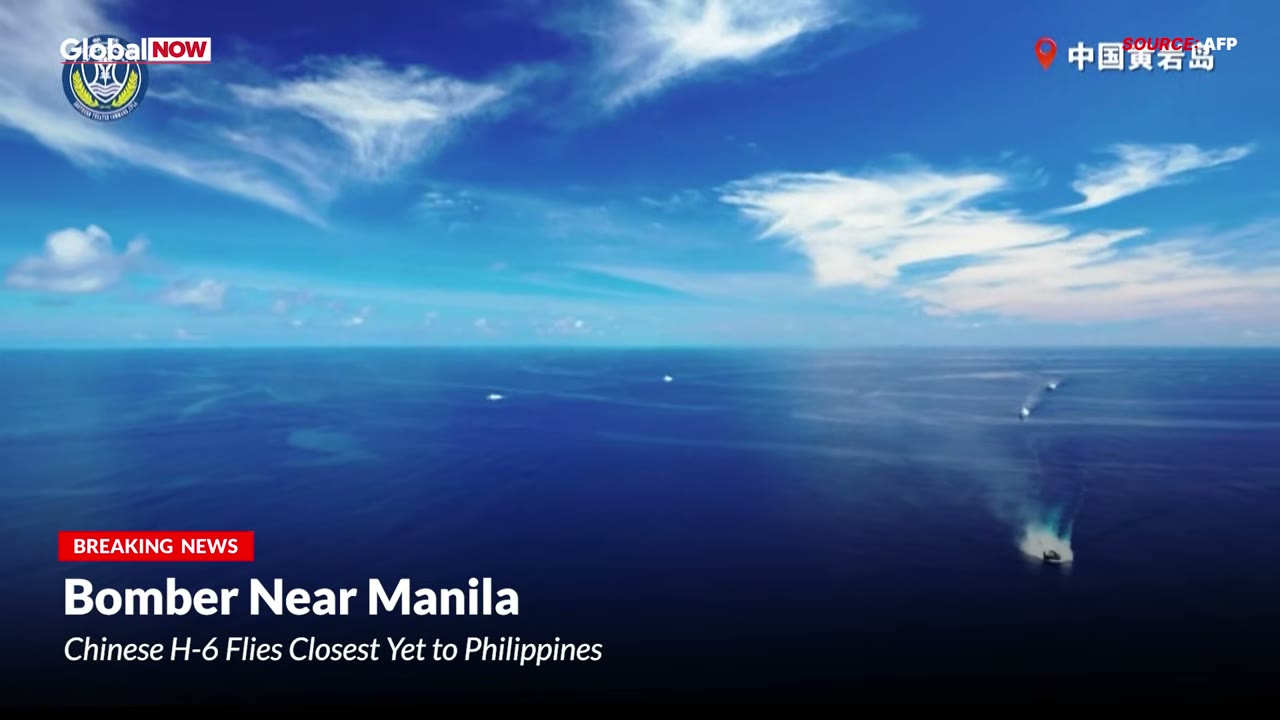
A Chinese H-6 bomber flew about 45 nautical miles from Luzon's coast, the closest such flight to the Philippines, then turned back 170 nautical miles from Manila. The Philippine military calls it a show of force, not an attack rehearsal, as China's air and sea pressure near Scarborough Shoal grows.
1Chinese H-6 Bomber Approaches 45 Nautical Miles From Luzon Coast
A Chinese H-6 bomber flew within about 45 nautical miles of the Luzon coast — the closest any aircraft of its type has come to the Philippine mainland, according to the Philippine military.
The Armed Forces of the Philippines confirmed the PLA Air Force bomber flew over the West Philippine Sea this week, operating between Bajo de Masinloc, also known as Scarborough Reef, and Luzon.
It turned back about 170 nautical miles from Manila, a city of more than 13 million people. The military says the message is clear: China is demonstrating its strength.
2Philippines Confirms H-6 Flight Tracked From Scarborough Toward Luzon
The bomber showed up on the public flight-tracking platform ADS-B Exchange on November 21 — four days before the Philippine military confirmed it was monitoring the aircraft.
Observers who follow military aviation spotted the route and spread it online. On Wednesday, November 25, the Armed Forces of the Philippines publicly confirmed the flight.
According to the military, the bomber flew from the direction of Scarborough Reef toward the Luzon coast, came within about 45 nautical miles, then made a sharp U-turn and flew back.
Retired Rear Admiral Roy Vincent Trinidad, the military's spokesman on West Philippine Sea issues, said it was the closest flight of a Chinese bomber of this type near the Philippines and part of a broader trend of patrols coming closer to Philippine shores.
3What the H-6 Bomber Is and Why Its Cruise Missiles Matter
The H-6 is China's main bomber, and its design dates back to the Soviet era — to a bomber first built in the 1950s.
China began producing its own aircraft a decade ago and has upgraded them repeatedly. The latest versions have new engines, new electronics, and the ability to carry long-range cruise missiles.
That last point matters. A bomber armed with long-range cruise missiles does not need to fly over a target. It can launch from hundreds of kilometers away and turn around without entering a country's airspace.
That is why military strategists pay close attention when an aircraft of this type approaches a coastline and then turns back.
4Philippine Military Rejects Claims Flight Rehearsed Manila Missile Strike
The Philippine military strongly rejected online claims that the bomber's sharp turn near Luzon was a rehearsal for a missile strike on Manila.
"There is no indication that this was a rehearsal for a missile strike," said Retired Rear Admiral Roy Vincent Trinidad, the military's spokesman on West Philippine Sea issues.
Some observers online had suggested the turn could have simulated an air-to-surface missile strike. Trinidad said the military does not know the exact model of the bomber or what it was carrying, because that cannot be determined from publicly available tracking data.
He urged Filipinos to check facts before spreading claims about the flight. The military's official assessment: it was a show of force, not preparation for an attack. Trinidad later called it a routine patrol consistent with Chinese bomber practices.
5Philippines Detected Bomber Before It Entered Exclusive Economic Zone
The Philippine military detected the Chinese bomber before it entered the country's exclusive economic zone — a first for a military that long struggled to monitor its own waters and airspace.
Retired Rear Admiral Roy Vincent Trinidad credited the country's military modernization program, saying it has accelerated "in seven-mile steps."
For years the Air Force had few modern radars and aircraft capable of patrolling the vast maritime area. That is changing: the Philippines is adding new air surveillance radars, new aircraft, and new partnerships.
Japan has played an important role. In February, it transferred five coastal radar systems to the Philippine Navy. On November 9, it signed a new deal worth 4.3 billion yen, about $27 million, for a coastal radar system and reconnaissance drones.
6Scarborough Shoal's History From 2012 Standoff to 2016 Ruling
Scarborough Reef is a triangular ring of reefs and rocks about 120 nautical miles west of Luzon, lying deep inside the Philippines' 200-mile exclusive economic zone.
For generations it has been a rich fishing ground for Filipino fishermen from Zambales and Pangasinan. In 2012, a standoff between Philippine and Chinese ships ended with China establishing de facto control. Chinese Coast Guard ships have kept a near-constant presence since.
In 2016, an international arbitration court in The Hague ruled China's extensive territorial claims in the South China Sea had no legal basis under the UN Convention on the Law of the Sea, and found China violated Filipino fishermen's rights near the shoal. Beijing rejected the decision and never recognized it.
Since then, Chinese coast guard ships have used water cannons against Philippine government vessels and harassed Filipino boats. In August 2025, a Chinese coast guard ship pursuing a Philippine vessel collided with a Chinese warship. Last year, China announced a so-called nature reserve on the shoal.
7Escalating Air Pressure Around Scarborough From Flares to H-6s
The pressure around Scarborough is no longer only on the water — it has moved into the air.
In August 2024, the Philippines said Chinese aircraft fired flares into the path of a Philippine government plane flying near the reef.
In March 2025, satellite images released at the time showed China had deployed two H-6 bombers around Scarborough.
Now an H-6 flew from the reef toward the coast of Luzon Island. The Philippine military points to exactly this sequence as evidence of escalation.
8Bomber Flight Coincides With Surge of 48 Chinese Ships in West Philippine Sea
The bomber flight came the same week the Philippine military reported a sharp jump in Chinese ships in the West Philippine Sea — from 19 to 48.
From November 17 to 23, the military counted 48 Chinese coast guard and navy ships near four key sites. The week before, there were 19.
That quieter week was the week the Philippines hosted world leaders: Manila held the 49th ASEAN Summit, with leaders gathered in the capital.
9Flight Follows Manila's Defense Pact With Australia and Chinese Warning
The bomber flight came shortly after Manila signed a new defense cooperation agreement with Australia — and Beijing responded with a warning.
China's Defense Ministry criticized the pact, warning it could increase tensions and vowing to counter what it called provocations in the South China Sea.
Put together, the picture that emerges is of Beijing exerting pressure at sea and in the air at the same time, while Manila deepens its partnerships with the United States, Japan, and Australia.
10Luzon Strait's Strategic Importance in Any Taiwan Crisis
The waters between Luzon Island and Taiwan — the Luzon Strait and the Bashi Channel — are among the most important waterways in the region.
Chinese military aircraft regularly fly through the area on their way to the Western Pacific. In the event of any crisis around Taiwan, the airspace and seas around northern Luzon would become critically important.
That is one reason the Philippines is strengthening defenses in the north, and why the United States has access to military facilities in Northern Luzon under the Enhanced Defense Cooperation Agreement.
11China's Bomber Patrols Near Taiwan, Japan and South Korea Follow Pattern
The Philippines is not the only country receiving such visits from Chinese bombers.
Taiwan's Ministry of Defense regularly reports H-6 bombers flying around the island, often in large groups with fighter jets and support aircraft. Japan has repeatedly scrambled fighter jets to escort Chinese bombers near its southwestern islands. In recent years, China and Russia have conducted joint bomber patrols over seas near Japan and South Korea, prompting both to raise their air forces.
In each case the goal is similar, according to the reporting: the flights demonstrate Beijing's ability to project air power far beyond its coast, test how neighbors detect and respond, and send a political signal — often timed to diplomatic events Beijing does not like.
12New Element Is Distance as Bomber Tracked in Near Real Time
Chinese bombers have operated over the South China Sea for years, including near Scarborough. What is new is distance: this bomber turned so close to the Philippine mainland that observers on the ground could track its path in almost real time.
Within hours of the flight's release, claims spread on social media that China was rehearsing an attack on Manila. The military quickly released its own assessment, and Retired Rear Admiral Roy Vincent Trinidad stressed the need to verify every fact.
13Military Urges Fact-Checking as Attack Rumors Spread Online
The Philippine military says there is no missile exercise, no imminent threat and no reason to panic — but it is still urging the public to fact-check what they see online. Its spokesman acknowledged that Chinese patrols are approaching, and that each flight tests how quickly the Philippines can detect, track and respond.
Calm words, then a warning about rumors. The military says it has been watching the flight the whole time and calls it a show of force.
The bigger question is whether these bomber flights become regular. If they do, the Philippines will need more than radar: stronger air defenses, more interceptor aircraft and closer coordination with allies — the capabilities Manila is trying to build through its modernization program and partnerships.
14Analysts Weigh Whether Bomber Flights Will Become Regular
A Chinese strategic bomber turned around just 45 nautical miles off the coast of Luzon — close enough to shrink the distance between the West Philippine Sea dispute and everyday life.
For Filipinos, the flight is a reminder that the dispute is not just about remote reefs and fishing grounds. It concerns the security of the Philippine mainland itself.
The Philippine military says it will keep monitoring Chinese air and sea activity and report on it publicly. That transparency, the military says, has become a factor of its own.