Trump put Jensen Huang back in charge of NVIDIA despite investigations into whether a woman he was dating was a spy, a panel said. Critics call it staggering corruption and warn national security is being subordinated to Trump's wishes.
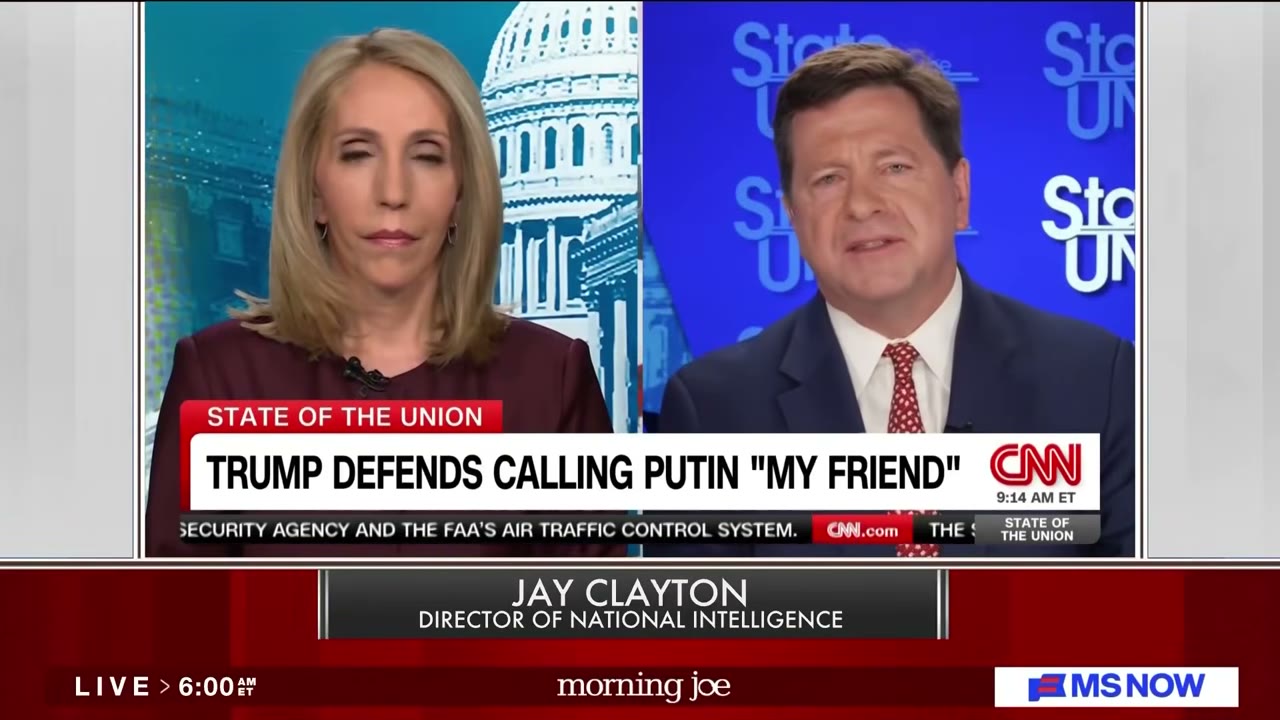
1DNI Jay Clayton pressed on whether Putin is America's friend
Jay Clayton says calling Vladimir Putin a "friend" is "entirely appropriate" in one context — but not in Ukraine.
Pressed repeatedly on whether Putin is a friend of the United States, the director of national intelligence defended the word. He said the president pulled off a summit bringing the three main nuclear powers together, calling the picture "historic."
"In that circle of that conversation, using the term 'friend' is entirely appropriate," Clayton said. Asked directly if Putin is America's friend, he answered: "He is not America's friend in Ukraine. Not at all."
2Panel condemns Trump's embrace of Putin as a friend
Vladimir Putin considers the United States his "sworn enemy" and works every day to destroy it, a panel said after Donald Trump doubled down on calling Putin "my friend."
The comments followed Trump's social media post reaffirming the relationship after a summit where he was captured on video warmly greeting Putin as "my friend."
One panelist said calling Putin Trump's friend is "absolute, it's lunacy." Another asked why Trump keeps doing it: "Why is he so scared of Vladimir Putin?" The panel said Trump's actions have hurt him politically and predicted investigations into the relationship.
3Democrats win 258 House seats in historic midterm wave
Democrats have won at least 258 House seats — the largest majority for either party in more than 30 years.
The number was reached after a recount confirmed Democrat Chuck Hubbard defeated Republican Congresswoman Virginia Foxx in North Carolina. MSNL estimates Democrats will win at least one more, controlling 259 seats.
One panelist said not a single Republican holds a seat Kamala Harris won two years ago — something "that's never happened in our lifetime." He compared the map reshuffle to 1966. Turnout, he said, was the big story.
4Panel debates Democratic leadership and Ossoff's 2028 prospects
A new Emerson poll shows Ossoff could win the South Carolina primary in 2028, a panel said — despite it being a 70% Black primary.
One panelist said Ossoff ran a strong campaign in Georgia, kept gaining, and built a larger coalition. "He is the real winner of this election has been Osaf," he said, adding voters don't think the way pundits expect.
The panel also debated Democratic leadership, praised Marco Rubio for acting "like a Republican," and said Black Americans are the base of the party because they understand general elections.
5Panel says cynical gerrymandering and Civil Rights attacks backfired
Gutting the Civil Rights Act did more to destroy Republicans this election than anything else, a panel said — and every cynical move backfired.
The panel pointed to redistricting and gerrymandering: had Trump gotten his way in South Carolina and Indiana, Republicans would have lost about 10 more seats.
Instead, the panel said, voters elected a Black man in Mississippi, the first Black female governor in Georgia, and a Hispanic woman as governor of Texas. The cynicism, one said, "completely blew the map up for Republicans."
6Democrats weigh investigations versus governing on affordability
Democrats won, but now face a split: the House wants to investigate everything, while the Senate wants to be choosier.
As January approaches, one panelist urged the party not to spend too much energy on investigations despite hunger in the base for accountability. "Govern, govern, govern, govern," he said.
He said Democrats must deliver on health care and cost — and be clear about what they'll actually do, since Medicare for all isn't feasible. He also said Trump reads the room better than anyone and might be more congenial than expected.
7Wall Street Journal editorial calls Trump's system state capitalism
A Wall Street Journal editorial calls Trump's economic system state capitalism — and one panelist went further: "This is state socialism."
The panel said the editorial argues Trump admires President Xi and wants the United States to look like China. It compared the moment to Great Britain in 1978, before Thatcher.
According to the Cato Institute, Trump has seized control, or part control, of 40 companies, the panel said. It also cited Tom Cotton's claim that the Intel chairman has communist connections, and Trump's demand for a 10% stake or a $25 million library contribution.
8Trump reinstates Jensen Huang despite spy investigation concerns
Trump put Jensen Huang back in charge despite ongoing investigations into whether a woman he was dating was a spy, a panel said — and Trump made up to $15 million the day before.
The panel said investigations at the Treasury Department, national security agencies and intel community were examining what information and technology was turned over to the Chinese.
"Not only did he put America's national security at risk," one panelist said. He called it "state cronyism" — pure insider dealing — and noted Silicon Valley leaders who demanded an AI fight against China suddenly went quiet.
9Panel questions Silicon Valley silence on China AI chip fight
Silicon Valley leaders who called AI supremacy an existential fight against China have gone silent now that money is at stake, a panel said.
One panelist said he likes Jensen Huang and considers him gifted, but that the investigations must be completed first. "We need to know what happened first," he said, instead of Trump "bigfooting everybody" and saying the investigations don't matter.
He called the decision "state incompetence and also state insanity" and said it puts America's national security last.
10Analyst says US lacks AI chips yet sells them to China
There aren't enough AI chips for American companies right now — yet the U.S. is still selling chips to China, a panel noted.
Citing a Center for a New American Security report, the panel said every chip exported to China is one fewer available to U.S. companies and allies, and expands compute the Chinese Communist Party can use against American interests.
The panel also said Rep. Jim Himes asked the DNI and CIA director whether there was a comprehensive counterintelligence investigation and whether phones were compromised. Both said: "We don't know."
11Panel says Silicon Valley puts profits over national security
Most Silicon Valley leaders just want to make money and believe they are "post-state," a panel said — and that's why the Huang decision is dangerous.
The panel said some tech leaders have argued for years that the U.S. should sell chips to China to make Beijing dependent on American technology. Hawks disagree "one thousand percent."
One panelist compared it to wartime: if Admiral Nimitz had been caught with someone who might be a Japanese spy, that person would be sidelined immediately. "Not here," he said.
12Panel: Beijing may have had an asset and Trump ignored it
Beijing may have had an asset in the U.S. who got caught — and Trump said, "Eh, it's okay. Keep at it," a panelist said.
The panel said Trump was made aware of the spy concerns for months, according to reporting by The New York Times and others, and lied about it. He also met Xi Jinping in China without confronting him.
The panel said Trump's decision puts the stock market above national security and is politically damaging: Republicans just won an election where voters were angry about corruption, cronyism and the empowering of tech lords.
13Joe urges Democrats and Silicon Valley to work together
Silicon Valley is at its "lowest ebb" after Trump reinstated Jensen Huang — a "black eye for everybody" in the tech community, a panel said.
One panelist had urged Democrats to work with tech leaders because America's future depends on government and Silicon Valley cooperating to regulate AI safely without letting China overtake the U.S.
The panel said tech leaders were panicking for two weeks and lobbying to get Huang back. Markets rose 30%, and they celebrated. The administration's rationale: Attorney General Todd Blanche assured the president there was no active investigation.
14Stephanie Ruhl calls Huang reinstatement staggering corruption
Stephanie Ruhl called the board's decision to reinstate the CEO "absolutely staggering," saying it was the product of pressure from the president and vice president. The board had said it would not let him back, she said, yet reversed course after the intervention.
Ruhl, host of Money, Power, Politics, said the move is not free market capitalism or even state-run capitalism. "This is Donald Trump personal wealth optimization," she said.
She pointed to the president crediting himself with "direct and indirect influence" over the board's reversal. The CEO, she said, most likely compromised national security and violated serious HR rules.
15Panelists warn Trump's Huang move inflates AI bubble without fixing industry
Reinstating the CEO does not fix the AI industry's finances, panelists said: the sector is cash flow negative by hundreds of billions. The move may put "a finger back in the dam" of the AI bubble, one said, but the bubble has been losing steam for months.
One panelist compared it to Ken Lay returning to Enron. Employees clapped and cheered when he walked back in, the panelist said. A hundred and ten days later, the company filed for bankruptcy.
The panelists said they were not rooting against the market or the economy, but warned that societies with no consequences do not end well.
16Wall Street Journal editorial blasts Trump's NVIDIA intervention
The Wall Street Journal's editorial board mocked the president's claim that a "very thorough investigation" exonerated the CEO, calling it "the quickest, very thorough investigation in history." The board said the impetus for the intervention appeared to be the stock market.
The editorial said the company's success should not hinge on one man, and called the move a political bailout for investors who believe the CEO is indispensable. The stock regained nearly $1 trillion in market value on Monday.
That gain, the board wrote, does not eliminate the heavy costs to the rule of law and national security.
17Critics say export controls and national security subordinated to Trump's wishes
The Wall Street Journal editorial board said the president is signaling that export controls are notional and that national security is subordinate to his political wishes. It pointed to his refusal in 2025 to follow a bipartisan law banning TikTok over national security concerns.
The board also cited his pressure on Intel's CEO: according to the editorial, the president's response to criticism was that the CEO had to go unless he gave him a 10 percent stake in the business.
One panelist objected to the editorial's language, arguing the behavior is not crony capitalism but "state socialism."
18Officials contradict themselves on NVIDIA investigation and chip smuggling
Officials have given conflicting accounts of the investigation into the chipmaker. Jay Clayton said Sunday, "We know that the chips ended up in places where they shouldn't." Asked last night whether the probe was over now that the CEO is back, Todd Blanch replied, "What investigation?"
A week earlier, Treasury Secretary Scott Bessent said the CEO was out and someone from the outside was needed. On Sunday he said the CEO is "on the outside right now."
The Wall Street Journal editorial page noted the Justice Department is investigating a mass smuggling of Nvidia chips into China, and that Bessent mused the company's culture may have facilitated export control evasions.
19Panelists demand full investigation before clearing Huang
The panelists stressed they are capitalists who want clean capitalism that is above board. They called for investigations into the allegations, saying that if the CEO is cleared, that would be great news for the country.
"But we don't know that. We do not know that," one said, arguing the questions should be answered before the case is closed.
The CEO is set to appear next week, the panel noted.
20Trump's intervention said to crush the American dream for outsiders
The intervention drives "a stake even deeper" into the American dream, one panelist said, the idea that everyone has an equal chance. He argued the president is acting as "the traffic cop on who's going to make it and who isn't."
He said the country grew up believing hard work and playing by the rules could build a life, and that this is now gone.
For young people looking up, he said, "that's not a glass ceiling. That's a concrete ceiling."
21Jensen Huang's immigrant rise contrasted with today's protected tech elites
The CEO came to the United States as an immigrant, ended up at a Baptist school in Kentucky by mistake, then worked at Denny's before starting the company as a video game venture of sorts, a panelist said. That path, he argued, is not happening now.
Today's tech leaders cozy up to the president at the inauguration and get "blanket protection," he said, while others are shut out of the American dream by what he called crony capitalism or crony socialism.
The move affirms Silicon Valley's view that a handful of people are above government, he said.
22Guest says government reinstating a CEO is unprecedented in 50 years
A financier who has worked in and around finance for 50 years said he has never seen anything like the government reaching down to put a CEO back. "Unprecedented," he called it.
He listed other unusual features: the CEO had 60 direct reports, no designated successor, and was 63. The board, he said, never pushed back and was complicit.
The board commissioned a study by a prestigious law firm a week ago and does not have the results, he said — a project that takes weeks if not months. The board, he said, allowed itself to be leaned on.
23Huang accused of lying to counsel about affair with subordinate
Lying to the board's chief counsel is a career-ending line in corporate America, panelists said. The CEO lied to chief counsel about an affair with a subordinate, according to the discussion.
The affair itself is something HR sorts through, one said. The lying, he said, "breaks something" and is "a complete no-go zone" — a reason many CEOs have lost their jobs.
The board also allowed the CEO to make himself indispensable, the panel said, never demanding a number two or a succession plan.
24Guest rebuts 'indispensable' defense with De Gaulle quote
Asked about the argument that the CEO is indispensable in the race with China, one guest cited De Gaulle: the graveyards are filled with the bodies of indispensable men.
He said he has seen many cases where someone thought indispensable had to go, and life and the company went on. But this company is riskier than most, he said, because the board did nothing to prepare for an alternative.
In a normal corporation, he said, the CEO presents a succession plan every year.
25NVIDIA's sudden rise left no bench or succession plan
Nobody had really heard of the chipmaker two or three years ago, and suddenly it became the most important company on the planet, a guest said. It started making little chips for navigation screens and cars before the CEO pivoted it.
Companies that grow are expected to build a bench, he said. Mark Zuckerberg brought in Sheryl Sandberg as a number two; Google's founders brought in Eric Schmidt for what they called adult supervision.
This company, he said, was "a complete cult" around the CEO.
26Guest describes toxic culture under Huang, including screaming at staff
Among the things the CEO could be terminated for, a guest described a "pretty terrible culture" reported in recent days: meetings of 60 people where he screamed at staff.
He said to one employee, according to the guest, "I'm gonna rip off both your arms and then beat you to death with one of them."
The guest said he was not suggesting termination on that basis alone, but cited the reports as part of the case against him.
27Shareholder lawsuits expected over board's handling of Huang
Shareholder lawsuits are expected to follow the board's handling of Jensen Huang, with one observer predicting litigation that will outlast his grandchildren. Investors who sold stock on Friday, acting on the board's information, now face Trump's intervention in the market.
The board decided against bringing him back on Friday, a move that sent the stock lower. "There are going to be lawsuits until the day my grandchildren die," the observer said. Some board members are expected to be sued personally.
The prediction is that the legal fight will run for years. No filings or named plaintiffs have been confirmed yet.
28Companies' codes of conduct show CEOs fired for affairs or misleading boards
Twelve major companies have seen a CEO or senior leader leave over conduct violations or misleading the board, according to a chart compiled for the discussion. The list includes Boeing, Priceline, NBCUniversal and BP.
Every company has a code of conduct, and an affair with a subordinate is described as a complete no-go zone in modern corporate America — separate from the spy issue, which was set aside for the point.
The argument is that Jensen is not being singled out; he is being treated like any other executive. "Every company has a policy against it," the speaker said.