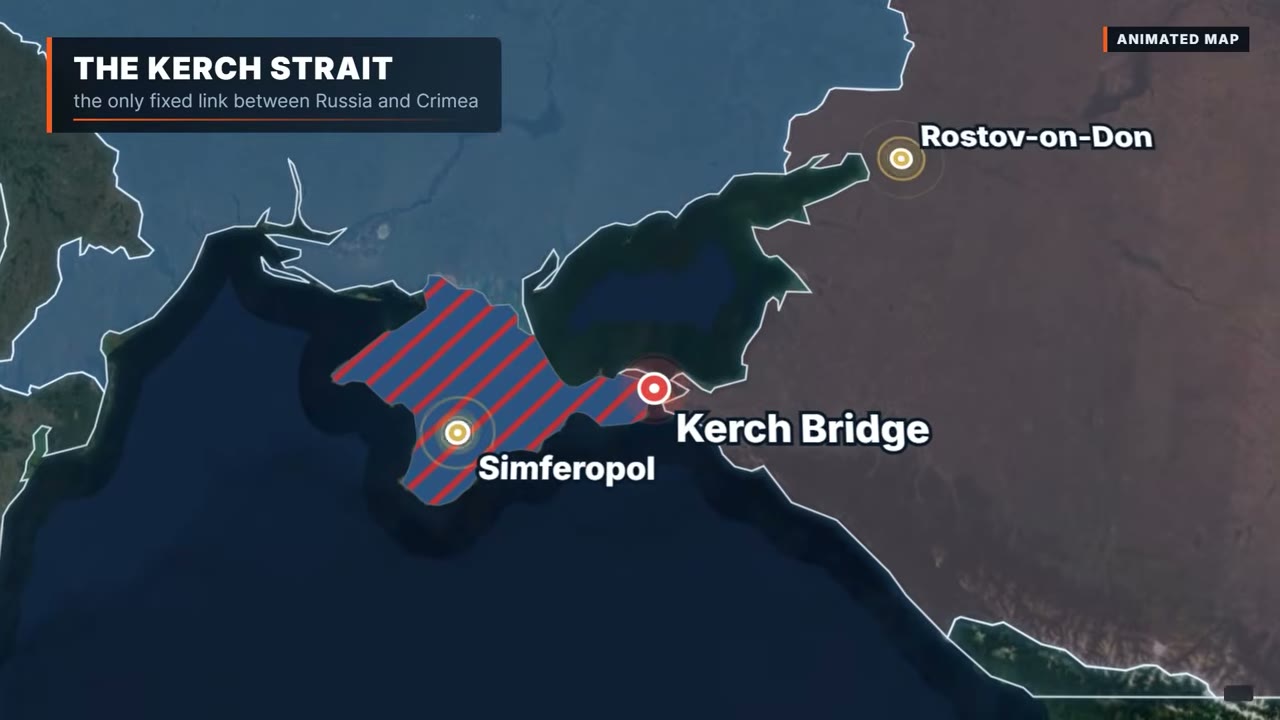
Ukraine knocked down a main arch of the Kerch Strait bridge on November 17, cutting the road link to occupied Crimea just as Putin traveled to China to meet Xi Jinping and Donald Trump. The strike reportedly used Ukrainian-made weapons and relay drones instead of US satellites.
1Ukraine destroys Kerch Strait bridge arch, halting road link to Crimea
A 5,000-ton steel arch taller than a 15-story building dropped into the Kerch Strait on the night of November 17, taking a long stretch of roadway with it. It now lies directly across the shipping lane it was built to span. Road traffic between Russia and occupied Crimea stopped, and the railway beside it was damaged. For eight years the Kremlin had called the structure proof that Crimea belonged to Russia forever, ringing it with air defenses. Ukraine says it used weapons it built itself, and a Ukrainian officer says it did so without the American satellite network it has depended on for most of the war. It happened just as Vladimir Putin was heading to China to meet Xi Jinping and Donald Trump.
2Bridge's $3.7 billion history and three failed Ukrainian attacks
The Kerch Bridge survived a truck bomb, sea drones and two tons of underwater explosives before November 17. Russia calls it the Crimean Bridge: roughly 19 km long, costing around $3.7 billion, opened by Putin in 2018, four years after Russia seized Crimea. Russian state media said it was designed to carry 40,000 cars a day. In October 2022 a truck exploded on the road section, igniting fuel tanks on a passing train; Russia patched it and traffic kept moving. In July 2023, Ukraine's SBU sent naval drones carrying up to 850 kg of explosives each at the concrete supports. Russian officials said two civilians were killed and their daughter was injured. Repairs followed, and the bridge stayed open. In June 2025 the SBU said its agents had planted explosives on underwater supports, with a charge equivalent to 2,000 kg of TNT; spokesman Dmitry Peskov said there had been an explosion but nothing was damaged and the bridge was working.
3Why the shipping-channel arches were the bridge's irreplaceable weak point
Two enormous steel arches carry the road and railway across a 227 m gap over the shipping channel, and they were the most irreplaceable pieces of the entire crossing. Most of the bridge is a chain of ordinary spans resting on pillars; lose one and you swap in a replacement, as Russia did in 2022 and 2023. Over the channel there are no pillars in the middle. According to analysis published by United 24 Media, more than 14 months passed between the start of assembly and the final installation of those structures in 2017. The strait is shallow, and nearly all serious shipping squeezes through a single narrow canal roughly 120 m wide right under the arches. Drop an arch and you do not just cut the road; you plug the waterway.
4Zelensky says seven-stage operation stripped bridge defenses first
Ukraine did not try to punch through Russia's defenses in one night. According to President Volodymyr Zelensky, the attack was the seventh stage of an operation carried out over several weeks, planned and coordinated by the SBU together with Ukraine's general staff. Over those weeks, he said, Ukrainian forces gradually destroyed air defense systems, radars, electronic warfare equipment and other designated targets around the crossing, peeling the defenses away layer by layer. Zelensky listed 11 weapons used across the operation, including the Flamingo and the R360 Neptune, and said nearly all were developed in Ukraine. Then came the final stage.
5First strike on November 16 bent an arch; Moscow called damage insignificant
The first blow landed on November 16, during a massive overnight drone offensive, and one of the navigation arches over the road was struck and bent out of shape. Crimea's Russian-installed governor said traffic was restricted. Around 2,000 vehicles were reported stuck in lines on either side while inspectors looked it over. Moscow's message that day came from Dmitry Peskov, who called the damage insignificant. About 24 hours later, that word aged very badly.
6Second barrage collapses arch and road span using Flamingo and Neptune missiles
On the night of November 16 into 17, Ukraine returned with a far larger barrage. Zelensky said Palianytsia drones struck the road section, while Neptune missiles, Router drones and FP5 drones hit the railway. Flamingo missiles, he said, carried out a precision-guided strike, and he added that the communications uplink worked flawlessly until the very last seconds. Analysts at the Long War Journal counted at least three Flamingos, seven Router missiles and a handful of Palianytsias, with footage showing at least 10 hits. The Dutch-based company Destinus told Reuters that seven of its Router cruise missiles struck the crossing. The Flamingo reportedly carries a warhead of more than one metric ton. Russia's defense ministry claimed record interceptions: more than 1,300 drones on the first night and more than 1,400 on the second. By morning, Ukraine's general staff said an arch and a span of the road section had collapsed, severing the road link. Defense Express reported that a section of about 270 m had come down.
7Russian state TV omits bridge attack; Peskov promises rebuild better than before
Russia's transport ministry halted road and rail traffic and told motorists not to travel toward the bridge. Rail traffic was later partially restored, reportedly on a single track. For the most part, Russian audiences did not hear about the collapse: the independent Russian outlet Agenstvo reported that federal television channels did not mention the attack in their morning news bulletins, covering Russian strikes on bridges in Kyiv and elsewhere instead. Officials confirmed an attack and a traffic suspension but avoided saying a piece of Putin's prized bridge was underwater. Dmitry Peskov told the newspaper Izvestia there was absolutely no doubt the bridge would be restored and that it would be, in his words, "even better than before." He said Deputy Prime Minister Marat Khusnullin had already briefed Putin after a meeting of a government commission.
8Starlink speed limits above 161 km/h hamper Ukrainian drones
For most of the war, Ukraine's drone fleet has leaned on Starlink and its military version, Starshield, both run by SpaceX, to see through a drone's camera and control it in real time far beyond the horizon. This autumn that lifeline tightened. In October, Ukraine experienced speed restrictions affecting fast-moving terminals, lifted after about 10 days following heavy criticism from Kyiv and reportedly pressure in Washington. Then they returned, this time in occupied territories and along the front line. When a drone carrying one of these terminals goes faster than about 161 km/h, it loses its connection. On November 15, two days before the bridge fell, Zelensky warned that Ukrainian interceptor drones were losing contact while chasing Russia's jet-powered Shahed drones and that many strikes on Ukrainian substations were getting through. "We are counting on these restrictions being lifted," he said. Musk said the limits were set by the Pentagon and the US president personally; Zelensky called them a very, very bad signal.
9Ukraine reportedly guides missiles with its own relay drone network
If a Flamingo missile flying at high speed toward Crimea could not count on American satellites, how was it guided until the very last second? According to a Ukrainian officer who spoke to the Times of London, Ukraine built its own network in the sky. The officer said the Americans had tried to paralyze Ukraine's connectivity for operations like this, but the mission proved Ukraine could create its own connections to relay radio signals. For the first time in history, he claimed, Ukrainian forces used groups of drones to pass video signals to missiles so they could hit precise points on the bridge. The Long War Journal reported that the Flamingo had reportedly been modified so an operator could steer it with relay drones carrying the control link over a mesh radio network. The account comes from a single unnamed officer and the technical details have not been independently verified; analysts note both armies already use airborne radio relays, and relay drones can themselves be shot down or jammed.
10Strike timed as symbolic blow before Putin's meeting with Trump and Xi
The same Ukrainian officer who described the relay drone network told the Times the strike was planned as a symbolic gesture, timed to the eve of a meeting between Trump, Putin and Xi to show that Putin is weak. The strike coincided with Putin's trip to the Apex summit in Shenzhen, where he was due to meet both leaders. Dmitry Peskov himself suggested the attacks might be linked to that upcoming meeting, though he offered no evidence. Whatever the intent, the timing could hardly have been more awkward for the Kremlin: Putin arrived in China with the most famous symbol of his annexation broken in half.
11Engineers say repairing the span could take two years or more
Moscow says it can fix the bridge. Engineers are far less optimistic. Colin Caprani, a professor of structural engineering at Monash University in Australia, told the BBC the main span had suffered catastrophic damage: "It is completely destroyed." In his view, repairing it could be harder than building it from scratch, with a large amount of debris underwater, piers and foundations possibly damaged, and some surviving structures possibly needing demolition before repairs begin. Engineers cited by the New York Times estimated restoring vehicle traffic could take around two years, assuming no further attacks and that the supports were not badly damaged. Inga Krun, a structural engineer at the Danish firm Koi, said replacing the roughly 227 m span and its arch could take more than a year. The new span would likely have to be built north of the bridge because it cannot be floated under the surviving railway bridge. A faster temporary fix would mean stopgap columns in the water, which could block ships. Retired Ukrainian Navy Captain Andriy Ryzhenko estimated clearing the channel could take at least several months, possibly longer.
12Russia begins salvage as estimates put bridge costs near $8.6 billion
Within two days, ship tracking data showed at least seven vessels, including tugboats and a dredger, gathered near the worst-damaged section. Deputy Prime Minister Marat Khusnullin said it would take about a week just to determine a repair timeline and that some sections might be running again in a month or two. An open-source analyst cited by United 24 Media estimated Russia may have spent roughly $8.6 billion building, defending and repairing the bridge, including about $2.4 billion worth of air defense and radar equipment lost around the crossing. Those are estimates, not official figures, but they show what was riding on this one structure.
13Bridge's military role had already shrunk to under a quarter of Crimea cargo
Russia had already stopped relying on the bridge for most of its military traffic. According to the Long War Journal, by mid-2024 the bridge carried less than a quarter of the military cargo going into Crimea, down from about three-quarters in 2022. Russia shifted toward ferries and a so-called land bridge running through occupied southern Ukraine. One researcher quoted by Al Jazeera, Nikolai Mitrokhin, called the strike militarily counterproductive, arguing the drones would have been better spent on roads near the Sea of Azov. Putin himself insisted the bridge was being used only for civilian purposes and had not carried military equipment or petroleum products for a long time. Many analysts still see the strike as a major blow.
14Ukraine pressures all Crimean supply routes, turning peninsula into an island
Ukraine has spent this year cutting every route that keeps Crimea supplied, not just the bridge. Medium-range drones hit logistics across the occupied south, with a focus on the R280 highway running from Russia through occupied Ukrainian territory toward the peninsula. Bridges along that route were struck, including several crossings over the Mas River.
In July, Ukraine claimed it had cut ferry capacity in the Kirch Strait by 75%. Now the road bridge is down. Every alternative route Russia uses is under pressure at once.
"Logistically, Crimea is turning into an island," Ukrainian analyst Igor Tishkevich told Alazer. The blocked channel adds an economic problem: Al Jazzer reported the fallen arch is cutting off freighters carrying grain and steel from southwestern Russia and occupied regions.
15Crimea's 2.5 million residents face blackouts, fuel lines and extended school break
Roughly 2.5 million people live on the peninsula, and this year has been brutal for them. In June, Russian-installed authorities declared a state of emergency after Ukrainian strikes hit the energy grid.
Ukraine's military intelligence said a prolonged blackout in July left 1.4 million subscribers without power. Gasoline reached many stations only once every few days, and lines stretched for more than a kilometer.
In early November, the peninsula lost power again. Occupation authorities extended the school break, citing what they called the current difficult situation. They insist food, medicine and fuel supplies are uninterrupted, and announced a ferry service to the Russian mainland — though a ferry is a far cry from a four-lane highway.
16Putin vows painful revenge and scraps energy moratorium after bridge strike
Speaking in Shenzhen, Putin said Russia's answer would be, in his words, far more painful than what the Kyiv regime did to the bridge. He also scrapped an idea he had floated just before: a possible moratorium on attacks against each other's energy facilities and shipping. After the bridge strikes, he said there will be no agreements.
Russia had already been hammering Ukrainian bridges for months. On the very night the arch fell, Zelensky said seven Russian ballistic missiles struck Kyiv's north and south bridges, and at least two people were killed in the capital.
17Ukraine strikes bridge a third time, damaging railway tracks with Neptune missiles
Ukraine did not wait for Russia's revenge. Within days, it struck the bridge for a third time that week.
Ukraine's general staff said Neptune missiles were used to damage the railway tracks — the part of the crossing that was still working.
The message seemed clear: Ukraine is not finished with this bridge. Zelensky framed the Kirch operation as an answer to Russia's campaign against Ukrainian bridges. That is the cycle now — bridges for bridges, power grids for power grids, and no deal in sight.
18Why this attack succeeded and what it means for long-range strike rules
Ukraine went after the one part of the bridge that could not simply be swapped out. It reportedly spent weeks dismantling the defenses first — and, if the officer who spoke to the Times is right, did it with its own weapons and its own communications just as its access to American satellite links was being squeezed.
Does that change the war in the south overnight? Not necessarily. Russia has other routes, and some experts argue the bridge mattered more as a symbol than as a supply line. But Putin built it to tell the world Crimea was Russian forever, and its centerpiece now lies at the bottom of the Kirch Strait.
The Kremlin says the bridge will return, better than before. Engineers say it may take two years — if the strikes stop.