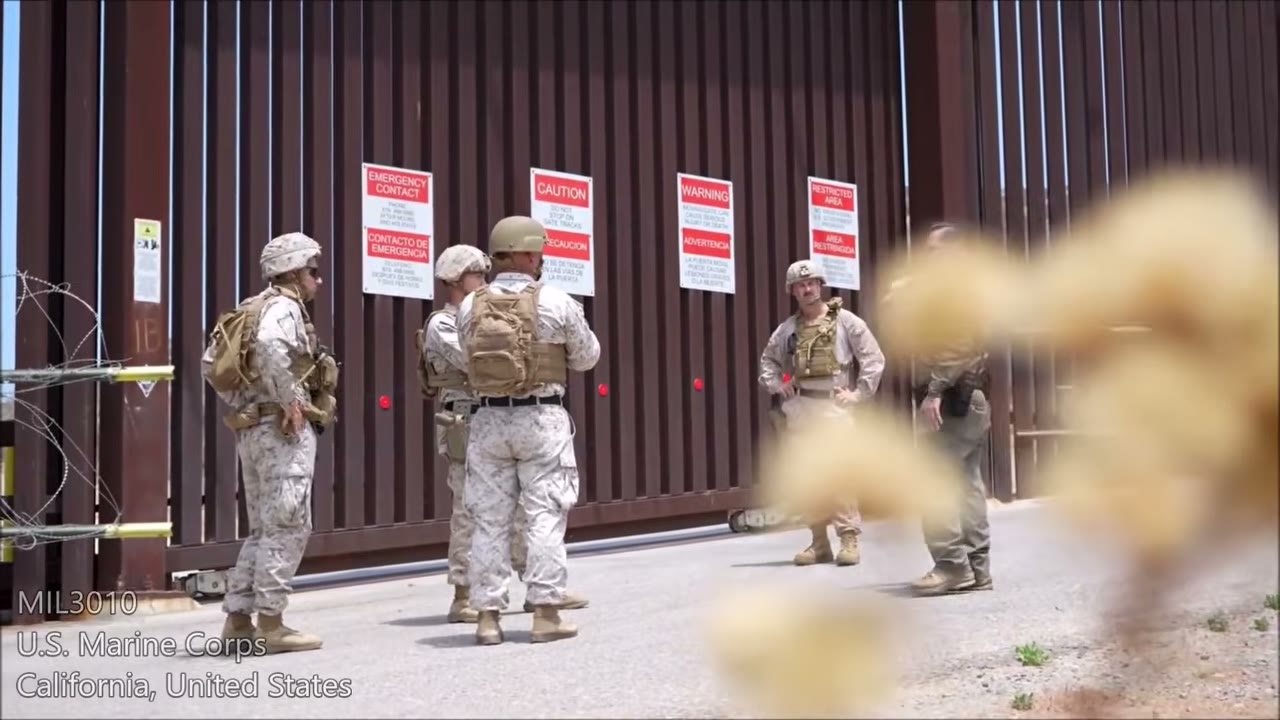
A MIL3010 report follows U.S. Marines and border personnel in California as they discuss barrier tactics, drone operations and Starlink connectivity near the southern border. The footage shows troops adapting fencing and launching drones to watch remote terrain.
1Troops discuss migrants cutting holes in border barrier with ladders
Migrants are cutting holes in the southern border barrier and sliding back through, according to troops stationed there. The troops described a routine: a ladder goes up halfway, someone reaches through, snips an opening, then slips back out.
One noted the terrain where it happens is mostly a hill to flat ground. The crew has cut pieces stacked against the barrier, apparently to deal with the damage.
That is why the troops are reconsidering how the barrier sections are installed. The conversation moved straight from the holes to a fix: running the pieces vertically instead of horizontally.
Details on location, timing and how often the cutting happens were not given. What comes next is the change in installation, which the crew began discussing on the spot.
2Crew decides to mount barrier pieces vertically instead of horizontally
Barrier sections will be run vertically instead of horizontally, a crew member said, explaining the switch on site. The change follows reports of holes being cut in the barrier.
The crew member laid out the plan plainly: rather than horizontal placement, the sections go up vertical. Work was set to begin right away.
No numbers were given for how much barrier would be reinstalled or how long it would take. The adjustment is a small tactical tweak to how the sections are mounted.
3Personnel test drone equipment and check heat in the sun
The gear was getting warm in the sun as personnel set up drone equipment outdoors. One person poured out components while noting the heat.
Beeps sounded during the checks. A reading of 55 came up, then 13, as the crew worked through the equipment.
Someone asked about multiple fog units and whether they were connected to Starlink or Wi-Fi. The question was left open in the exchange.
No results from the testing were stated. The crew kept working through the setup in the heat.
4Question raised whether drones link to Starlink or Wi-Fi
Are the drones connected to Starlink or Wi-Fi? That question came up as personnel worked with the equipment on the southern border.
The person asking directed it at the crew nearby. The reply suggested that is exactly why they were doing the work, and that someone was able to get that connection.
No answer was given on which network the drones actually use. The exchange left the connectivity question open.
It matters because drone operations depend on a link to send back what the aircraft sees. For now, the setup was still being worked through.
5Operator takes photo and raises drone higher for a better view
An operator pushed the drone higher to get a better view and took a photo. The aim was to see if the extra height helped.
A bird came into the picture during the flight. The operator confirmed the photo was taken.
No details were given on what the imagery showed or what it would be used for. The flight was part of the crew's drone work on the southern border.
6Crew compares the site to a nicer, newer ship
The site drew a casual comparison to a nicer, newer ship. A crew member pointed to the similarities between the setup and the vessel.
Another agreed the comparison made sense. The exchange stayed light, with no technical details offered.
The talk then turned to keeping equipment tucked away. No specifics were given on what was being stowed or why.
7Instructor coaches proper hand-holding and launch technique
An instructor walked an operator through holding and launching the drone, step by step. Keep it tucked until the mark, then call it out.
The coaching focused on the grip: keep holding it, don't creep up too much. The instructor stressed being ready before the launch.
The clipboard came up in the same breath, described as like a nurse's. The session stayed hands-on, with the instructor calling the timing.
8Crew uses an Amazon nurses clipboard for field notes
The crew's field clipboard is a nurse's clipboard bought on Amazon. One member explained the pick while going over notes.
The same instructions carried a warning: make sure you don't start running. The clipboard is used to record field notes during the drone work.
No other details were given about the setup. It is a small, improvised piece of gear in an operation built around drones and barrier work.
9Instructor sets timing for when the operator may start running
The operator was told not to start running until the instructor gives the word. The instruction set the timing for the launch.
The same exchange included a mention of pain and a note that someone could not be reached. The context for both was not clear.
The timing rule was the clear takeaway: hold position until told to move. No further details on the launch were given.