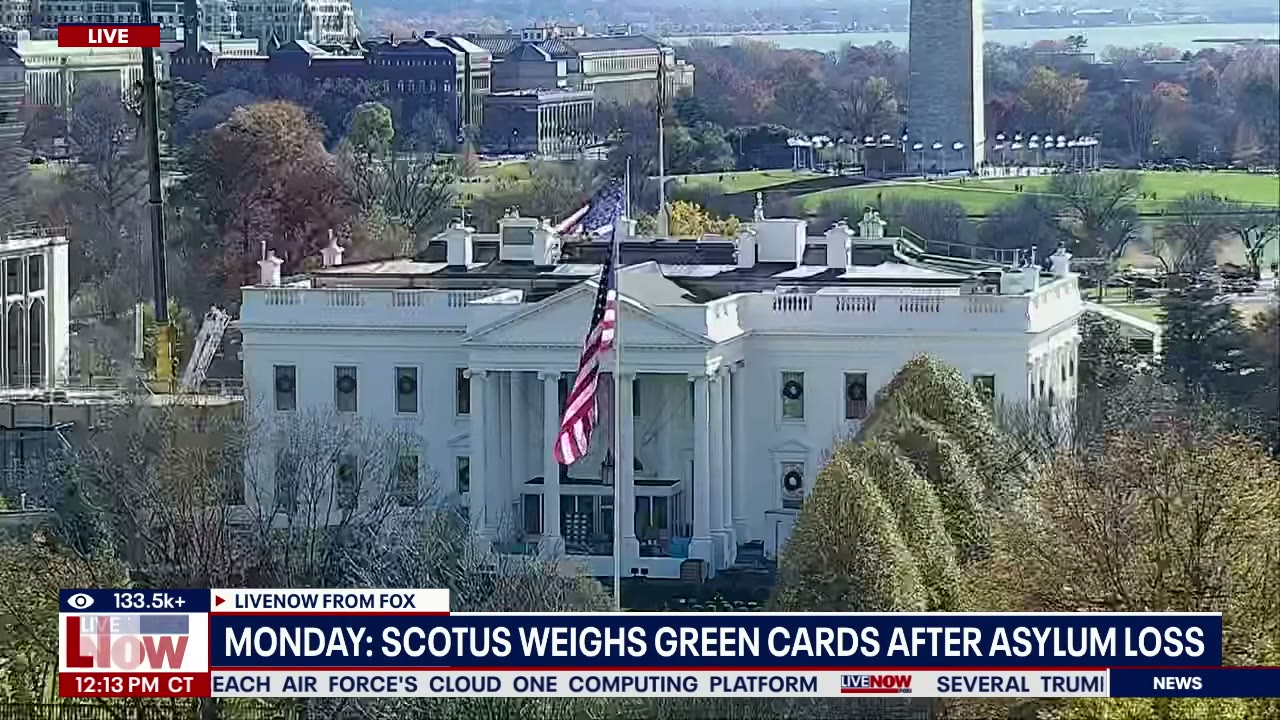
The Supreme Court hears oral arguments Monday on whether immigrants whose asylum protection has been terminated can still apply for green cards. Circuit courts are split, with the Fifth Circuit allowing applications and the Second and Fourth Circuits barring them, leaving immigrants and attorneys watching closely.
1Supreme Court to hear green card case for terminated asylum seekers
The Supreme Court hears oral arguments Monday on whether immigrants whose asylum protection has been terminated can still become legal permanent residents — green card holders.
Immigration attorney Sushant Modi joined the discussion ahead of the arguments. The case turns on a question that has divided lower courts: does losing asylum shut the door to a green card, or does the law still allow an application?
Modi said the case differs from other immigration disputes that have reached the high court because it deals specifically with asylum and the ability to apply for permanent residence after asylum is terminated.
The justices will hear the arguments Monday. What they decide will set the rule for immigrants in the same position across the country.
2Circuit courts split on green card applications after asylum termination
Federal appeals courts are split on whether immigrants whose asylum has been terminated can still apply for a green card — and the Supreme Court is now stepping in.
The Fifth Circuit Court in Texas, known as very conservative, ruled in clear language that you can apply for a green card even after asylum is terminated. Modi called it "a very liberal decision based on a plain language reading."
The Second and Fourth Circuit Courts ruled the opposite way: no green card application once asylum is terminated.
That contradiction among the circuit courts, which have jurisdiction over many states, is the crux of the problem now before the justices.
3Attorney says justices should judge each case on its own merits
The Supreme Court should judge each case on its own merits, immigration attorney Sushant Modi said, because the cases are very different from one another.
Asked whether rulings from the past two years of the Trump administration might influence the justices, Modi said each rule should be judged on its own merits and that the justices should read the precise law Congress intended.
His point: past decisions may not predict the outcome here, because the legal questions in each case differ.
He then turned to the purpose of Congress and the origins of asylum law.
4Attorney explains origins of US asylum and refugee law
American asylum and refugee law traces back to the Holocaust and the Nazi persecution of Jews, immigration attorney Sushant Modi said.
Modi, who taught asylum and refugee law as a law professor about ten years ago, said the rule came from that cruel environment: if you come here and face persecution, serious harm, torture or attacks, you can't be deported.
He called it one of the most important humanitarian values Americans uphold.
The real difference between asylum seekers and refugees, he said, is that refugees are outside the United States, while asylum seekers are already here.
5Court composition and ideology loom over the asylum case
Judges bring their own principles to the bench — some conservative, some liberal — and that structure hangs over the asylum case now before the Supreme Court.
With the court's composition and its rulings from the last two years in mind, Modi was asked whether he has doubts about the direction the justices will take.
He was also asked what to expect in the verbal arguments, without anyone calling him a betting man.
His answer turned on how the lower courts have read the law — and what the statute actually says.
6Fifth Circuit says law does not require current asylum status
Nowhere in the law does it say you must currently be an asylum seeker to apply for a green card, according to the Fifth Circuit Court.
The court, generally known as conservative, ruled there is a right to apply for green cards. Its reasoning: it is enough that you were recognized in the past.
The Second and Fourth Circuits, known to be slightly more liberal than the Fifth, ruled to the contrary.
Given the current composition of the Supreme Court, Modi said, it will be very interesting to see how the judges rule.
7Attorney urges Supreme Court to read whole statute for Congress intent
When a statute's language is unclear, the Supreme Court should look at the entire statute to understand Congress's intent, immigration attorney Sushant Modi said.
He said the clear language is confused by differences of opinion among the circuit courts — one court says one thing, another says the opposite.
So the justices should go one step further, he argued, and read the whole law rather than isolated words.
Modi referred to Parliament; the discussion was unfolding live from the US Capitol building.
8Blue wave could reshape immigration law and Congress next year
A "blue wave" has swept across the country, and it will affect control of the House of Representatives and the Senate on Capitol Hill.
Asked whether that will affect immigration law — and whether more challenges could follow even after the Supreme Court rules — Modi said yes in some ways and no in others.
There are rumors about immigration reform, he said. Both Republicans and Democrats have said they favor the measure, especially for DACA applicants — long-time residents with little or no criminal record.
There has to be a way for them to stay, he said.
9Dignity Act and Trump support for bipartisan immigration reform
President Trump has indicated he may consider supporting immigration reform, but only depending on its composition — it must be bipartisan.
A law called the "Dignity Act" has recently drawn references, Modi said.
Even with Democrats controlling both houses of Congress, that is not a majority, so a filibuster is likely. The president can also use veto power.
Some compromises will be needed, he said.
10Seattle ICE enforcement draws public outcry and fear
Masked agents, people fearing for their lives at airports, and American citizens targeted and killed in ICE raids — Modi pointed to a strong public outcry over enforcement in Seattle.
He said there is great fear among the people, and that ICE may be overreacting.
Still, he said the public is making an effort to see the issue as a humanitarian one.
He then returned to the Supreme Court case, calling it a humanitarian issue as well.
11Attorney clarifies case is about judge's authority to consider petition
The Supreme Court case is not about whether immigrants get green cards — it is about whether an immigration judge can even consider a petition for one, Modi said.
He said that is what Congress intended. The question is whether there is a complete exemption in the law, or whether the judge cannot consider the petition at all.
Even if a judge considers it, and asylum has been revoked and there is any criminal problem, the judge can use their power to reject it.
They are not obligated to issue a green card. The question is whether they have the authority to consider it in the first place.
12Immigration lawyer urges eligible asylum holders to apply now
People with asylum status who have been in the country more than a year and can apply for a green card should do it immediately, an immigration lawyer advised — before the Supreme Court rules. Oral arguments begin in 48 hours.
The lawyer, Susham, warned that if the court rules they cannot apply and the administration tries to revoke asylum status for many, they would be pushed into an even more complicated situation. "If eligible, apply for a green card quickly," she said.
She also pointed to a split among appeals courts. In the Fifth Circuit, which includes Texas, the rules differ from the Second and Fourth Circuits, where people can still apply even if their asylum was revoked. She said the Supreme Court could rule differently in those circuits, with additional time.
Her third piece of advice: explore other options. Asylum claims have been suspended, she said, but that does not mean people have none.
13Attorney hopes justices examine refugee and asylum seeker distinction
Congress required refugees outside the United States to keep their refugee status — but set no such requirement for asylum seekers, the lawyer told the program. She hopes the justices examine that distinction.
Susham said she is curious what the Supreme Court will look at beyond the clear language in its ruling, and whether it can determine Congress' intent, since the circuits show no clear reading of the split.
She argued the requirement would make little sense for asylum seekers, who are likely to lose status quickly if conditions in their country change and they cannot go back. She said that is likely why Congress created the exemption standard.
She also warned that blocking the humanitarian exemption for applying for adjustment before a judge would destroy the law itself.
14LiveNOW to broadcast Monday's Supreme Court oral arguments
Oral arguments in the case over whether immigrants whose asylum protection was terminated can become lawful permanent residents are set for Monday — and viewers will be able to hear them.
The broadcast will carry some of the arguments live, so audiences can follow how the questioning goes inside the Supreme Court.
There will be no immediate answers. The arguments are part of the coverage planned for Monday.