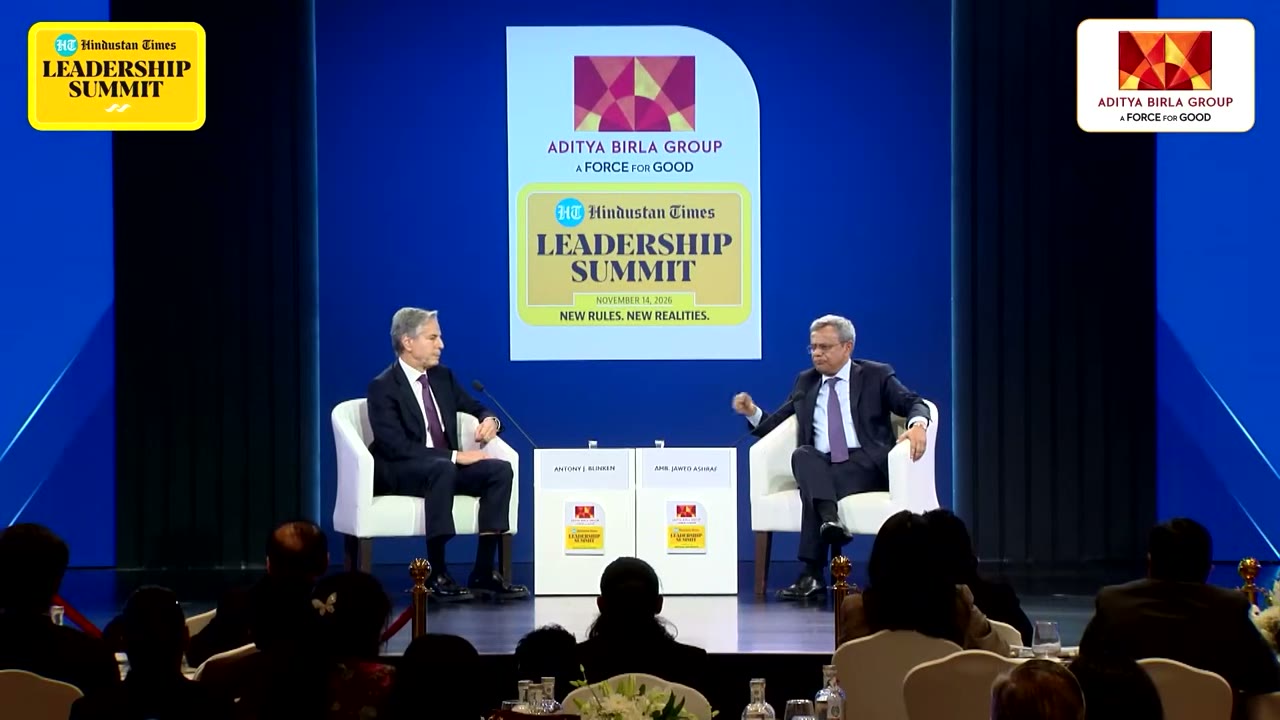
Former US Secretary of State Antony Blinken discusses the past and future of India-US relations at HTLS 2026. He addresses the iCET defense supply concerns, Quad uncertainty, trade tensions and Russia energy frictions, while calling technology cooperation the new driving force.
1Blinken Reviews Biden-Era iCET and Quad Challenges
A stalled engine deal hangs over the US-India defence relationship. Antony Blinken, reviewing the Biden era, named two defining issues: iCET and the Quad — and conceded the GE-414 fighter jet engine transfer still has problems, with no hot section transfer.
Those delays, he said, "reinforce the perception of unreliability of the United States on defense supplies."
On the Quad, Blinken pointed to uncertainty over the Indo-Pacific's strategic framing and the unsettled contours of the US-China relationship, with India's ties to both powers in flux. He was asked for his biggest takeaways from his time in office.
2Blinken Says Strategic Goals Outweighed Trade Tensions
Trade tensions simmered between Washington and Delhi throughout the Biden years — and Blinken says they were consciously set aside. Asked whether concerns over Iran, Russia, India's internal situation or trade caused friction, he acknowledged the trade strain was real.
But the calculation, as he described it, was that the two countries had "larger strategic goals to pursue." Those bigger priorities took precedence over the disputes of the moment.
3Blinken Calls US-India Strategic Convergence Essential
Two countries that were "strange" to each other for 50 years rebuilt their relationship in just 25, Blinken said — and he calls the result essential to this century.
"The strategic convergence between the United States and India is an essential element of this new century," he said, adding it must be pursued and deepened.
The shift began at the end of the Clinton administration and carried through successive Republican and Democrat administrations, moving the pair from estrangement to what he called a genuine and in some ways unique partnership, built on shared strategic interests and deep people-to-people ties.
4Blinken Says Technology Cooperation Will Drive US-India Ties
Nuclear cooperation flipped the switch in US-India ties. Technology will drive them forward, Blinken said.
"Going forward, it's technological cooperation. That should be the driving force," he said.
He pointed to joint semiconductor production, securing AI supply chains, and working together in space and quantum — calling these "a glue that will continue to get stronger."
Blinken again returned to the people-to-people connections between the two societies, which he described as profound and in many ways unique.
5Blinken Accepts India's Strategic Autonomy on Russia
Washington should not expect Delhi to follow its lead on every issue, Blinken said — and he framed that as understanding, not complaint.
"The notion of strategic autonomy for India I fully understand," he said, citing India's history, geography and development needs as reasons the two countries won't always share a perspective.
The task, he said, is building trust and mechanisms to manage differences. On Russia, he said the US goal is not to end the India-Russia relationship, given its deep history, but to see India diversify on energy and military equipment so it isn't beholden to Moscow.
6Blinken Downplays Tariff and Russia Energy Frictions
It "looks a little hypocritical" for the US to complain about India's Russian energy purchases after Washington waived energy sanctions on Russia, Blinken said.
He listed recent frictions — tariffs, differences over Russia and energy, and personalities — but said they pale next to the strategic drivers uniting the two countries: a free and open Indo-Pacific, converging economies and deepening people-to-people ties.
"I remain very, very bullish about this unique relationship," he said.
But it doesn't just happen, he added: it takes hard work, commitment to deepen it, and managing the moments when two continent-sized democracies run into each other.