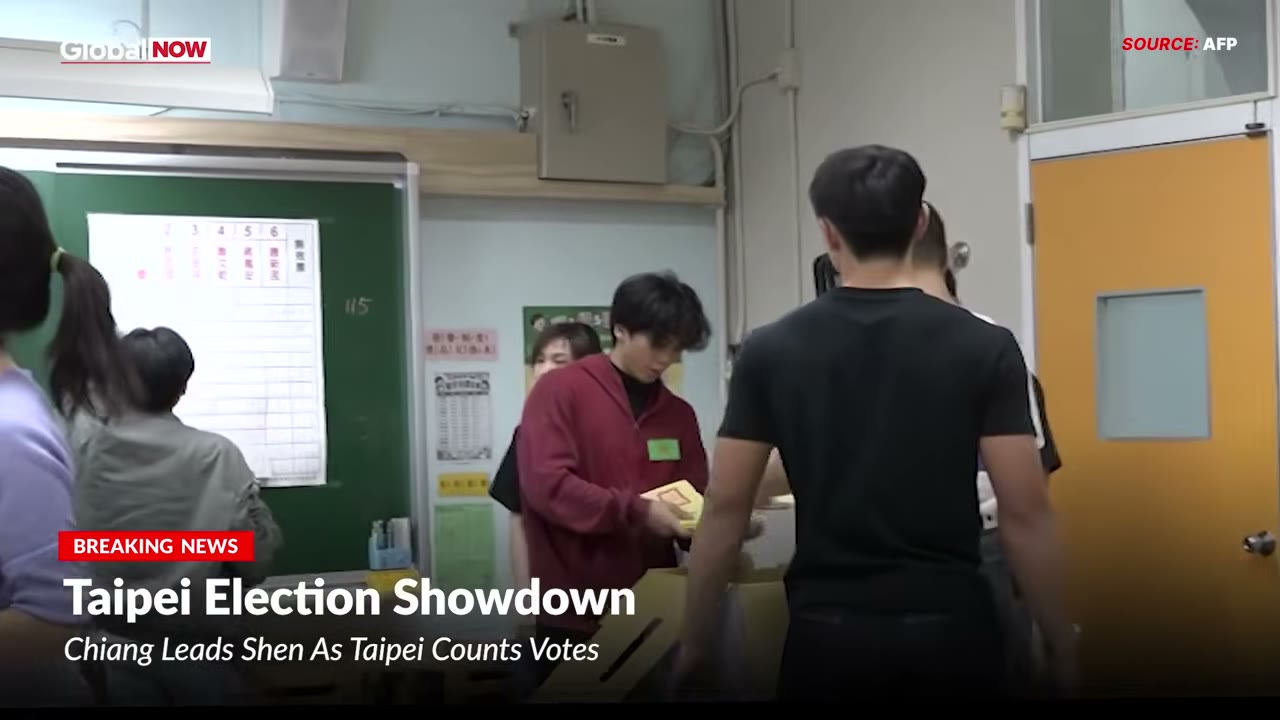
Vote counting is underway in Taipei's mayoral election, with preliminary data showing incumbent Chiang Wan-an ahead of DPP challenger Puma Shen. The race is a key political test for both parties ahead of the 2028 presidential election, drawing international attention.
1Vote counting begins in Taipei mayoral election with Chiang Wan-an leading
Vote counting is underway in Taipei, and early figures put incumbent Mayor Chiang Wan-an ahead of his main challenger, Puma Shen of the Democratic Progressive Party.
Election workers began processing ballots after polling stations closed. Supporters of political forces across the city waited for results in a race that has drawn attention domestically and internationally.
Preliminary data suggests Chiang has secured an advantage over Shen. Counting is still ongoing, so the figures are not final.
2Taipei race tests DPP and KMT ahead of 2028 presidential election
Preliminary figures in Taipei are not the final result — counting is still ongoing, and early numbers should not be treated as the outcome.
The race is a serious political test for both the ruling Democratic Progressive Party and the opposition Kuomintang. Both are preparing for the next presidential election in 2028.
That makes the capital vote a measure of each party's standing well before the national contest.
3Polling stations open across Taipei as residents vote for city leadership
Polling stations across Taipei opened at 8:00 a.m., letting citizens choose the city's leadership for the next four years.
Voters cast ballots at schools, community centers and local polling stations throughout the day.
Residents came to exercise their democratic rights in a race that will decide who runs the capital.
4Taipei voter turnout reaches nearly 69%, slightly above 2022
Voter turnout in Taipei reached almost 69%, according to preliminary data — slightly higher than the previous mayoral election in 2022.
The figure points to significant public interest in the race.
Higher turnout alone does not show which party benefited most from the added voters.
5Stakes for Chiang Wan-an and Puma Shen in Taipei contest
Both leading candidates voted earlier in the day, as the race offered each a different prize.
For Chiang Wan-an, re-election would secure another term and consolidate his position as one of the Kuomintang's most prominent political figures.
For Puma Shen, winning would challenge the opposition party's traditional hold on the capital and deliver an important breakthrough for the Democratic Progressive Party.
6Both candidates vote early, urging residents to turn out
Chiang Wan-an visited a polling station at Yong-An Elementary School and urged residents to vote. "Today is a beautiful day , so I urge everyone to come out and vote as early as possible to exercise their civil rights," the Taipei mayor said that morning.
Puma Shen arrived at Jinhua Middle School with his wife and daughter. The DPP candidate was in high spirits, and he spoke about the importance of family support, calling their presence a source of personal inspiration.
7Why Taipei's mayoralty is a launchpad for national politics
Taipei's mayoralty is more than a city job: previous mayors have gone on to national political leadership, making the post an influential platform.
As the capital and major economic center, the city is home to important government institutions, businesses, universities and diplomatic missions. Its mayor is often considered a prominent national political figure.
After weeks of campaigning and meetings with residents, both candidates entrusted their political futures to Taipei voters.
8Chiang Wan-an campaigns on incumbency amid public scrutiny
Chiang Wan-an won the mayoral election in 2022 and entered this race with the advantages of incumbency.
His administration's activities during the campaign were subject to close public scrutiny. Residents assessed whether his leadership was adequately addressing the city's problems and whether another four years would bring the improvements they expected.
Previous Taipei mayors have gone on to national political leadership, adding weight to the post.
9Puma Shen's profile as scholar on information manipulation and security
Puma Shen offered voters an alternative political course. A scholar who entered national politics, he became widely known for his research on information manipulation, foreign influence and civil preparedness.
His profile has drawn attention outside Taipei, particularly because of his outspoken positions on Beijing and Taiwan's security.
He is challenging the opposition party's traditional influence in the capital.
10Local issues dominate Taipei campaign: housing, child care, transport
For all the international attention, this election is about choosing a city leader. Taipei's mayor oversees public services, urban planning, transportation, housing policy and programs that affect residents' daily lives.
Throughout the campaign, affordable housing, child care, public transportation and environmental stewardship remained important.
For many residents, the decision depends less on international politics and more on which candidate can improve living conditions, reduce daily expenses and provide effective public services.
11Taipei faces housing affordability and urban development challenges
Housing affordability remains a significant issue in Taipei, especially among younger residents and families seeking long-term financial stability.
Urban development poses another challenge as authorities try to modernize infrastructure while preserving established communities and maintaining accessible public spaces.
Transportation, pedestrian safety and the quality of municipal services are also issues the next administration will have to address.
12Local elections diverge from presidential voting patterns
Local elections do not necessarily follow the same voting patterns as presidential races.
A voter who supports one party nationally may choose a candidate from another party in a municipal election, based on managerial experience or local program proposals.
That distinction matters when interpreting the results coming from Taipei.
13Taipei result will not directly shape Taiwan's foreign or defense policy
The Taipei result will not directly determine Taiwan's foreign or defense policy. Those responsibilities remain largely with the national government.
Beijing has a clear interest in political developments across Taiwan. China considers Taiwan part of its territory, while Taiwan has its own democratically elected government and independently runs its own affairs.
The race has drawn international attention because of Taiwan's relations with China.
14KMT and DPP differ on engagement with Beijing
Taiwan's two biggest parties split sharply on how to deal with Beijing, and that divide is shaping the fight for Taipei. The Kuomintang has traditionally advocated greater dialogue and engagement with Beijing. The Democratic Progressive Party puts more weight on Taiwan's separate political identity and the preservation of its democratic autonomy.
President Lai Tsing-de, who heads Taiwan's national government, insists Taiwan's future should be determined by its people.
Those differences add context to the attention on the Taipei mayoral election, where the parties' national stances sit behind a local vote.
15DPP seeks first Taipei mayoral win since Chen Shui-bian in 1994
The DPP has not won the Taipei mayor's office since 1994, when Chen Shui-bian was elected. A victory for Puma Shen would end that drought and mark a significant political breakthrough for the ruling party.
Another win for Chiang Wan-an would strengthen the Kuomintang's hold on one of Taiwan's most influential cities.
Still, reading the municipal elections only through Beijing-Taipei relations would overlook many domestic issues that shaped the campaign.
16Taiwan holds local elections across 22 cities and counties
About 19.58 million people were eligible to vote in Taiwan's local elections, spread across 22 cities and counties. More than 11,000 local government positions were up for grabs.
The Taipei mayoral race is one piece of that much larger democratic process. The elections determine the leadership of numerous communities.
They also give political parties a read on their level of public support.
17KMT defends 2022 dominance as DPP seeks local gains
In the 2022 local elections, the KMT won leadership positions in 14 cities and counties. The DPP took five.
Now the ruling party is seeking to strengthen its local representation, while the opposition hopes to consolidate its influence.
Another closely watched race is taking place in the neighboring city of New Taipei.