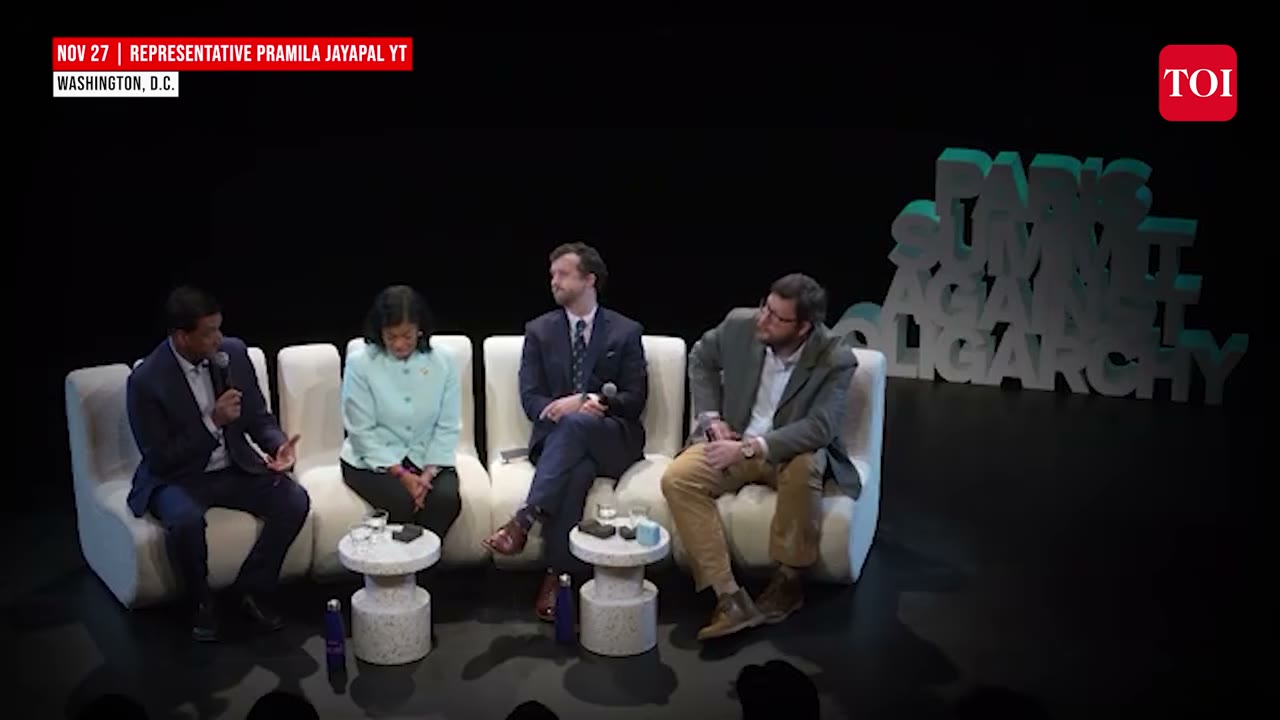
Progressive lawmakers and commentators debate why voters backed Donald Trump and Elon Musk despite billionaire influence. They argue liberalism must deliver on wages, childcare and healthcare, and warn that inequality, offshore money and campaign finance fuel voter anger.
1Liberalism failed to deliver and must offer a muscular alternative
Voters rejected liberalism as bureaucratic and captured, and one progressive says the answer is a bigger, more generous version of it. Ro Khanna argued the 2024 election was a rejection of a system that stopped delivering, which let a business person promise to tear everything down.
He said the task now is to offer the alternative: "a muscular liberalism that does deliver." That means raising the wage, child care with Medicare for all, free college — what he called the next New Deal.
He put the window at at least two years, maybe four.
2Billionaire investor argues Americans back billionaires like Trump and Musk
A New York billionaire told a Washington panel that Americans clearly love billionaires — because they elected one president and made another the second most powerful person in the country.
Ro Khanna recalled the exchange at a Council on Foreign Relations-style panel in DC. The businessman, Mark Laterer, owns one of the basketball teams and was being interviewed when he made the argument.
His logic: if Americans were really against billionaires, why elect Donald Trump, and why put Elon Musk in the second most important job?
Khanna's summary of the sentiment: "Americans love billionaires."
3Progressives say the election was a rejection of captured liberalism
The 2024 election was a rejection — not of billionaires, but of a liberalism that had become bureaucratic and captured, according to Ro Khanna.
He said that capture is what let a business person step in and promise to tear everything down and deliver. Tech billionaires, he argued, cannot be the answer to a captured system.
Instead, he called for a "muscular liberalism" that raises the wage, provides child care with Medicare for all and free college — what he called the next New Deal.
He said the window is at least two years, maybe four, before a different kind of anger emerges.
4Speakers warn against complacency and call for a muscular liberalism
Rejecting cruelty is not enough, a speaker warned — without delivery for working and middle class Americans, complacency sets in.
The speaker listed what was rejected: the cruelty of ICE, of depriving Black people of political rights, of nativism. That deserves celebration, the speaker said, but not rest.
What is needed now, the argument went, is "a muscular liberalism that actually delivers for working and middle class Americans."
A second speaker agreed, recalling a meeting in Canada that echoed the same point.
5Scholar predicts Americans will revolt but Trump himself is the revolt
A Canadian scholar who studies the United States was convinced Americans would not accept what Donald Trump was doing. Her prediction: "Americans will revolt."
The response came back: I hope you are right — but Trump himself is the revolt.
Whether or not he is a billionaire, the argument went, Trump was attacking a system, even one already gamed for people like him and his flunkies. He was articulating opposition to it.
The question now, the speaker said, is how to marshal that energy in a more positive, constructive direction.
6Casey outlines three planks to tackle American oligarchy
Donald Trump ran in 2016 on draining the swamp and fixing a corrupt system — and now Americans want accountability, a speaker said.
The speaker recalled Trump's pitch: "I know how the system operates. Elect me. I'm the one who can fix it." The speaker noted the oligarchy framing from that campaign.
In the most recent election, the speaker said, there are few things Americans hate more than the level of corruption and its brazen, in-your-face elements — alongside foreign policy disasters, macroeconomic struggles and the cost of living.
What they want now, the speaker said, is solutions and a path forward.
7Wealth inequality is worse than the Gilded Age, speaker says
Wealth inequality in the United States is greater than any point in recent American history — and arguably ever, at least since sometime in the 19th century, a speaker said.
The speaker described three primary planks that must be tackled simultaneously in addressing oligarchy. Wealth inequality is the first.
Fixing it means everything from tax policy to rebuilding the IRS, the speaker said.
The other two planks: the offshore economy and campaign finance.
8Offshore shell companies let wealth disappear untaxed
Anonymous shell companies and loopholes let money be spirited away and disappear forever — untaxed, untraceable and unavailable for public goods, a speaker said.
The speaker called the offshore economy and its tools the second plank in tackling American oligarchy. That includes the "wealth defense industry" and the loopholes behind it.
The United States, the speaker said, has for years been the primary provider and purveyor of these anonymous financial secrecy tools.
The first plank is wealth inequality; campaign finance is the third.
9Campaign finance and Citizens United fuel corruption fears
Americans are as angry about corruption as at any time since Watergate — and much of that anger runs through campaign finance, a speaker said.
Voters may not know about DOJ task forces or shell companies, the speaker said, but they know the sense of unfairness and rot starts with how politics is funded.
Citizens United, earlier decisions and the explosion of money in American politics sit at the core of those concerns, the speaker said.
Many Americans see politics being sold off to the highest bidder — including figures like Trump and Musk.
10War on Iran linked to higher gas and food prices
Voters drew a direct line between the war on Iran Trump launched at the end of February and their cost of living, a foreign policy-focused speaker said.
That covered the cost of gas, food and basic goods. Foreign policy is often seen as distant by voters, the speaker said — but not in this election.
The war also added to a sense of waste: enormous time, energy and attention spent, the speaker said, after Trump ran as an anti-war president in 2024.
The speaker asked progressive voices from California and Washington how constituents were registering it.
11Gas and food prices awakened voters to Trump's intentional choices
Gas prices and food prices going up did what years of scandal did not: they awakened a lot of Americans to the idea that this is not working, Ro Khanna said.
He opened with a rule for any president: keep one thing on the Oval Office desk — don't let the price of gas go up.
For all of Trump's corruption and violations of the Constitution, Khanna said, it was the rising cost of gas and food that broke through.
That realization, he said, is what shifted how people saw the administration.
12Khanna says Trump chose the Iran war and blanket tariffs
Donald Trump chose the war in Iran and chose blanket tariffs — deliberate decisions that drove prices up, Ro Khanna said.
He contrasted that with presidents buffeted by events. No one would blame President Biden for Putin invading Ukraine, Khanna said, even though it led to higher gas prices.
Trump, by contrast, made intentional choices, Khanna argued, and the American people realized it.
He said those deliberate choices are what led to the outcomes voters are now feeling.
13America's moral standing erodes as China gains trust
Polling in Italy, the UK and Germany shows China is more trusted than the United States, according to a US lawmaker who was in those countries. The claim came as he argued Americans sense their country's moral standing is slipping.
He said the public sees the US as "complicit in this genocide in Gaza" and blamed a "war of choice in Iran." Prices are rising, he added, and the country spends more on bombs and missiles than on childcare and healthcare.
"We're losing our moral standing," he quoted voters as concluding. He said they rejected the direction and wanted a different one, which is why he backs ending funding for the Iran offensive.
He said he knows Primila feels the same and would let the congresswoman speak for herself.
14Lawmakers call to end funding for the Iran war this year
Lawmakers want funding for the offensive war in Iran cut off this year, before the holidays.
One said the war was senseless and called it unconstitutional and illegal. When gas and grocery prices climbed, he said, Trump told people they had nothing to worry about — that they could buy a few less dolls and a few less pencils.
"Other kinds of protein," another lawmaker added, picking up the phrase.
The lawmakers called it mocking of the American condition for most people. They said the war cost taxpayers heavily at the same time Trump slashed healthcare and food stamps for millions and gave trillions in tax breaks to the wealthiest individuals and big corporations.
They said the contrast mattered, and that his promise had drawn people in.