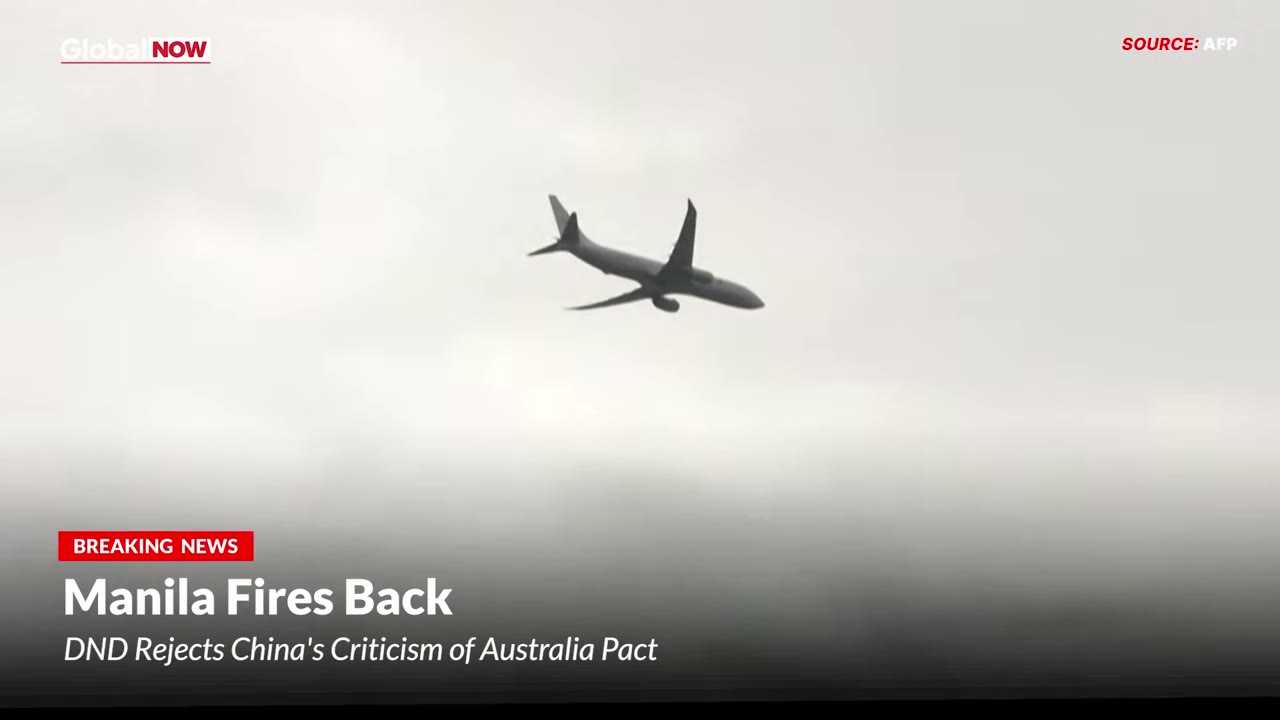
The Philippines has rebuffed China's objections to a new defense agreement with Australia, saying Beijing cannot dictate Manila's partnerships. The pact speeds up joint patrols, exercises and information sharing, amid rising tensions and a sharp war of words over the South China Sea.
1Philippines Tells China It Cannot Choose Manila's Friends
The Philippines has told China flatly that it does not get to pick Manila's friends. Its Department of National Defense rejected Beijing's criticism of a new defense agreement with Australia, and the ministry's spokesman did not soften a word of it.
Arsenio Andolong said China has "neither the right nor the moral grounds to dictate to the Philippines how and with whom to cooperate." Manila, he added, needs no permission from Beijing for its relations with other countries.
He accused China of making misleading accusations against other states while using coercion and intimidation to push its own claims in the West Philippine Sea. He called on Beijing to stop bullying and to respect other states' maritime rights under the UN Convention on the Law of the Sea.
2Philippines and Australia Sign New Defense Cooperation Agreement
The Philippines and Australia signed a new defense cooperation agreement in Manila on November 15, replacing a memorandum of understanding that had stood since 1995. Australian Prime Minister Anthony Albenizi attended the signing with Philippine Defense Secretary Gilberto Teodoro.
The ceremony came just before the 49th ASEAN Summit, which the Philippines hosted that week as this year's chair.
The pact is built to make joint patrols, military exercises and disaster relief operations easier to organize. It also covers information sharing, maritime awareness, strategic dialogue, training, interoperability of the armed forces and development of defense infrastructure.
3Defense Deal Aims to Speed Up Joint Patrols and Exercises
"This deal makes us faster." That was how Philippine Defense Secretary Gilberto Teodoro summed up the new agreement with Australia.
The point is not a separate weapon or a separate base. It is speed. When the two armed forces run joint exercises, patrols or disaster responses, they will spend less time on paperwork and more time at sea, because the deal simplifies coordination.
Australian Prime Minister Anthony Albenizi said it would enhance maritime awareness and information sharing and expand strategic dialogue, training and defense infrastructure development. Australian officials described the goal as strengthening deterrence in a region that has seen a growing Chinese military presence.
4Australia and Philippines Build on Years of Defense Ties
Australia and the Philippines are not new partners. Their agreement on the status of visiting forces has allowed their militaries to exercise on each other's territory since 2012, and in 2023, during Albenizi's previous visit to Manila, the countries upgraded relations to a strategic partnership.
Their naval forces have already conducted joint patrols in the South China Sea. In 2025, the two armed forces held their largest joint combat exercises, involving more than 3,600 military personnel.
Australian, Canadian and Philippine P-8 Poseidon aircraft have joined naval exercises in the South China Sea, and the Australian and Philippine defense ministers have publicly condemned what they call dangerous and destabilizing behavior by Chinese vessels toward Philippine ships. The new agreement simply makes that collaboration faster and broader.
5Australia's South China Sea Concerns Driven by Trade and Pressure
A large share of Australian exports — iron ore, coal and natural gas — travels by sea through Southeast Asian waters to major markets in North Asia. Any conflict or blockade in the South China Sea would hit Australia's economy directly. That is why the sea matters so much to Canberra.
Australia also has its own experience of Chinese military pressure. In 2025, it said a Chinese fighter jet fired flares near an Australian maritime reconnaissance aircraft over the South China Sea, calling the move dangerous and unprofessional.
That same year, a group of Chinese heavy warships sailed around Australia and conducted gunfire in the Tasman Sea between Australia and New Zealand, forcing commercial flights to change course. For Canberra, the South China Sea has become a direct national interest.
6Australia Brings Frigates, Patrol Aircraft and Submarines to Pact
Australia brings real capabilities to the partnership. Its navy has modern frigates and destroyers, and its air force flies P-8 maritime patrol aircraft — some of the most effective reconnaissance aircraft in the world, able to track ships and submarines across vast ocean expanses.
Through AUKUS, its partnership with the United States and Great Britain, Australia is also preparing to receive nuclear submarines in the coming decades.
For the Philippines, still modernizing its own armed forces, working closely with a military like Australia's means more training, more information sharing and more control over the waters. That is why the new arrangement focuses so heavily on information sharing and maritime awareness.
7China Warns New Pact Could Escalate South China Sea Tensions
China's Ministry of Defense addressed the new pact at its monthly press briefing on November 26, and its spokesman issued a warning. Spokesman Chen Shi said the deal could exacerbate tensions in a region with territorial disputes.
Chen Shi said: "China will continue to take necessary measures, resolutely counter violations and provocations, and firmly stop any attempts to destabilize the situation in the South China Sea."
He added that the South China Sea should be a sea of peace, friendship and cooperation, and that inciting conflicts and provocations is not what people want.
8Manila Counters China's Claims With Record of Harassment
China defends its behavior in the South China Sea as legal, saying its actions protect territorial sovereignty and maritime interests. Manila sees it the other way around.
From the Philippines' perspective, it was the Chinese coast guard that used water cannons against Philippine government vessels near Scarborough and Ayungin reefs. It was China that blocked and harassed supply missions of Philippine Marines aboard the BRP Sierra Madre. And it was Chinese vessels that tracked and harassed Filipino fishermen in their own exclusive economic zone.
In 2016, an international arbitration court ruled that China's large-scale claims in the South China Sea have no legal basis under international law. Beijing rejected the decision and has never recognized it.
9Law of the Sea Explained in the Philippines-China Dispute
Under the United Nations Convention on the Law of the Sea, each coastal country has an exclusive economic zone extending up to 200 nautical miles from its coast. Within it, the country has sovereign rights to fish and to explore for and extract resources such as oil and gas.
Scarborough, Ayungin and Escoda reefs lie within the Philippines' exclusive economic zone. China's claims rest on what it calls historical rights, marked on its maps by a dotted line encompassing most of the South China Sea — the claim an arbitration court rejected in 2016.
So when China calls Manila's partnerships destabilizing, the Defense Department's answer is simple: the problem is not who the Philippines cooperates with, but China's behavior at sea.
10China Sanctioned Philippine Defense Chief Teodoro in June
China banned Philippine Defense Secretary Gilberto Teodoro and his family from entering mainland China, Hong Kong and Macau in June, and barred Chinese organizations and individuals from doing business with them. Its Foreign Ministry accused him of irresponsible statements that harmed relations between the countries.
Teodoro brushed it off, saying the actions appeared aimed more at a domestic audience in China than at him personally. In August, after China detained several Filipinos for alleged immigration violations, he called China's actions pure extortion and blackmail.
He has repeatedly called China a serious threat to the Philippines, both territorially and politically. The pattern holds: each time Manila deepens a partnership, Beijing objects, and Manila responds more forcefully.
11Philippines Builds Network of Defense Partners Beyond Australia
The Australia pact is not isolated. The Philippines is building a network of defense partners.
The United States is its ally under the 1951 Mutual Defense Treaty, and under the Enhanced Defense Cooperation Agreement, US forces have access to designated Philippine military facilities, several in northern Luzon opposite Taiwan. Japan has signed its own agreements with Manila, including a mutual access agreement letting their forces train on each other's territory and a deal to share resources for joint exercises.
On November 9, Japan signed a 4.3 billion yen deal to provide a coastal radar system for the Philippine Navy and reconnaissance drones for the Air Force. It also plans to transfer five decommissioned Abukuma-class escort destroyers to the Philippine Navy.
12Analysts Call US-Japan-Australia-Philippines Grouping The Squad
Some analysts call the grouping of the United States, Japan, Australia and the Philippines "The Squad." It is not a formal alliance like NATO, and no single treaty binds all four, but it is a network of agreements that intersect and point in the same direction.
The Chinese state-run Global Times quoted a Chinese expert who questioned the group's prospects. At the same time, it noted that Australia's military cooperation with the Philippines is closely linked to Manila's alliance with Washington, and that the strategic intention to counter China is quite clear.
For Beijing, this is precisely what is worrying: each new agreement makes it harder to isolate the Philippines.
1348 Chinese Ships and Bomber Near Philippines as Talks Escalate
Forty-eight Chinese coast guard and navy ships were reported in the West Philippine Sea in a single week — up from 19 just a week earlier. The Philippine military logged the sharp jump as a Chinese H-6 strategic bomber was confirmed flying about 45 nautical miles off the Philippine coast.
The surge came the same week Manila's new defense agreement with Australia took shape. That pact, according to the reporting, makes it harder for Beijing to isolate the Philippines and deal with it one-on-one — Manila's main goal in the deal.
Beijing has warned of rising tensions. Manila says the numbers show where the pressure is coming from.
The timing matters: the ship count and the bomber flight landed in the same week as the war of words over the pact.
14Filipino Public Backs Firm Stance but Marcos Seeks Dialogue
Most Filipinos distrust China and back a firm stance on the West Philippine Sea, according to opinion polls cited in the reporting. That makes confronting Beijing publicly politically popular at home for President Marcos — not just a foreign policy call.
Still, Marcos has repeatedly said he wants to manage tensions through dialogue and avoid incidents that could escalate into armed conflict.
That is the balance Manila is trying to strike: strong words and more partners, but no war. The public mood pushes one way; the president's stated goal pulls the other.
15What to Expect Next in the South China Sea Standoff
Expect more joint patrols involving Australia and the Philippines, now that coordination between them has become easier. More Japanese equipment and new joint US-Philippine exercises in the north are also on the table.
Beijing is likely to respond with statements, ship escorts, or both. The Chinese Ministry of Defense and Foreign Ministry hold regular briefings where the South China Sea is often raised, and each new statement from Beijing will likely draw a public reply from Manila — from the Department of National Defense, the Ministry of Foreign Affairs, or the Philippine Coast Guard.
The rhetorical exchange has become part of the conflict itself. The open question: will Beijing's warnings force Manila to back down? So far the answer from the Ministry of National Defense is unequivocal — no.