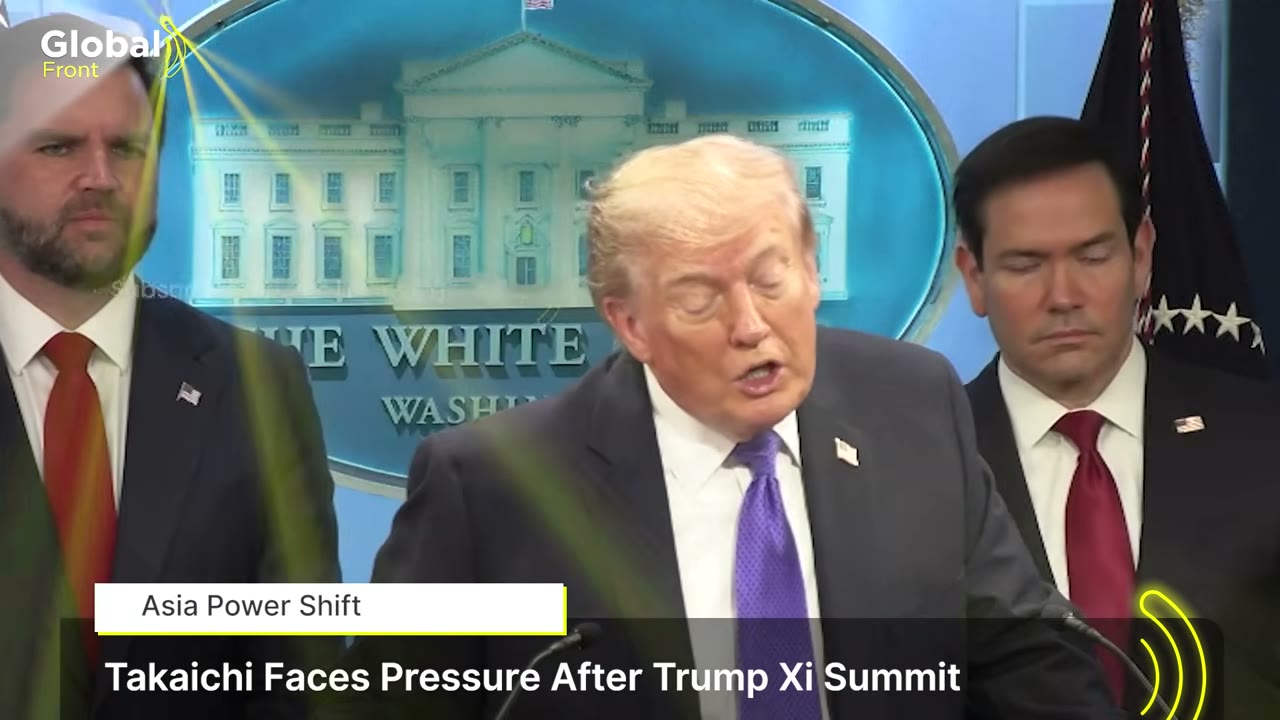
A historic Shenzhen summit brought Trump, Xi and Putin together on security, trade and nuclear risks. Japan's Prime Minister Sanae Takaichi received a low-key welcome and faced scrutiny over her Taiwan remarks and Tokyo's alliance with Washington.
1Trump, Xi and Putin Hold Historic Shenzhen Summit on Security and Nuclear Risks
Three rival superpower leaders shared one stage in Shenzhen. US President Donald Trump, Chinese President Xi Jinping and Russian President Vladimir Putin met in a historic trilateral summit, presenting it as a chance to strengthen global stability.
The event also raised uncomfortable questions for America's traditional allies, Japan among them. Prime Minister Sanae Takaichi returned from the Asia-Pacific Economic Cooperation summit facing fresh criticism over her approach to China, her statements about Taiwan and the future of Japan's security relationship with Washington.
The contrast between the major powers and Japan became one of the most closely watched events of the summit.
2Takaichi Returns From APEC Facing Criticism Over China and Taiwan Stance
Trump, Xi and Putin took the international spotlight in Shenzhen, discussing global security, economic cooperation and the possibility of reducing nuclear risks.
Japan's Sanae Takaichi got a noticeably more reserved welcome from her Chinese hosts. Her interaction with Xi was brief, and no formal bilateral summit between the Japanese and Chinese leaders took place.
The situation has heightened fears that Japan's complex relationship with Beijing could become even more complicated as Washington forges closer diplomatic engagement with China.
3Takaichi Declines to Detail Military Response to a Taiwan Crisis
Japan's prime minister refused to say whether Tokyo would intervene militarily in a conflict over Taiwan. After the summit, Sanae Takaichi faced questions on exactly that.
Instead of outlining a specific military response, she declined to discuss a hypothetical scenario and stressed that Tokyo's fundamental diplomatic position remains unchanged.
"Absolutely nothing has changed in this position," the Japanese Prime Minister stated.
41972 Japan-China Communiqué Shapes Takaichi's Taiwan Position
A 1972 agreement still shapes Tokyo's Taiwan stance more than five decades on. Takaichi's statement that nothing had changed referred to the Japan-China Joint Communiqué, which established diplomatic relations between Tokyo and Beijing.
The issue remains extremely sensitive, as Takaichi's early views are viewed ambiguously. Her statements in November 2025 provoked a prolonged confrontation with China.
5Takaichi's 2025 Remarks on Taiwan Survival Threat Spark China Standoff
Takaichi suggested in parliamentary debates that a serious Taiwan crisis involving military force could create a situation threatening Japan's survival.
Under Japanese security law, such a situation could significantly affect the country's ability to exercise collective self-defense.
Beijing strongly objected, interpreting the remarks as a sign Japan might directly intervene in the conflict over Taiwan. China has repeatedly demanded that Takaichi retract those comments.
6China and Japan Lock Horns Over Taiwan Remarks and Security Law
Beijing wants Takaichi to retract her Taiwan remarks. Chinese officials argue Japan should respect its historical diplomatic obligations and avoid actions Beijing sees as interference in its internal affairs.
Tokyo insists its established policy has not changed and that decisions on national security must follow Japan's laws and the circumstances of any future emergency.
These competing positions constantly return to the topic of emergencies and created a complex diplomatic stalemate, as neither government showed any willingness to make significant concessions.
7Low-Key Reception for Takaichi Contrasts With Lavish Welcome for Trump
Other prominent leaders got a lavish welcome in Shenzhen. Takaichi's arrival was comparatively low-key, while Trump received a particularly loud reception and Putin also took part in important diplomatic events.
Takaichi did exchange handshakes and greetings with Xi, but those ceremonial interactions did not lead to the formal discussions Tokyo sought.
The difference was widely interpreted as evidence of ongoing tensions between China and Japan. Yet diplomatic photographs and ceremonial arrangements do not necessarily reveal the full essence of international relations.
8Trump Reassures Takaichi on US Alliance in 20-Minute Call
A roughly 20-minute phone call between Trump and Takaichi on November 19 came shortly after the US president wrapped up his meetings in China. Trump was returning to the United States aboard Air Force One.
According to Japan's Foreign Ministry, Trump explained the results of his meetings with Xi and Putin, and the two leaders discussed the Indo-Pacific region, Ukraine and the broader international security environment.
The conversation also contained an important reaffirmation of American commitments to Japan. Washington emphasized its continued engagement in the Indo-Pacific, and the two governments agreed to strengthen their alliance and deepen cooperation.
9Analysts Split on Whether Trump Call Reassures or Marginalizes Allies
The Trump-Takaichi call has sparked debate. There had been suggestions that Trump's engagement with China and Russia could reduce Washington's focus on the security concerns of its traditional Asian partners.
Some observers interpreted the call as reassurance that Japan remains a central part of American strategy. Others argued it highlighted a changing diplomatic environment in which Washington has become increasingly comfortable negotiating directly with Beijing and Moscow, without always putting allies' interests at the center.
Both interpretations reflect broader concerns about the international order.
10Japan's Security Reliance on US Clashes With Washington's China Outreach
For decades, Japan has relied heavily on American security commitments while building its own economic and diplomatic influence. The United States maintains military forces in Japan and considers the alliance a key pillar of its regional security strategy.
At the same time, Washington needs to normalize its relations with China. These economic and military capabilities have expanded significantly.
The Shenzhen Summit illustrated this balancing challenge.
11Xi Warns Great Power Conflict Brings Chaos at Shenzhen Summit
Xi Jinping used the Shenzhen meeting to stress cooperation between the world's most influential countries. Speaking about relations between great powers, he said: "When great powers conflict, the world descends into chaos."
His message presented dialogue between China, the United States and Russia as necessary to prevent broader instability.
Subsequently, the three governments issued a declaration dedicated to strategic stability, international institutions, energy security and nuclear risks.
12Three Powers Issue Declaration on Strategic Stability and Nuclear Risks
Trump, Xi and Putin backed a declaration stating that nuclear war must never be unleashed. The three governments reaffirmed the principle and expressed support for dialogue aimed at reducing the dangers associated with nuclear weapons.
The declaration was dedicated to strategic stability, international institutions, energy security and nuclear risks.
Their agreement also included commitments to the United Nations and international energy supplies.
13Summit Declaration Leaves Ukraine, Trade and Taiwan Disputes Unresolved
The Shenzhen declaration did not resolve the fundamental disputes dividing the three countries. Russia's war against Ukraine remained unresolved.
Tensions remain over military security and international sanctions, and Washington and Beijing still have significant differences over trade, technology and Taiwan.
Despite the significance of the meeting, the grand pledge left those conflicts where they stood.
14Japan Weighs Its Place as Direct US-China Diplomacy Grows
Japan's long-held bet on Washington as its main strategic guarantee is now being tested by direct US-China diplomacy. The summit covered trade, technology and Taiwan, becoming an important diplomatic event without creating a comprehensive new international order. For Tokyo, that symbolism was hard to ignore. The government wants Washington to keep a strong regional presence while making sure warmer ties with Beijing do not come at Japan's expense.
15Analysts Debate Whether Great Powers Now Dominate Global Diplomacy
Whether great powers now run global diplomacy is splitting analysts. Some argue the US is adapting to contain China's growing influence and account for Russia's continued geopolitical importance, with diplomacy less dependent on American leadership alone and more focused on negotiations between competing centers of power. Others reject the idea that direct big-power dialogue automatically reduces allies' influence. They point to Japan, Germany, France, India, Australia and South Korea as important participants in international decision-making, citing their economic capabilities, technology, security partnerships and diplomatic relations.
16Japan's Challenge Is Adapting to Simultaneous US-China Cooperation and Rivalry
Japan's real test is not simply whether China has grown more powerful. It is whether Tokyo can adapt its diplomatic strategy to an environment where cooperation and competition between Washington and Beijing happen at the same time. That challenge sits at the center of the debate over Japan's place as direct US-China communication grows.
17Takaichi Backs Abe's Free and Open Indo-Pacific Via Quad Ties
Takaichi is leaning on the Quad to keep Shinzo Abe's free and open Indo-Pacific vision alive. Abe, the former prime minister, promoted the concept, emphasizing maritime security, the rule of law and cooperation among regional democracies. Takaichi continues to support it, particularly through cooperation with the United States, Australia and India within the Quad partnership. During recent meetings in Manila, Quad leaders discussed regional cooperation and reaffirmed their commitment to a free and open international order. Japan views these relationships as important for Indo-Pacific security, especially amid concerns about military activity around Taiwan and disputed maritime zones.
18Beijing Criticizes Japan's Military Modernization and Closer US Ties
Beijing has criticized the modernization of Japan's armed forces and closer coordination with Washington, arguing these actions risk escalating regional confrontation. Chinese officials interpret some aspects of Japan's security strategy in their own way. Tokyo responds that its defense policy aims at deterring aggression and protecting national security, not at threatening neighboring countries. The dispute plays out against concerns about military activity around Taiwan and disputed maritime zones.
19Wartime History Keeps Japan-China Defense Debate Volatile
Wartime history keeps making Japan's defense debate volatile. The experience of Japanese wartime expansion continues to influence Beijing's response to Japan's defense policy. Issues of historical responsibility, visits to controversial memorials and Japan's military capabilities regularly become sources of diplomatic tension. The Taiwan issue adds another layer of complexity to an already sensitive dispute.
20Taiwan's Status Adds Another Layer to Japan's Security Dilemma
Taiwan sits at the center of Japan's security dilemma. Beijing considers Taiwan part of China and does not rule out the use of force to achieve unification. Taiwan is governed separately under its own democratic political system, and its government rejects Beijing's claims to rule over the island. Japan maintains diplomatic relations with the People's Republic of China within the framework established in 1972, which recognizes the government in Beijing as the sole legitimate government of China and records Japan's understanding and respect for Beijing's position on Taiwan. It does not address all possible questions about how Japan will respond to a future security crisis.
211972 Deal Leaves Open How Japan Would Respond to a Taiwan Crisis
Japan's 1972 diplomatic deal with Beijing does not settle how Tokyo would act in a Taiwan crisis. Diplomatic recognition and military contingency planning involve different approaches, the distinction matters. The government can maintain a long-term diplomatic stance while assessing threats to its citizens, shipping lanes, military facilities and economic security. For Japan, a serious conflict in the Taiwan Strait could affect nearby territories, commercial shipping and American forces stationed on Japanese soil.
22Takaichi's Taiwan Comments Raise Question of When Japan Could Act
Takaichi's previous comments on Taiwan drew close attention because they raised the question of when Japan could consider an emergency there a direct threat to its national survival. Beijing viewed the discussion as provocative. Advocates of strengthening Japan's defense posture argued that regional security risks could not simply be ignored. The remarks left unclear the circumstances under which Tokyo would treat a Taiwan emergency as a survival threat.
23Takaichi Balances Conservative Base Against China Trade Tensions
Takaichi must balance diplomatic stability against the expectations of conservative groups who want a more assertive national security policy. A public retraction of her previous comments could be seen by domestic critics as a concession to Chinese pressure. But a withdrawal risks prolonging tensions with Japan's largest trading partner. That makes it difficult to maintain political authority at home while preventing further deterioration of relations with China.