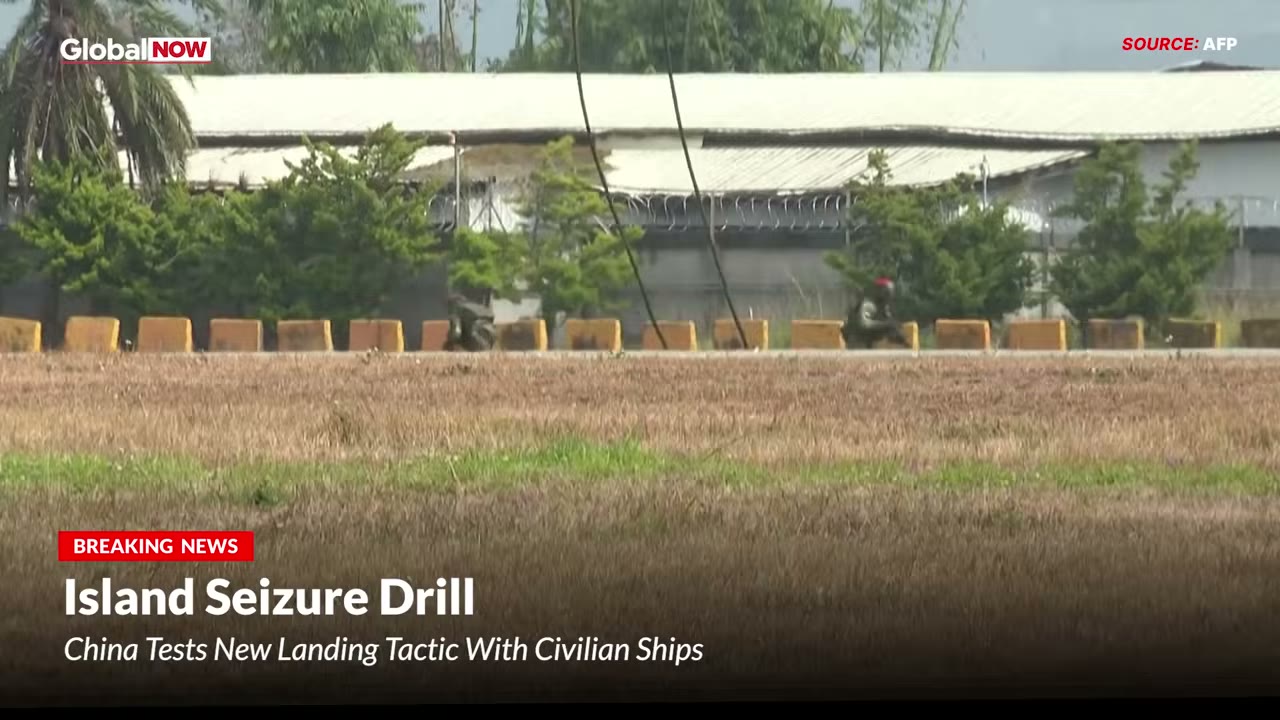
Satellite images and a Reuters-reviewed report show China running a week-long amphibious landing exercise in Fujian using civilian ships as makeshift bridges. An official says the drills practice rapid capture of small islands along the first island chain, putting the Philippines' Batanes and Luzon Strait in focus.
1China drills rapid island seizure, and the target may not be only Taiwan
China is rehearsing the rapid seizure of small islands — and an official familiar with the exercises says the target is not just Taiwan. The drills cover the whole island chain stretching from Japan through Taiwan to the Philippines.
Satellite images and a report reviewed by Reuters show a week-long amphibious landing exercise in Fujian province, on the coast opposite Taiwan across the Taiwan Strait. Footage shows tactics analysts say reveal how the Chinese military is preparing for a possible future conflict.
What exactly is China testing — and why should the Philippines, not just Taiwan, be watching?
2Satellite images show civilian ships forming makeshift bridge at Dazhang Bay
Civilian ships lined up from sea to shore in Dazhang Bay, on the coast of Fujian, in an image taken November 5 by satellite company Planet Labs. Analysts and officials describe it as a makeshift crossing — a temporary bridge that lets equipment move from ship to beach.
Jany Space, an analytics company that studied the images, noted that no special bridge equipment was seen. That suggests the Chinese military may be learning to use existing civilian vessels to build amphibious infrastructure in combat conditions.
Why does it matter? Because one of the hardest parts of any seaborne invasion is landing heavy equipment on shore.
3Landing heavy equipment without ports is the hardest part of invasion
The hardest part of any seaborne invasion is getting heavy equipment onto the shore. Soldiers can land from small boats, but tanks, armored vehicles, artillery, trucks and supplies are another problem.
That usually requires ports, piers or specialized landing ships. Ports can be destroyed or blocked by defenders, and specialized landing ships are expensive, few in number and easy for the enemy to track.
If China can turn ordinary civilian ships into floating bridges, it could land troops where there are no ports — using vessels that merge with regular commercial traffic, and do it faster.
4China has long prepared civilian ferries and barges for military use
China has spent years preparing civilian vessels for military use. The Chinese military has long trained on large civilian ro-ro ferries designed to carry vehicles, using them to move troops and equipment by sea during exercises.
Chinese laws oblige civilian vessels to support the military if necessary. Analysts have also reported that China is building special barges with long retractable bridges designed to connect ships to shore during disembarkation.
The exercises in Dazhang Bay look like another step in that direction.
5Official says exercises practice rapid capture of small islands
The exercises were aimed at "practicing the rapid capture of small islands," an official told Reuters on condition of anonymity. The official said they were very focused on contingencies along the first island chain.
That chain is an arc of islands running from Japan through Okinawa and Japan's southwestern islands to Taiwan, then south to the Philippines. In Chinese military thinking, it separates China's coastal waters from the wider Pacific.
For the United States and its allies, it is the first barrier to Chinese power projection into the Pacific. Whoever controls the islands and straits along the chain controls access between the South China Sea, the East China Sea and the open ocean.
6Drills part of combined-arms strategy; Beijing calls actions legal
The exercises appear to be part of the Chinese military's combined-arms strategic drills this year, the official said. They were called routine — but they came later in the year than in previous years.
Beijing justified its preparations, saying its military actions are entirely legal and justified.
Military attaches based in Asia told Reuters that China appears to be steadily improving its coastal exercises. That reflects the enormous difficulty of any attempt to cross the sea and land under fire.
7Past year saw blockade drills, missile launches and Xi's reunification vow
In late December 2025, China began large-scale military exercises around Taiwan, simulating a blockade of the island's ports. Its military fired missiles into the waters of the Taiwan Strait from the coast of Fujian province.
Days later, President Xi Jinping said in his New Year's address that reunification of China and Taiwan was inevitable. Beijing views democratically governed Taiwan as its own territory and has never ruled out force; Taiwan rejects Beijing's claims and says only its people can decide their future.
American officials have claimed for years that Xi ordered his military to be ready for a possible operation against Taiwan by 2027, while stressing that no decision to attack has been made.
8Small islands near Taiwan belong to Taiwan, Japan and the Philippines
The Batanes Islands, the northernmost province of the Philippines, sit less than 200 km from Taiwan across the Luzon Strait. Mavulis, the smallest and most northern of them, faces directly into Taiwan.
The phrase "small island" stands out. Taiwan itself is not small, but many small islands dot the first island chain: Jinmen and Matsu, which belong to Taiwan and lie just off China's coast, and Japan's Yonaguni, just over 100 km from Taiwan.
In any conflict over Taiwan, the Luzon Strait and the Bashi Canal would become among the region's most important waterways, forcing ships and submarines between the South China Sea and the Pacific through them.
9Philippines builds up Batanes defenses with US support
The Philippines is strengthening its defenses in Batanes. In 2023, the Philippine Navy established an outpost on Mavulis Island.
More troops and reservists were sent to the province, and the United States supported projects there, including plans to build a new port that could serve civilian needs and evacuations during a crisis.
Joint exercises between American and Filipino forces were also held in far northern Luzon.
10US gains access to northern Luzon bases and deploys missiles
Under the Enhanced Defense Cooperation Agreement, US forces have access to several Philippine military facilities in the north, including the airport at Lallo and the naval base at Santa Ana, both in Cagayan province, which overlooks the Luzon Strait.
In 2024, the US military deployed its Typhoon medium-range missile system to northern Luzon during exercises with the Philippines, drawing sharp criticism from Beijing. In 2025, during the annual Balikatan exercises, US forces deployed the NMSIS II anti-ship missile system in Batanes near the Bashi Channel.
Beijing sees these deployments as part of an American attempt to encircle China along its first island chain. For Washington and Manila, it is about deterrence.
11Japan and Taiwan also fortify islands along the first island chain
Japan is strengthening its southwestern islands, a chain stretching from Kyushu toward Taiwan. It has deployed missile units and radars on Yonaguni, Ishigaki and Miyako, and is deploying longer-range missiles.
Taiwan holds its annual Han Kuang exercises, practicing how to repel an invasion and defend its remote islands.
Every country along the first island chain is preparing for the same scenario China is rehearsing — a rapid offensive on small islands.
12Chinese vessels surge near Philippine-held Spratly features
The Philippines also holds small features further south, in the Spratly Islands. Pag-asa, home to a small civilian community and a military detachment, is the largest, and a small group of Marines is stationed aboard the BRP Sierra Madre on Ayungin Reef.
Chinese ships gather near these facilities every week. According to the Philippine Armed Forces, 48 Chinese coast guard and navy vessels were spotted near four sites in the West Philippine Sea from November 17 to 23 — up from 19 a week earlier.
13Analysts say Taiwan remains main target, but capabilities matter
The official quoted by Reuters did not name any specific islands as targets. The exercises are aimed at capacity building, and many analysts believe China's main target remains Taiwan itself.
But it is precisely these capabilities that defense planners should watch closely, according to the report.
An army able to quickly capture small islands using civilian vessels is an army that can create a crisis before others can respond.
14Civilian vessels blur line between fishing boats and invasion force
China's maritime militia — boats that look like ordinary fishing vessels — has spent years surrounding reefs and blocking Philippine ships in the South China Sea. Philippine and Western officials claim the boats are organized and funded by the state, blurring the line between civilian and military activity.
That ambiguity is the point. Opening fire on what looks like a fishing boat or ferry carries enormous political risks, making it hard for other countries to respond.
If China can also use civilian ferries and cargo ships to land troops, the same tactic could be applied in a military operation. A fleet gathering near an island could be normal trade, a political protest, or the first phase of a landing — and by the time it becomes clear, it may already be too late.
15Speed and ambiguity give defenders little warning time
Taiwan's coast guard regularly releases footage of its vessels tracking and responding to Chinese ships around remote islands, including Jinmen, just a few kilometers off China's coast. Its armed forces are training to defend against rapid, close-range operations.
The strategic worry is speed. If an island can be captured in hours rather than days, allies have less time to react — and the side that acted first can confront the world with a new reality on the ground.
Civilian vessels make early warning harder still. A line of ferries and cargo ships near the coast may look like ordinary commercial traffic, until in an instant it changes.
16Manila's four takeaways: observation, response, partners, citizens
About 150,000 Filipinos live and work in Taiwan — and in any conflict, their protection and evacuation would be one of Manila's biggest challenges. That is one of four conclusions drawn for the Philippines.
First, observation: it is impossible to react to what you cannot see, which is why Japan's coastal radars and new reconnaissance drones, provided for in the November 9 agreement, matter to the Philippine military.
Second, rapid response — quickly moving troops, ships and aircraft to remote islands like Batanes or Pagasa could decide the outcome of any crisis.
Third, partnerships: no country along the first island chain can contain China alone, so the Philippines is working more closely than ever with the United States, Japan and Australia, forging agreements that accelerate joint training and patrols.
17Exercises in Fujian send signal down the first island chain
The exercises are taking place in Fujian province, opposite Taiwan — but their signal spreads much further along the first island chain: to Batanes, Luzon and the Spratly Islands.
That reach is what makes them matter beyond the drills themselves. The same waters touch Philippine territory at several points, and the message is being read across the region.
Monitoring of China's exercises and their significance for the Philippines is set to continue.