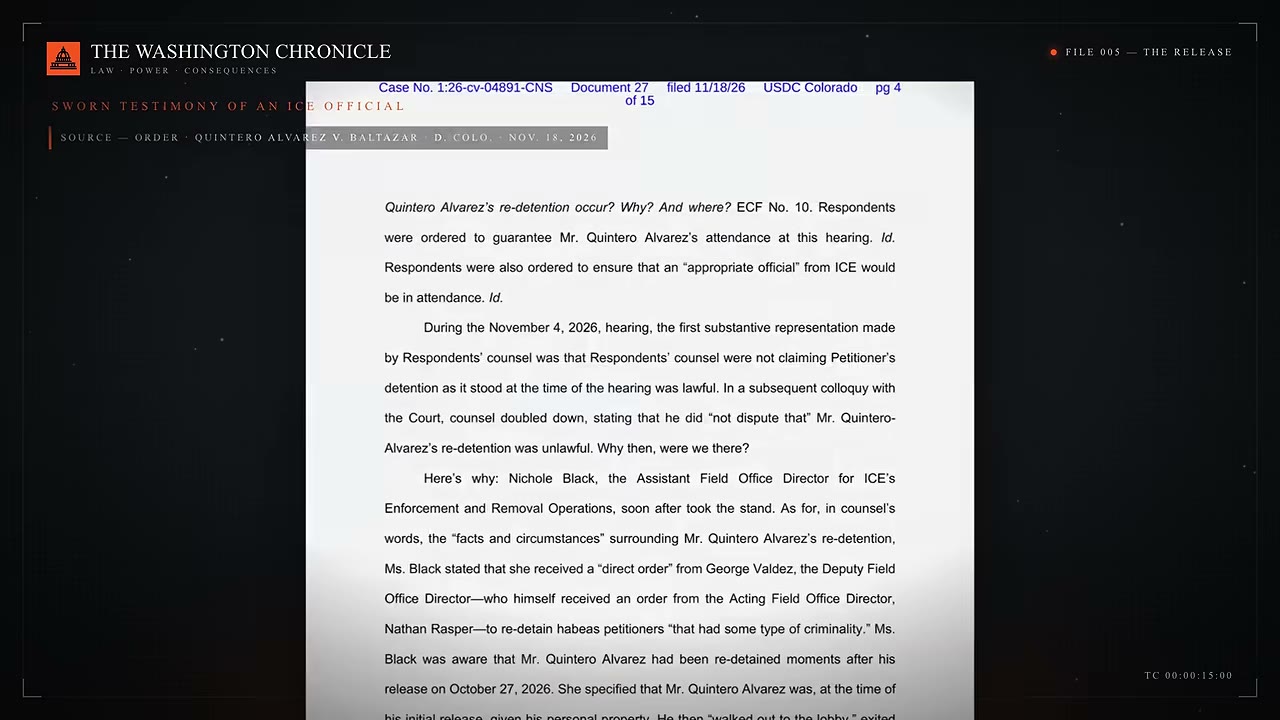
A federal judge found ICE's Denver field office in contempt after officers re-arrested Ramon Quintero Alvarez minutes after a court-ordered release. Testimony revealed a directive from Minnesota colleagues, and the judge's ruling warned that all court orders must be obeyed, even by ICE.
1Federal judge holds ICE Denver office in contempt for defying release orders
A man walked out of an immigration detention center in Aurora, Colorado, a federal judge having ordered his release. Officers were waiting outside. Moments later, he was back in custody.
This week, the judge who ordered him freed put in writing who gave the order, where they got the idea, and what it means. A federal judge says immigration officials in the Denver field office for ICE were in contempt of court orders.
The judge says it happened when ICE rearrested more than a dozen individuals the court had ordered to be released.
2Ramon Quintero Alvarez fought his detention alone and won release
Ramon Quintero Alvarez came to the United States with his mother more than 30 years ago and has never left. He has lived in Wyoming for about 12 years. He has two sons, both American citizens.
ICE detained him in February. He had faced arrests in the past, but the charges from his most recent arrest were dropped in April.
So he did something most people in his position never do. He went to federal court alone, no lawyer, filed a habeas petition himself and paid the $5 filing fee.
3Government misses deadline, then admits it re-detained him unlawfully
On October 20th, Judge Charlotte Sweeney gave the government a week: explain why this man should stay locked up, or release him within 24 hours. The deadline came. The government didn't respond.
Two names on the other side of the case: Homeland Security Secretary Mark Wayne Mullen and Attorney General Todd Blanche.
On November 3rd, the government filed a status report, a few lines that gave the whole game away. He was released on October 27th. He was immediately re-detained, and the government would not even argue that his detention was lawful.
Judge Sweeney ordered everyone into her courtroom.
4ICE official Nicole Black testifies she acted on a direct order
Judge Sweeney ordered everyone into her courtroom the next morning, in person. No delays, no video. She wanted someone from ICE who could answer three questions: when, why, and where.
On November 4th, Nicole Black, an assistant field office director in Denver, took the stand. She testified she got a direct order. It came down the chain from acting field office director Nathan Rasper: re-detain habeas petitioners who had, quote, some type of criminality.
She believed Quintero Alvarez had criminal charges pending. He didn't. On the stand, she agreed her information was inaccurate, and she still believed walking a man into a public area and grabbing him again counted as obeying the court.
5Quintero Alvarez questions his own jailer; judge bars re-arrest without bond
The court minutes show the next person to question Nicole Black was Ramon Quintero Alvarez himself. By 2:00 that afternoon, he was free.
This time, the judge barred ICE from picking him up again without a bond hearing where the government carries the burden.
He wasn't the only one. Black said she knew of about 10 cases like his. The government's own list later put it at 18.
So Judge Sweeney called in the man at the top.
6ICE boss Nathan Rasper testifies the idea came from Minnesota colleagues
On November 9th, Nathan Rasper testified. He said ICE has an obligation to make lawful arrests. Then he explained where the idea came from: colleagues in Minnesota.
Minnesota had seen this before. In January, a lawyer in Minneapolis described what happened to a client the morning after a judge ordered him freed.
"ICE asked to have him come back this morning for a quick check in," the lawyer said. "And so we were just down at the Whipple building for his check in where they took him back into custody this morning."
About five officers came out and said they were taking him back into custody.
7Minnesota judges counted nearly 100 violated court orders by ICE
By then, federal judges in Minnesota had already started keeping count.
"Mr. Secretary, this is from a federal court decision regarding ICE's activities in Minnesota," a senator said. "ICE is not a law unto itself. ICE has violated nearly 100 court orders."
Rasper said the re-arrests started in Colorado on October 27th, the same day Quintero Alvarez walked out.
And here's the detail that should worry everyone.
8Rasper says he only learned of Colorado's release agreement days before testifying
The federal court in Colorado has an agreement with the US Attorney's Office on how these releases work. Rasper testified he only learned it existed a day or two before he took the stand.
When the judge asked about Nicole Black, the boss blamed the subordinate.
Then he promised under oath that the practice had stopped.
It won't happen again.
9Judge Sweeney's 15-page contempt ruling blasts ICE from top to bottom
On November 18th, Judge Sweeney issued 15 pages. The answer comes on page two. Contempt has three boxes: a valid order, they knew about it, they disobeyed it. She checked all three, literally.
She wrote that this should and must shock any reader, that there's not a single word in the Constitution that supports what Black believed. And she didn't let the boss off either. She called it an effort to throw Black under the proverbial bus for unconstitutional behavior that runs top to bottom.
"In her pretty fiery ruling, she says things like sometimes behavior stuns and renders a listener speechless," a reporter said.
So why no fine? Why nobody in jail?
10No fine or jail because civil contempt aims to force compliance
This is civil contempt. It exists to force compliance, not to punish. And ICE had already stopped.
The judge said the single thing that saves them is Rasper's promise, and she reminded them that sworn testimony is binding.
She closed with a line the Supreme Court wrote in 1883: a government of laws and not of men.
You might expect the government to say this was a mistake.
11Homeland Security calls court orders sabotage as president demands fewer trials
That isn't what Homeland Security said. Sabotage, that's what they call a judge asking them to obey her order.
And it didn't come from nowhere. Listen to the president on what he wants from judges.
"I mean, we need judges that are not going to be demanding trials for every single illegal immigrant," he said. "We have millions of people that have come in here illegally, and we can't have a trial for every single person."
Ramon Quintero Alvarez didn't ask for millions of trials. He asked for one. He won it, and the government tried to make the win disappear on the sidewalk.
12Nominee refuses to say he will comply with court orders
Listen to one of the men named in this case when a senator asked him the simplest question there is.
"Can you commit to us that if a court judges something ICE is doing, something DHS is doing as illegal and constitutional tells you to stop, that you will comply with the court order?" the senator asked.
"I will tell you that um we will never break the Constitution and we're not going to break the law, but we're going to enforce our nation's laws," he said.
Asked again whether he would implement court orders: "If we didn't think courts were politicized, then I would probably be able to answer that."
He wouldn't say yes. Five months later, his agency was in contempt.
13What ICE lost: a court record of admitted defiance
ICE's own officials admitted under oath that a judge's order existed, that they knew about it, and what they did — and that admission is now a permanent court record.
The case itself ended with no fine and no jail. But the excuse is gone: the agency can no longer claim it didn't know or didn't understand the order.
It isn't one judge, either. Two weeks earlier, another judge in Colorado, Kato Cruz, looked at a rearrest just like this one.
14Advocates warn ICE may find another way to flout judges
The judge called it no release at all, and warned the government that the next instant rearrest could bring contempt proceedings.
The people who pushed for the ruling aren't celebrating yet. Advocates who fought for the contempt order said they're happy with it but aren't sure ICE won't find another way to flout what judges have told them to do.
Three things to watch: whether rearrests return in Colorado now that a sworn promise is on file; whether judges in Minnesota still split on this, stop it there; and whether Homeland Security keeps calling court orders sabotage.