A Houston federal prosecutor sent letters to six Democratic lawmakers warning of legal consequences for their televised statements. The move prompted a bar complaint, a senator's demand to preserve records, and scrutiny under the Constitution's speech or debate clause.
1Prosecutor Sends 'First Arrow' Letters to Six Democrats in Nine Days
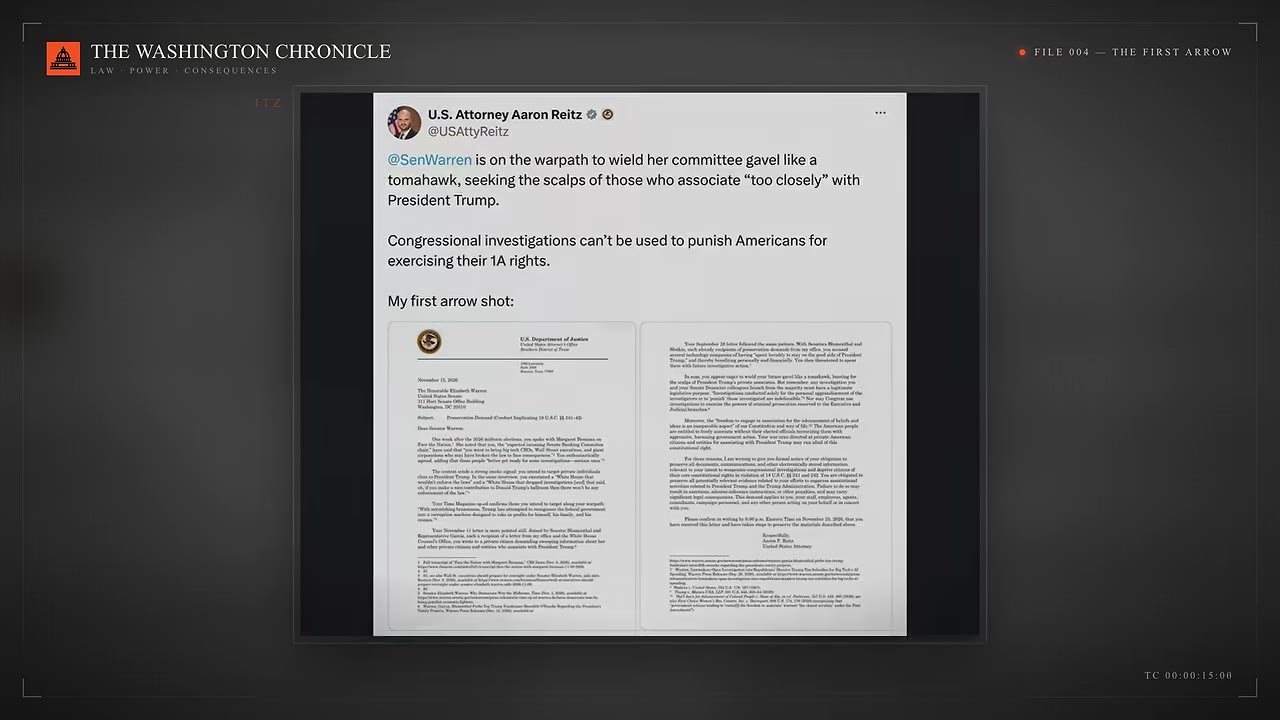
A federal prosecutor in Houston told a U.S. senator to preserve her records — not over a crime, but over something she said on television. He then posted the letter online with four words: "my first arrow shot."
In nine days, he sent letters like that to six Democrats in Congress, according to the account. Attorney General Todd Blanche, who says there is no investigation into their words, called him a great U.S. attorney.
This week the arrows started coming back: a bar complaint, a senator with a famous lawyer, and a Supreme Court case that says this is exactly what the Constitution was written to stop.
2Democrats Win Congress, Warn Trump Officials to 'Lawyer Up'
Democrats won the House and the Senate on election night — and the man about to take over the House Oversight Committee posted two words: "lawyer up."
Robert Garcia said there is "a lot of work to do, but I think there's definitely a mandate to ensure we have accountability and affordability."
Five days later, the incoming chair of the Senate Banking Committee, Elizabeth Warren, went on Face the Nation and warned: "If you've been making your profits by cheating American families and scamming your investors, you better get ready for some investigations, serious ones."
3Trump Calls for Imprisoning Democratic Lawmakers on Truth Social
The day before Elizabeth Warren's Face the Nation warning, Donald Trump had already answered on Truth Social. He didn't cite a single law.
The next morning, his attorney general, Todd Blanche, was on CNN.
According to the account, Trump said the Democratic lawmakers are extortionists and they should be imprisoned.
4Attorney General Todd Blanche Discusses Threats and Investigations on CNN
Attorney General Todd Blanche said on CNN that whether lawmakers could be imprisoned "depends on what the crime is and what they've done."
He said threats can become "so vile and so dangerous" that "at some point you have to draw the line," pointing to warnings to college students about working in the Trump administration and to an incoming chairman telling people to "lawyer up."
Robert Garcia answered on the same show, calling it a threat: "He is trying to stop us from doing real oversight."
5Who Is Aaron Writes, the U.S. Attorney Behind the Letters?
Aaron Writes is the U.S. attorney for the Southern District of Texas in Houston — 39, a former Marine officer, Ken Paxton's deputy in the Texas attorney general's office, and Ted Cruz's chief of staff.
In March he ran for Texas attorney general himself. He finished fourth out of four, with 14%.
In July he got the Houston job, not through the Senate — the district's judges appointed him. A few weeks before the election, he recorded a video. November 11th came letter number one.
6Letters to Blumenthal, Slotkin, and Warren Cite Criminal Laws
Letter number one, dated November 11th, went to Senator Richard Blumenthal, who has been asking who the secret donors are behind Trump's White House ballroom.
It cites two federal criminal laws — Section 241, conspiracy against rights, and Section 242, deprivation of rights under color of law — and warns of significant legal consequences.
Next came Slotkin, who in October said she wanted young graduates to think twice before working for Trump. Writes wrote that it "sounds potentially illegal to me." Then Warren on November 15th.
7Prosecutor Mocks Warren with Native American Ancestry Language
The letter to Elizabeth Warren used words like "tomahawk," "scalps," "smoke signal" and "war cries" — language that, as boston.com pointed out, reaches back to the old fight over her claim of Native American ancestry.
Writes posted it with four words: "my first arrow shot." Trump reposted it. Stephen Miller reposted it too, with one line: 18 USC 241 and 242.
November 16th brought the letter to Garcia.
8Attorney General Blanche Says No Ongoing Investigations Into Lawmakers' Words
Four days after CNN, Attorney General Todd Blanche held a press conference, and the tone had changed.
"Free speech is allowed," he said. "You can be critical of this administration." But he added that criticism can become a threat, and a threat can become something criminal — though he said he'd never said that point has been crossed.
"There's no ongoing investigations, criminal investigations into words that that incoming senators or congressmen have said," Blanche said. Asked about Writes by name, he called him "a great US attorney."
9Raskin Says Prosecutor Works in Coordination With Main Justice
Four days after Blanche's press conference, Raskin sent the Garcia letter and posted about it. He told Democracy Docket he works in close coordination and cooperation with Main Justice.
That leaves two possibilities, as the account frames it: either the attorney general doesn't know what his own prosecutor is doing, or he does. Neither answer looks good.
Then comes the legal problem — Article One of the Constitution.
10Constitution's Speech or Debate Clause Protects Congressional Speech
Article One, Section Six of the Constitution — the speech or debate clause — says members of Congress "shall not be questioned in any other place."
In 1966, the Supreme Court explained why that clause exists. In 1975, it said the power to investigate, subpoenas included, sits inside that protection.
To be fair, a TV interview is not a speech on the Senate floor.
11First Amendment and DOJ Rules May Also Protect Lawmakers
A TV interview is not a speech on the Senate floor, and the courts have said press releases aren't covered. But that's where the First Amendment comes in — the same First Amendment rights the prosecutor says he's defending.
Then there's the Justice Department's own rule book: any investigation involving a member of Congress requires consultation with the Public Integrity Section first.
Nobody has said whether that happened.
12Watchdog Group Files Bar Complaint Against Prosecutor Writes
On Monday, November 16th, the watchdog group Campaign for Accountability filed a grievance against Writes with the State Bar of Texas.
One of the rules it cites says a prosecutor can't threaten a charge he knows isn't supported by probable cause.
The complaint followed warnings that a prosecutor shouldn't try to stop a congressional inquiry with a threatening letter.
13Blumenthal Orders Prosecutor to Preserve His Own Records
Writes called it a "harassing, frivolous bar complaint." The Justice Department called it "selective bar fare."
Then the senators answered. Blumenthal turned the letter around — ordering Writes to preserve his own records, including anything he'd exchanged with the White House about it.
"It is laughable," Blumenthal said, calling it "such an abuse of the prosecutorial power."
14Slotkin Says DOJ Again Threatens Indictment Over Her Words
The Justice Department has threatened to criminally indict Senator Slotkin over her words — for the second time in a year, she says.
Speaking while traveling, Slotkin said official word came as she flew in the night before: prosecutors were again threatening an investigation and a criminal indictment "because of my words said out loud."
Earlier this year, grand jurors unanimously refused to indict her and five other Democrats over a video telling troops they could refuse illegal orders.
Slotkin called it a sign of an authoritarian leader devolving, saying it is a playbook she has seen in Eastern Europe and the Middle East. "This says more about him than it does about me," she said. On Wednesday, she answered in writing.
15Slotkin Hires Former U.S. Attorney Preet Bharara as Lawyer
Slotkin has retained Preet Bharara, the former U.S. attorney in Manhattan, as her lawyer.
She answered the Justice Department in writing on Wednesday, with Bharara representing her.
The hire puts a high-profile former federal prosecutor in Manhattan behind her response to the indictment threat, which she says is the second in a year over her speech.
Politico asked the experts about the move.
16Prosecutor Writes Previously Said Democrats Use Investigations as Punishment
The prosecutor behind the threat told a tea party event in January that Democrats want to use investigations as punishment.
That is the man now threatening to indict Slotkin over her words, for the second time in a year.
At the January tea party event, Rites said Democrats want to use investigations as punishment, according to the account.
Three dates now loom in the fight.
17Key Dates: November 23 Deadline, Bar Review, New Congress
Three dates could decide the legal and political fallout.
Sunday, November 23rd, 6:00 p.m. Eastern: the deadline Rites gave Warren and Garcia to confirm they are keeping their records.
Mid-December: the state bar has 30 days to classify the complaint — dismissed, or a real grievance.
Then January 3rd, the new Congress. Democrats take the gavels and the subpoenas follow.
Here is the twist. If a Trump official defies one of those subpoenas, criminal contempt needs a prosecutor from the Justice Department — Todd Blanche's department.