A federal judge ordered the Justice Department to publish three sets of handwritten FBI interview notes by Monday, November 23. The notes involve a woman who alleges Epstein introduced her to Trump when she was about 13 and that Trump assaulted her. Trump denies wrongdoing, and the allegation has never been tested in court. DOJ has filed a notice of appeal.
1Judge Sets Monday Deadline for DOJ to Post Three Sets of Handwritten Epstein Notes
A federal judge in Washington has given the Justice Department until Monday, November 23, to post three sets of handwritten FBI notes in its own online Epstein library.
The notes come from interviews with a woman who told the FBI that when she was about 13, Jeffrey Epstein introduced her to Donald Trump and that Trump assaulted her. Trump has repeatedly denied any wrongdoing related to Epstein. Her allegation has never been tested in court.
On Tuesday, November 17, with six days left, the department filed a one-sentence notice of appeal. That filing does not stop the clock.
The judge built a trap door into his order, and it only opens if the government files one more thing. As of Friday, November 20, nobody has reported seeing it.
2Congress Passed the Epstein Files Transparency Act Over Trump's Initial Resistance
Congress passed the Epstein Files Transparency Act just over a year ago, ordering the Justice Department to make its Epstein files public. It almost didn't get a vote.
A discharge petition — the tool a House majority uses to force a vote its leaders don't want — got its 218th signature, four of them from Republicans. The President had resisted.
Then on Sunday, November 16, he reversed himself on Truth Social, writing that House Republicans should vote to release the files because "we have nothing to hide."
The vote was 427 to one. Two days later, the Senate passed it without objection, and Trump signed it on November 19, 2025.
3The Law's 30-Day Deadline Expired and Bars Withholding Records for Embarrassment
The Epstein Files Transparency Act gave the Justice Department 30 days to release its files — a deadline that ran out on December 19, 2025.
The law allows only five reasons to hold anything back, such as protecting victims' identities or an active investigation. It also contains this line: "No record shall be withheld, delayed, or redacted on the basis of embarrassment, reputational harm, or political sensitivity, including to any government official, public figure, or foreign dignitary."
Embarrassment isn't an excuse, not even for the president.
The department published about three and a half million pages and says it complied. The fight is over what it left out.
4Judge Orders Release of Raw Handwritten FBI Notes Behind Typed Interview Reports
The judge wants the raw notes, not the edited typed reports.
When FBI agents interview someone, one of them takes notes by hand. Later, those notes are typed into a formal report, the FD 302. Think of the handwritten notes as the raw footage and the 302 as the edited cut.
Here, the typed reports are already public. The judge wants the handwritten notes behind three of them.
"Todd Blanche is still sitting on 37 pages that are almost certainly the agents note," one speaker said.
Whose interviews? After Epstein was arrested in July 2019, a woman contacted the FBI, and agents interviewed her at least four times that year.
5Woman Alleges Epstein Introduced Her to Trump, Who Assaulted Her at About 13
According to the court record, a woman alleged that in the 1980s, when she was about 13, Jeffrey Epstein introduced her to Donald Trump, who then assaulted her.
That is an allegation. NPR reviewed the files and found no FBI conclusion on whether she was credible, and no court has ever tested it. Trump has repeatedly denied any wrongdoing related to Epstein and has not been charged with any crime connected to him.
"As far as the Epstein files is I have nothing to do with Jeffrey Epstein," Trump said. "I threw him out of my club many years ago because I thought he was a sick pervert."
Caroline Leavitt, then the White House press secretary, called them completely baseless accusations backed by zero credible evidence.
6FBI Records on the Allegation Were Missing From the Epstein Library
When people went looking for the typed version of the woman's interview, they couldn't find it.
In February, NPR, CNN and MS Now found that FBI records tied to her allegation weren't in the Epstein library.
"Yesterday, Congressman Massie and I went to the Department of Justice to read the unredacted Epstein files," one speaker said. "We spent about 2 hours there and we learned that 70 to 80% of the files are still redacted."
The department said everything had been produced and nothing deleted. Nine days later, it posted 16 new pages, including three more FBI interview summaries with this woman. The explanation: 15 documents had been incorrectly coded as duplicative.
7Journalist Katie Fang Sued the Attorney General to Enforce the Epstein Law
Can a journalist take the attorney general to court over this law? That was the first fight.
Katie Fang is an attorney and independent journalist in Miami who used to host a show on MSNBC. On April 27, she sued Todd Blanche in his official capacity — suing the office, not the man.
The government's first answer wasn't that it followed the law. It was that she can't sue.
First, standing. To sue in federal court, the problem has to hurt you specifically. If your neighbor's tree falls on your car, you can sue. If it falls on someone else's car, you can't. The government called Fang's complaint a grievance everyone shares.
8Judge Sullivan Ruled Fang Can Sue and Found the DOJ in Violation
The judge is Emmett G. Sullivan, on the bench in Washington since 1984. On June 25, he ruled that Fang likely has standing and can sue under the Administrative Procedure Act, which lets people challenge what federal agencies do.
The government never defended what it had actually done. So he wrote that the attorney general conceded he is in violation of the act.
He granted a preliminary injunction — an order that comes before the final verdict to stop harm while the case goes on.
The bond, normally a guarantee in case the order turns out wrong, he set at $1.
9DOJ Called the Notes Duplicative and Hard to Redact; Judge Disagreed
Why weren't the notes published? On July 2, the department gave two reasons: they were substantially similar to the typed reports, and handwriting is hard to redact, so a mistake could expose a victim's identity.
That second worry is real. Victims' lawyers had told another court that earlier mistakes caused suffering and fear for personal safety.
In August, a government lawyer told the judge the determination had been made that the handwritten notes were duplicative of materials already produced.
Fang's lawyers pointed out the department had already published nearly a hundred other sets of handwritten interview notes, redacted, online, in the same library. So what made these three different?
10Judge Reviewed the Notes Privately and Ruled They Are Not Duplicates
On September 16, Judge Sullivan ordered the notes delivered to him for in camera review — Latin for in chambers. The judge reads them privately, just him.
In the same order, he wrote that the underlying handwritten notes are not duplicates of the FD 302 interview reports.
The department handed them over unredacted. So the judge asked for redacted copies too — the versions it would be willing to show the public. On October 16, it sent them.
In doing that, the department told the judge in writing that these three sets were already redacted under its own rules.
11Judge Ordered the Notes Published by November 23 and Rejected a Stay
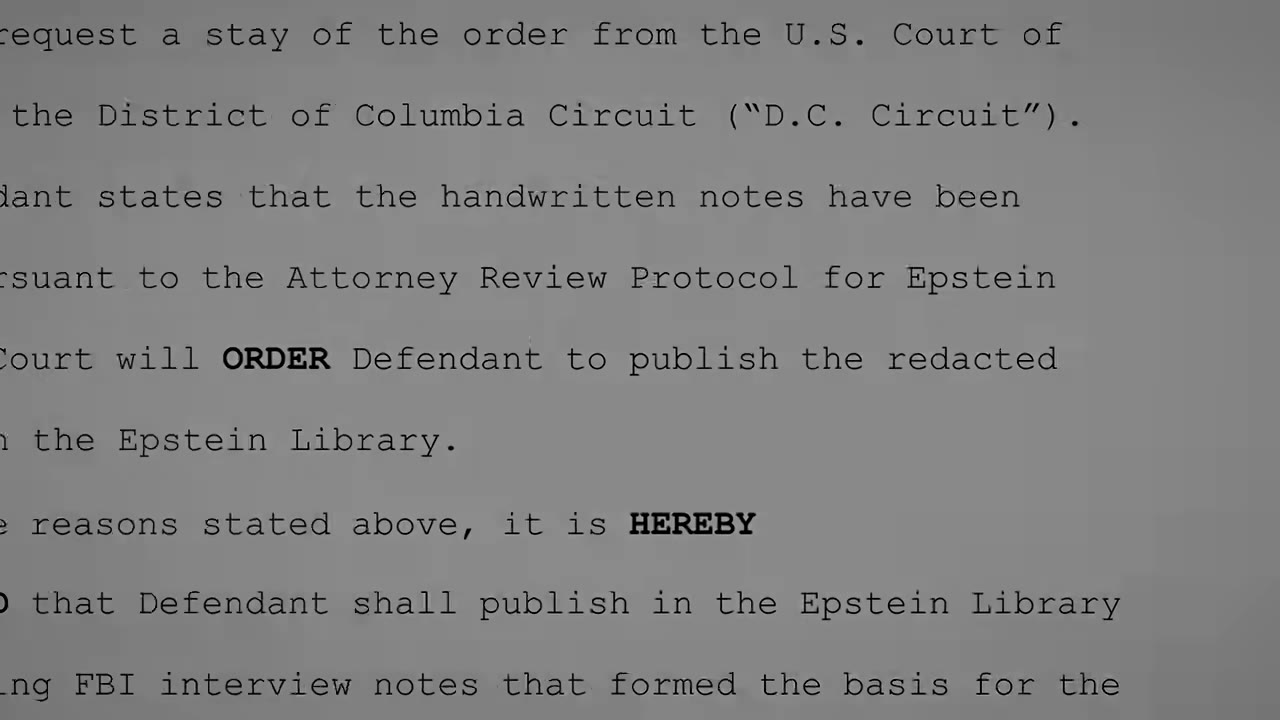
On November 9, the judge wrote one word: publish them.
The order gave the department 14 days to post the three sets of notes in the Epstein library, then 24 hours to tell the court. Fourteen days from November 9 is Monday, November 23.
The department had asked for a stay — a pause button that freezes a court order while a higher court takes a look. The judge said no, writing that the court will not stay its order but will establish a deadline that gives the defendant adequate time, 14 days, to appeal and request a stay.
Then at the bottom of page three, the trap door. If the department asks the appeals court for a stay and for expedited review before the 14 days run out, the order pauses on its own until that court rules. Two conditions, both before the deadline.
12DOJ Filed a One-Sentence Notice of Appeal Without a Stay Motion
On November 17, the department made its move. The filing's body is one sentence: the department is appealing the November 9 order to the DC circuit.
A notice of appeal is a flag in the ground — we're going to challenge this in a higher court. On its own, it pauses nothing. That takes a stay.
On November 18, the district court sent its docket sheet to the appeals court. On it: the notice of appeal and no stay motion. What's unknown is whether a stay request went straight to the DC circuit. That docket sits behind a paywall, and as of Friday, November 20, no major outlet has reported one. The department can still file one right up to the deadline.
This is the department's third appeal in this case, run by Attorney General Todd Blanche, Donald Trump's former personal defense lawyer, confirmed by the Senate in August 50 to 49.
13DOJ's Likely Appeal Arguments Include That Produced Documents Cannot Be Unproduced
The Justice Department has appealed a judge's order to release three sets of handwritten Epstein notes — and its earlier filings hint at how it will fight. The notice of appeal doesn't spell out the arguments, but past court papers show the playbook.
First, the department argues the requester, Fang, has no standing. Second, it says the law doesn't let private citizens sue. Third, its likely strongest card: once a document is produced, it cannot be unproduced.
A lawyer quoted in the case said, "My heart breaks for every survivor, every victim of Mr. Epstein, absolutely, and I would love to prosecute anybody that did any harm."
14Three Scenarios for Monday: Stay Granted, Notes Posted, or Contempt
Contempt of court is on the table if the Epstein notes stay secret past Monday, November 23rd.
One path: before the deadline, the department asks the D.C. Circuit for a stay and expedited review. The order pauses automatically until that court rules, which could grant the stay or deny it and revive the order.
Another: no motion in time, and the department posts the redacted notes and tells the court within 24 hours. Once out, the appeal would likely become moot — an argument the department has made itself.
Third: no stay and no notes. Fang could ask the judge to enforce his order, and the judge could order the department to show cause — explain why it shouldn't be held in contempt. In September, Judge Sullivan called contempt premature in a different part of the case and set the standard: a clear and unambiguous order, violated, proved by clear and convincing evidence. Against the federal government, contempt is rare and can be appealed. Nothing on the record says it will happen by Monday.
15Democrats Take the House in January With Subpoena Power Over the Files
Monday isn't the end of the fight over the Epstein files. By December 31st, Fang must answer the department's request to throw out the whole case.
And on January 3rd, Democrats take over the House — with subpoena power.
On November 18th, incoming Democrats sent letters asking agencies to preserve documents, including one to Blanch about the Epstein files. One speaker said, "I'm here to defend my motivations for taking up and supporting the victims of Jeffrey Epstein and the survivor."
So even if the courts pause the release, Congress is lining up a second road to the same files.
16Why Three Sets of Handwritten Notes Matter to the Rule of Law
Three sets of handwritten notes are at the center of the case — and the question is whether a law Congress passed almost unanimously means what it says when the person it could embarrass is the president.
One speaker said, "We may look like grown adults when you see us now, but we were children, young girls at the time of our abuse."
The notes could match the typed reports word for word, or they could differ. Nobody outside the Justice Department and the court has seen them, and nothing in them would prove an allegation never tested in court.
What is known: in September, the judge ruled the notes are not duplicates. Then he read them himself and ordered them published.